Corsi Block Test: What Visual Memory Scores Mean (and How to Improve)
How the Corsi block visual memory test works, what a good spatial span is, and the visualisation techniques that reliably add a block or two to your score.
The Corsi block test is the spatial cousin of the digit span: instead of remembering numbers, you watch blocks light up on a grid and tap them back in the same order. It has been used in cognitive research since the 1970s, and a modernised version appears in most HireVue-style assessment batteries as the "visual memory" game.
How does the Corsi block test work?
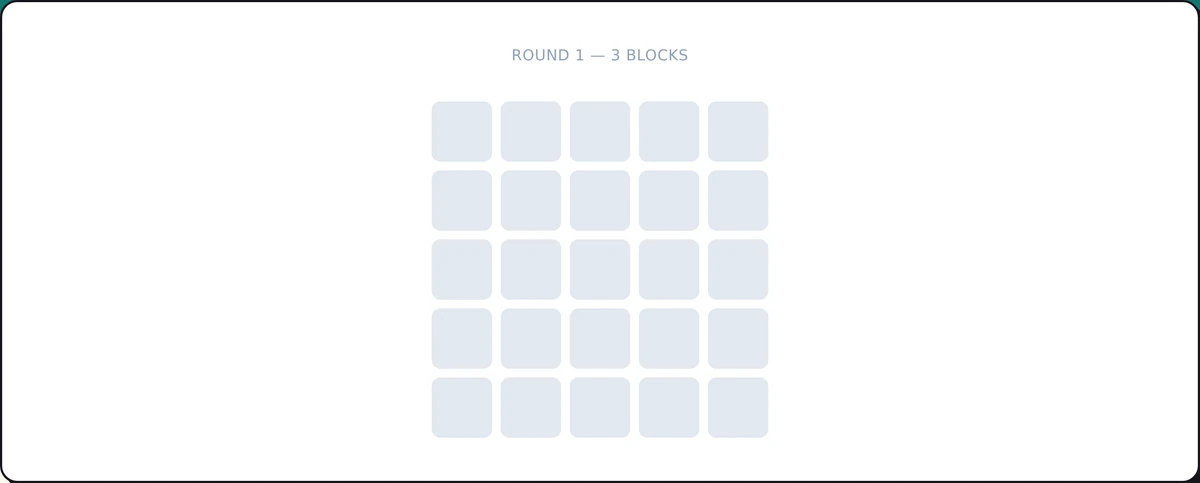
A grid of blocks appears. A few of them flash in sequence, one at a time, and when the sequence ends you tap the blocks back in the order they lit up. Get it right and the next sequence is one block longer; miss and you usually get one more attempt at the same length before the game ends or steps down. Your spatial span is the longest sequence you can reliably reproduce.
It measures visuo-spatial working memory — holding where and in what order in your head. That is a different mental system from the verbal loop you use for digit sequences, which is why some people with an excellent digit span are surprised by a mediocre Corsi score (and vice versa).
What is a good Corsi block score?
Norms for adults are remarkably stable across studies:
- Average spatial span: 5–6 blocks. Most healthy adults land here.
- 6–7 blocks is clearly above average.
- 8+ blocks is an excellent score you can expect to beat the large majority of candidates.
Note that spatial span runs about one item shorter than digit span on average — remembering positions-in-order is simply harder than remembering digits. Do not be alarmed if your Corsi number is lower than your digit span; recruiters compare you against Corsi norms, not digit norms.
Can you improve your spatial span?
Unlike digits, you cannot rehearse block positions by saying them — the trick is making the sequence visual and spatial:
- Trace the path, not the blocks. Treat the sequence as a single connected route across the grid — a zig-zag, a hook, a letter shape — instead of a list of separate positions. One path is one memory item; five positions are five.
- Chunk turns. Long sequences almost always contain little sub-patterns (two in a row going right, a diagonal pair). Group them the way you would chunk digits into phone-number blocks.
- Keep your eyes moving with the flashes. Following each block as it lights encodes the sequence in eye-movement memory as well as visual memory — two copies beat one.
- Replay once, immediately. In the pause before you answer, run the path through your head one time at speed, then answer without hesitating. Long deliberation degrades the trace.
- Practise at your edge. Spans grow from repeatedly attempting sequences just past your current limit. Ten minutes a day for a week or two typically buys one extra block — often the difference between an average and an above-average percentile.
Corsi vs digit span vs n-back: what is the difference?
Assessment batteries usually include more than one memory game because they probe different systems: digit span is verbal storage, Corsi is spatial storage, and the n-back tests updating — holding a stream while constantly replacing it. Practise all three rather than doubling down on your favourite; the battery scores you across the set, and the full guide to game-based assessments shows how they fit together.
Try it now
Play the free Corsi block visual memory game — it runs exactly like the assessment version, with server-side scoring against fixed norms, so the number you see is the percentile you have actually earned.
Which assessments use the Corsi block test?
Spatial-memory tasks like the Corsi block show up in several employers' game batteries. If you're preparing for a specific process, Arctic Shores' behavioural assessment leans heavily on this kind of visual working-memory challenge, and the memory-and-planning demands of the McKinsey Solve game draw on the same system. Both guides show how it fits their wider battery.
What do people actually score?
In our own data the median first attempt is 5 blocks, with the strongest tenth reaching 7, across 40 players. Returning players gained a median of 20 percentiles between their first run and their best.
FAQ
What does the Corsi block test measure? Visuospatial working memory — how many positions you can hold in order, rather than how many numbers or words.
Is spatial memory the same as visual memory? Not quite. This task is about where things were and in what order, which is why people who are good with faces or shapes do not automatically do well at it.
What is a typical score? In our first-attempt data the middle is 5 blocks; the strongest tenth reach 7.