Digit Span Memory Test Practice
This memory test is the digit span: the most widely used measure of short-term and working memory. Digits flash on screen one at a time and you type them back in order.
Free, no sign-up, about 3 min, scored on our server as a percentile the moment you finish.
Players' first attempts here: median 6, middle half 5–7 digits recalled, 481 players, as of . All score benchmarks
Loading game…
Watch the 2-minute walkthrough
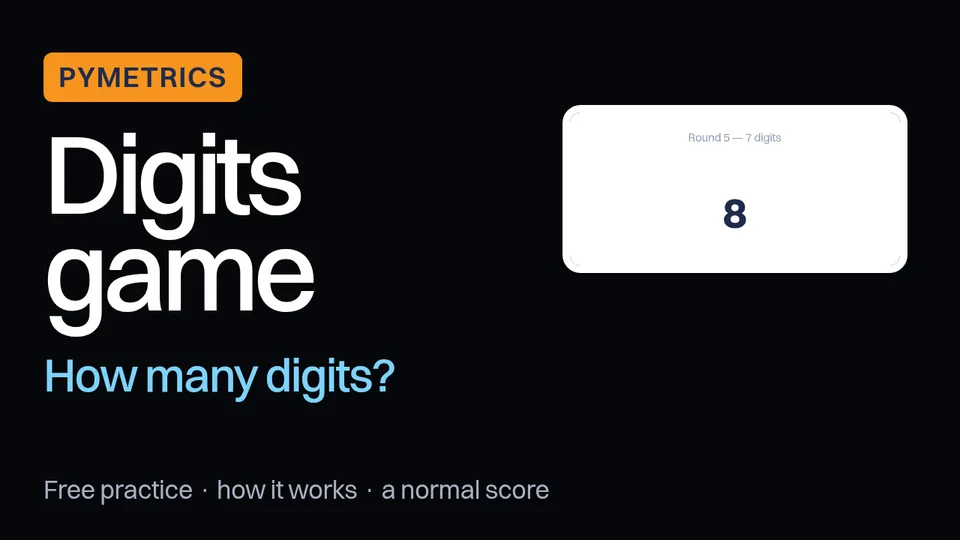
Plays from YouTube (youtube-nocookie.com) once you press play; nothing loads before that. Watch on YouTube
Transcript
Got the pymetrics digits game? It's a memory test, and one of the few pymetrics games where practice really shows. Here's our free practice version. Same idea, slightly different rules, which I'll flag.
Digits flash up, one at a time.
Then you type them back, in the same order. Get it right, and the next sequence is one digit longer. Prep providers report that the pymetrics version starts at four digits, drops a digit after a mistake, and ends after three wrong answers. Ours starts at three, and two misses at the same length end it.
It's a digit span task, one of the oldest standard tests of short-term memory. It measures capacity, not a trait, so practice genuinely helps.
Here's a real run, at seven digits. Group them as they arrive: eighty-nine, fifty-eight, two oh five.
Typed back in one go. Correct. Eight digits, and one slips. Two misses at the same length, and our version ends there. So: chunk the digits in twos or threes, like a phone number. Rehearse the chunks silently as new ones arrive. Keep a steady rhythm, because the order is half the task. Replay it once in your head, then type it in one go. And stop when you're tired, because your span drops with fatigue.
pymetrics doesn't publish norms or a cut-off. It compares your whole trait profile with the role's, not your span with a pass mark.
Our version scores the longest sequence you got fully right.
So what's normal on ours? We looked at 422 players' first attempts, from mid July to early November 2026. The median was 6 digits, and the middle half managed five to seven.
Practise free at benchkithq.com/gameprep
What is the digit span memory test?
This memory test is the digit span: the most widely used measure of short-term and working memory. Digits flash on screen one at a time and you type them back in order. Every correct answer makes the next sequence one digit longer, and two misses at the same length end the run, so in about three minutes the test finds the limit of what you can hold in mind: your digit span.
What is a good memory span?
Most adults recall between 5 and 8 digits forwards. George Miller's famous "seven, plus or minus two" (1956) came from tests like this one. Later research suggests people really hold about four chunks at once, and that a long span comes from packing digits into chunks rather than from a bigger memory. This is the table each run is graded against:
| Digit span | Percentile |
|---|---|
| 3 digits | 10th |
| 4 digits | 25th |
| 5 digits | 40th |
| 6 digits | 60th |
| 7 digits | 75th |
| 8 digits | 85th |
| 9 digits | 92th |
| 10 digits | 96th |
| 11+ digits | 98th |
A span of 7 is better than three quarters of test takers; 9 or more is excellent. Accuracy across rounds is shown with your result, but the score is the longest sequence you got fully right.
The memory tests employers use
Working memory predicts how well people learn new procedures and juggle information, so it appears in most game-based assessments in one form or another:
- Forward digit span (this test): repeat a growing list of digits. Used in HireVue-style games and in neuropsychological testing.
- Backward digit span: the same, typed in reverse. Harder, because you have to manipulate the list, not just hold it.
- Corsi block test: the visual-spatial version, tapping blocks in the order they lit up.
- N-back: say whether the current item matches the one from two steps back, which tests updating memory under time pressure.
- Arctic Shores, pymetrics and Cappfinity games wrap the same skill in sequences of symbols, coloured lights or numbers, and some (Arctic Shores' ticket and order games) mix it with speed.
How to remember more digits
- Chunk: hear 4-8-2-9-1-7 as 482-917, like a phone number. Two or three chunks of three are far easier than six single digits.
- Rehearse in rhythm: repeat the chunks silently in a steady beat while the digits are still appearing.
- Do not type until you have the whole sequence: starting early breaks the rehearsal loop.
- Stay calm after a miss: you get a second attempt at the same length, and most runs end on nerves, not on memory.
- Practise briefly and often: chunking speed improves within a week of daily runs; a single long session mostly makes you tired.
For what a given span means in more detail, read what is a good digit span score, and for training ideas, how to improve working memory before an assessment.
What's a good score?
Across 481 first attempts here, the typical first try is 6 and the top quarter starts at 7. Target: the 70th percentile on our scale and up, what our readiness check counts as prepared. Employers do not publish their cut-offs.
What people score on this test
First attempts of 481 people who took this test on GamePrep, in digits recalled.
- Top 10%
- 8
- Top 25%
- 7
- Median
- 6
- Bottom 25%
- 5
- Bottom 10%
- 0
A first try, before any practice. All games' results · the data study · how scoring works
- 1
Play
Hit start and the game runs the way the real assessment does, timers and all.
- 2
Get scored
Your result is graded on the server against fixed norms and turned into a percentile.
- 3
Improve
Save your run to a free account and watch your score climb across sessions.
Frequently asked questions
What is a good memory test score?
On a digit span test most adults recall 5 to 8 digits. A span of 7 is better than about three quarters of test takers, and 9 or more is an excellent result.
What is the average digit span?
About 6 to 7 digits forwards for adults, which is where Miller's "seven, plus or minus two" comes from. Backward span is usually one or two digits shorter.
Is this the same digit span test used by HireVue?
It follows the same classic forward digit span mechanic used in HireVue-style game-based assessments: sequences get longer after each correct answer and the game ends after two mistakes at the same length. It is an independent practice tool, not the official test.
Can I improve my memory span with practice?
Yes, mostly through strategy. Chunking digits into groups of two or three and rehearsing them in rhythm can add one or two digits to your span within a few weeks of short daily practice.
How is my score calculated?
Your score is the longest sequence you recalled correctly (your max span). The result also shows your accuracy across all rounds and a percentile from the table on this page.
What is the difference between short-term and working memory?
Short-term memory holds information briefly, as in forward digit span. Working memory also manipulates it, as in backward digit span or the n-back task. Hiring assessments care most about working memory, but forward span is the usual starting point.
Which other memory tests should I practise?
Backward digit span, the Corsi block test (visual-spatial memory) and the n-back task cover the other memory formats used in game-based assessments. All three are free on GamePrep.
Read more about this game
More cognitive games to try



The free prep checklist
Assessment coming up? One email with the 1-page checklist candidates use before a game-based assessment: which games to drill, and what to do the night before. Unsubscribe anytime.
No spam. We never share your email.
Keep your scores
Guest scores live only in this browser. Create a free account to keep them on any device and track your percentile across all 43 games.