HireVue Game Assessments: The Complete Guide + Free Practice
What HireVue-style game assessments are, the games you'll face, what employers measure, and how to prepare — with a free practice game for every one.
TL;DR: A game-based assessment is a battery of short, timed mini-games measuring cognitive traits — working memory, attention, processing speed, numerical reasoning, spatial ability — rather than knowledge. Because they test aptitude rather than facts you cannot revise for them, but practising the mechanics removes the unfamiliarity that costs most candidates their score.
If you have applied for a graduate scheme, an internship, or an early-career role in the last few years, there is a good chance you were asked to play a set of short games instead of sitting a traditional aptitude test. These game-based assessments — popularised by HireVue and its MindX engine, and by rivals like pymetrics, Arctic Shores and Aon — now sit at the front of thousands of hiring funnels.
They feel strange the first time. There is no obvious "test", the timers are tight, and there is rarely a back button. This guide is the map: what you are walking into, every game you might meet (with a free version to practise on), what employers actually score, and exactly how to prepare so that unfamiliarity never costs you the job.
What is a game-based assessment?
A game-based assessment is a battery of short, timed mini-games that measure cognitive traits — working memory, attention, processing speed, numerical reasoning and spatial ability — rather than knowledge. Each game often adapts to your performance: answer correctly and it gets harder; slip and it eases off. Your result is a profile compared against other candidates, or against a model of who succeeds in the role.
Because they measure aptitude rather than facts, you cannot revise for them the way you would for an exam. But you absolutely can practise the mechanics — and that is where most of your advantage comes from.
Why candidates fail (and it is not ability)
The single biggest reason strong candidates underperform is unfamiliarity. The first time you meet a task like the n-back memory test or the Numerosity number game, you spend your first thirty seconds just working out the rules — and in a two-minute game, that is a third of your score gone. Candidates who have seen the format before start calm and fast.
The second reason is nerves compounding that unfamiliarity: a strange interface, a ticking clock and no undo button push people into rushing or freezing. Both wreck accuracy. Rehearsal removes the novelty, and once the novelty is gone the nerves shrink with it — we go deeper on this in can you fail a game assessment?
Every game, explained (with a free one to practise)
HireVue-style assessments draw from a pool of around a dozen games. Below is every task you are likely to meet, grouped by the trait it measures, with the free practice game and its in-depth guide. Play each one at least twice before your assessment — that alone removes the biggest score leak.
Memory & working memory
- Digit span — recall ever-longer number sequences. The purest working-memory task in the battery. See what a good digit span score looks like.
- Backward digit span — the same, but recalled in reverse; it forces you to hold and manipulate, not just store. Why it is harder, in the backward digit span guide.
- Corsi block (visual memory) — repeat a sequence of highlighted squares. Spatial rather than verbal memory. Details in the Corsi block test explained.
- N-back — track whether the current item matches the one n steps back. A demanding updating task, covered in the n-back test explained.
Attention & processing speed
- Reaction time — respond the instant a signal appears, hold back on false starts. Pure processing speed plus impulse control; see reaction time norms.
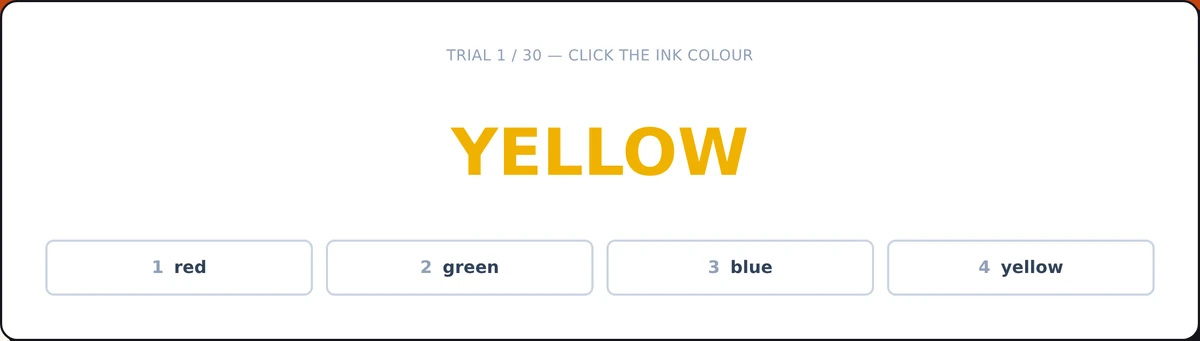
- Stroop test — name the ink colour, not the word. Measures attention control under interference; strategy in the Stroop test explained.
- Flanker (arrows) test — judge the middle arrow while its neighbours mislead you. Selective attention, broken down in the flanker test explained.
- Task-switching — judge a shape or its colour as the rule keeps changing. Cognitive flexibility: how much time and accuracy you lose each time the rule flips. (Note: Aon's similarly-named switchChallenge is a reasoning task, not this — see the switchChallenge guide.)
Numerical reasoning
- Numerosity — combine numbers to hit a target under time pressure. Practise it with the Numerosity how-to guide.
- Disco Numbers — rapid magnitude comparison, decision after decision. See the Disco Numbers guide.
- Mental math — fast arithmetic under a timer. Ten minutes a day makes the calculations automatic; more in mental math for game assessments.
- Numerical reasoning (data interpretation) — read a table of figures and answer a total, difference or percentage. This is what SHL and cut-e / Aon actually mean by "numerical reasoning"; deep-dive in the numerical reasoning guide.
Spatial reasoning
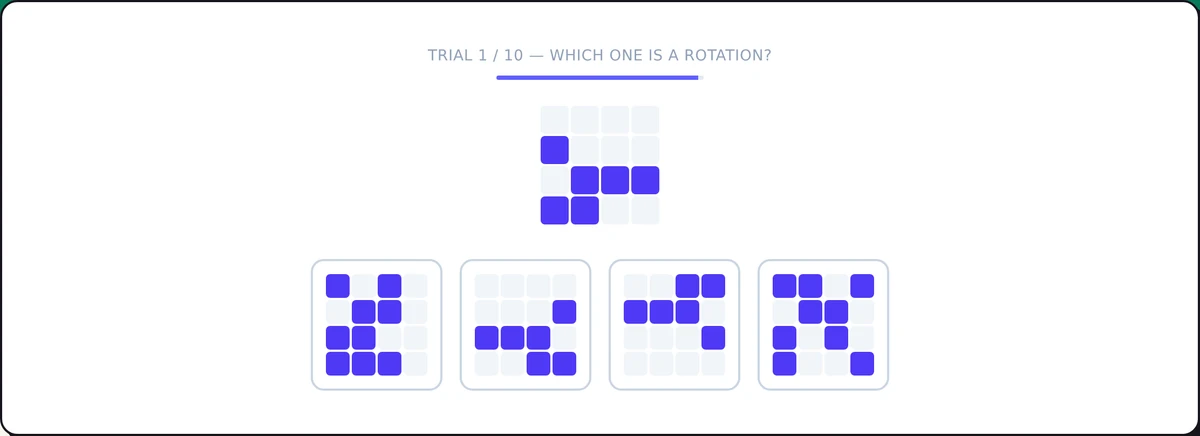
- Mental rotation (Shapedance) — decide whether rotated shapes match. A classic spatial task, walked through in the mental rotation guide.
- Odd one out (Singularity) — find the different shape as the grid grows. Visual search, covered in the odd-one-out guide.
- Pathfinder — plan a route before the timer runs out. Planning and foresight, in the Pathfinder puzzle guide.
Logical & abstract reasoning
- Inductive reasoning — a row of shapes changes by a hidden rule; pick what comes next. The signature format of SHL, cut-e / Aon and Cappfinity tests; train it alongside the psychometric test guide.
Some batteries also include behavioural or trait games (a balloon-pump risk game, money-sharing fairness tasks, effort-allocation sliders). These measure disposition, not skill — there is no high score to chase. Play them naturally and consistently; they cross-check each other, and trying to game them usually backfires.
What employers actually measure
Employers are not scoring "did you win the game". They are estimating stable traits:
- Working memory — how much you can hold and manipulate at once.
- Processing speed — how quickly you take in and act on information.
- Attention control — how well you focus and ignore distraction under pressure.
- Numerical and spatial reasoning — role-specific aptitudes.
There is usually no visible pass mark. Your profile is compared to a benchmark or a role model; candidates above it advance, those below quietly do not. Many games report a percentile — "you scored better than 70% of players" — rather than a raw number, which is why a stable, repeatable performance matters more than one lucky run. There is a fairness debate worth understanding, which we unpack in are game-based assessments fair?
Assessments by employer
The games barely change between companies — but the process around them does (which provider, how many stages, whether a video interview follows). We break down the big employers company by company:
- Banking & finance: JPMorgan, Goldman Sachs, Morgan Stanley, Citi, Barclays, HSBC, Lloyds, NatWest and Standard Chartered.
- Consulting: McKinsey (Solve), BCG, Bain, Deloitte, EY, KPMG, PwC, Accenture and Capgemini.
- Consumer & retail: Unilever, P&G, Nestlé, L'Oréal, Diageo, Mars, Aldi and Lidl.
- Tech & industry: Amazon, IBM, Rolls-Royce and Vodafone.
- Public sector & graduate schemes: Civil Service Fast Stream and Teach First.
See the full list on the assessments by employer page.
Assessments by test provider
If you know which company runs the assessment, you know its format and timing. Our provider guides cover what each one measures and how to practise:
- pymetrics (now Harver) and the Harver platform
- HireVue
- Arctic Shores
- SHL
- cut-e / Aon — including the switch challenge and the grid challenge
- Cappfinity
- Test Partnership — including the six MindmetriQ games
- Criteria (Cognify)
Confused about how two of these relate? Harver vs pymetrics explains why they are now the same company and what that means for your invitation.
Scoring, retakes and what "passing" means
No vendor publishes a pass mark and almost no employer sends you a score, which is why this stage generates more anxiety than any other. Three guides cover what actually happens behind the screen:
- Can you fail a game assessment? — how the invisible, employer-set benchmark works and why feeling wrecked afterwards means nothing.
- What is a good game assessment score? — why the bar is a percentile rather than a number, and how to find your own baseline.
- Can you retake it? — who controls a reset, when a second attempt is genuinely granted, and what to do if it is refused.
For consulting simulations specifically, how the McKinsey Solve score is judged covers why process is read alongside outcome.
By test type
Prefer to train by the skill being measured rather than by employer? Start here:
- Numerical reasoning — speed and accuracy with numbers, tables and ratios under a timer.
- Working memory — how to actually improve the span these tests probe.
- Psychometric & aptitude tests — the cognitive games you can genuinely practise, and what you can't.
How to prepare in one week
- Learn every game's rules so nothing is new on the day. Play each one here at least twice.
- Drill your weak categories. Most people are strongest in one area (say numerical) and shakier in another (say spatial). Spend your time on the gap — one cold run of each game shows you where it is.
- Rehearse under time pressure, not leisurely — the clock is the real difficulty.
- Fix the basics: a full night's sleep, a quiet room, a stable connection, a laptop rather than a phone, and a proper mouse or trackpad. Reaction time and working memory both degrade measurably when you are tired or distracted.
Short on time? We have a dedicated 24-hour preparation plan and a step-by-step how to pass game assessments.
FAQ
Can you actually practise for a game-based assessment? Yes — the cognitive games (memory, attention, speed, math) measure trainable skills, and simply removing the "what do I do?" penalty by playing each format once is the single biggest, cheapest gain. You cannot revise answers, because there are none, but you can absolutely arrive familiar and calm.
Is there a pass or fail score? Rarely a visible one. Most assessments compare your profile to a benchmark or role model and advance the closest fits, so aim for a strong, consistent performance rather than chasing a single number.
Are these the exact games the employer uses? No — these are free, independent practice equivalents built to match the mechanics and skills of common assessment games. Game sets change, and formats vary by employer and region, so always treat your invitation email as the source of truth.
How long do game-based assessments take? Most run 20–40 minutes across roughly a dozen short games. Some providers add an on-demand video interview afterwards.
Do I need to pay to practise? No. Every practice game here is free, with instant scores and percentiles — start now and play each one until the mechanics feel automatic.
GamePrep is an independent practice platform and is not affiliated with HireVue or any assessment vendor. We provide practice only — no leaked questions or answers. Hiring processes change; verify details against your assessment invitation.