The N-Back Test Explained — and Whether You Can Train It
What the n-back working-memory game measures, why it feels so hard, the honest science on training it, and how to avoid the classic false-alarm trap.
The n-back is a working-memory game: items appear one at a time and you respond whenever the current item matches the one from N steps back. A 2-back means "does this match the item two before?" It measures working-memory updating, feels brutally hard at first, and can be trained for the test itself, though claims that it raises general IQ are contested. The main skill is resisting false alarms.
The n-back is the working-memory game with the fiercest reputation, and for good reason. Items appear one at a time and you respond whenever the current item matches the one from N steps back. Holding the last N items in mind and refreshing them every second is genuinely demanding, which is exactly why assessments use it.
What does the n-back test measure?
The n-back taps working-memory updating: your ability to keep information live in mind and refresh it under time pressure, discarding what is no longer relevant. That is different from simple storage. You are not just holding a list, you are running a moving window that shifts with every new item. This updating ability correlates with learning speed and multitasking, which is why assessments include it (HireVue calls its version Flashback).
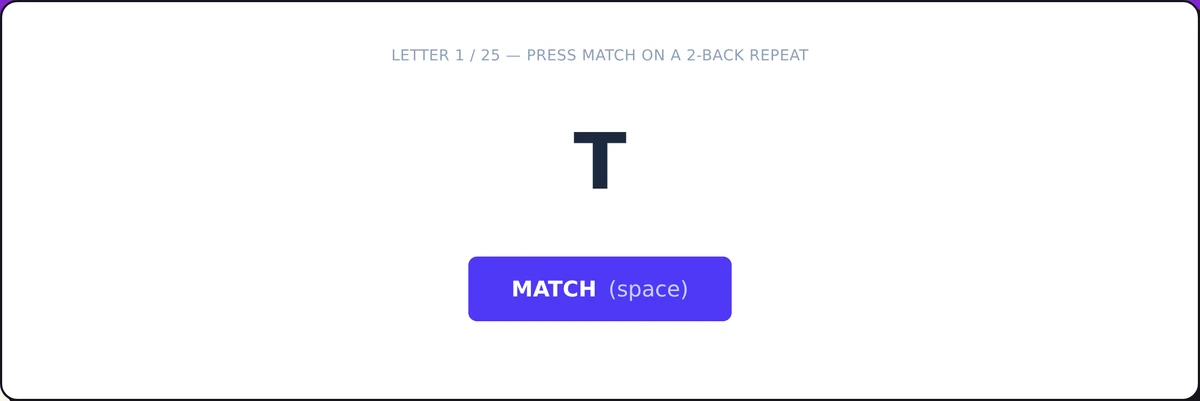
Try the 2-back on the n-back memory test.
How do the n-back levels work?
The "N" sets the difficulty:
- 1-back — does this item match the one right before it? A gentle warm-up.
- 2-back — match against two items ago. The most common assessment level, and where most people feel the jump in difficulty.
- 3-back and higher — you hold a longer moving window. Accuracy drops fast for almost everyone, so do not be alarmed.
Most people handle 1-back comfortably, find 2-back demanding but doable with practice, and struggle at 3-back. Steady, accurate 2-back performance is a solid result.
Why does the n-back feel impossible at first?
You are doing three things at once: remembering the item N back, comparing it to the current one, and updating the buffer as the next item lands. The classic mistake is matching against the previous item (1-back) instead of two back. It feels impossible partly because it is unfamiliar, and partly because the task never pauses to let you catch up. Familiarity alone removes a surprising amount of that early panic.
Beating the false-alarm trap
Pressing on everything gets you nowhere. Good scoring rewards real hits (correctly spotting a match) and punishes false alarms (pressing when there is no match). Many people, feeling behind, start guessing, and their false-alarm rate wrecks the score. The fix is to stay disciplined:
- Rehearse the held window as a rhythm ("K–F… K–F"), updating it as a chant.
- Update deliberately as each item appears, sliding the window forward one slot.
- Accept the occasional miss rather than chasing a lost item and panic-pressing.
- Only press when you are genuinely sure. A missed hit costs less than a stream of false alarms.
A worked example
In a 2-back, the stream is: C, H, C, K, K, H. When the second C appears, compare it to two back (the first C) — match, press. When the second K appears, two back was H, not K, so do not press even though a K just went by; that "K just happened" pull is exactly the 1-back trap. When the final H appears, two back was the first K, so no press. Getting these right is less about speed than about faithfully sliding the window and resisting the urge to react to the most recent item.
What mistakes cost the most points?
- Matching the previous item instead of N back. The single most common error, especially when tired.
- Panic-pressing when behind. Guessing floods your score with false alarms. When lost, reset and wait for a clear match.
- Sub-vocalising too many items. Trying to hold more than the window needs overloads you. Hold exactly N, no more.
- Chasing a missed item. One miss is cheap; freezing over it causes several more. Let it go and re-anchor on the current item.
- Ignoring accuracy. Raw button-mashing looks active but scores badly. Deliberate and correct beats fast and wrong.
Can you actually train it?
Honestly: practising n-back reliably improves your n-back performance, which is what matters for the assessment. A few short sessions noticeably reduce false alarms and calm the early panic. Claims that it raises general intelligence are scientifically contested, so ignore that hype and focus on test-day readiness. You are training familiarity, rhythm, and restraint, and those transfer straight to the score.
Pair it with the Corsi visual memory game and the digit span test to round out your working-memory prep.
N-back is the most demanding working-memory task in the battery, which makes it the one worth training deliberately — improving working memory for assessments sets out how, and is honest about the limits.
What do people actually score?
First attempts split hard: the median is 13 out of 100 across 34 players, while the top tenth reach 88. Very few tasks here produce a gap that wide, and it is the clearest sign that n-back punishes unfamiliarity more than ability.
FAQ
What is a good n-back level to reach? Comfortable, accurate 2-back is a strong practical target, since that is the level most assessments use. Reaching 3-back is impressive but not necessary for most tests.
Does n-back training make you smarter? It reliably improves your n-back performance, but the claim that it raises general intelligence is contested and unreliable. Train it to do well on the task, not as a brain-boosting shortcut.
Why do I keep pressing when there is no match? Usually because you are reacting to the most recent item (a 1-back reflex) or guessing when you feel behind. Slowing your internal rhythm and only pressing on sure matches fixes most false alarms.
How long should I practise before an assessment? A handful of short sessions over a few days is plenty to shed the unfamiliarity and lower your false-alarm rate. Long marathon sessions add fatigue without much extra benefit.
Is n-back the same as digit span? No. Digit span tests how much you can store and repeat back, while n-back tests how well you update a moving window. They are related but distinct working-memory skills, so practising both is worthwhile.
GamePrep is an independent practice platform, not affiliated with any assessment vendor. We provide practice only — no leaked questions or answers. See the complete guide for the full battery.