Stroop Test: What It Measures & How to Beat the Interference
The Stroop effect explained, why employers use it to measure attention control, and the practical technique for beating the word-versus-colour interference.
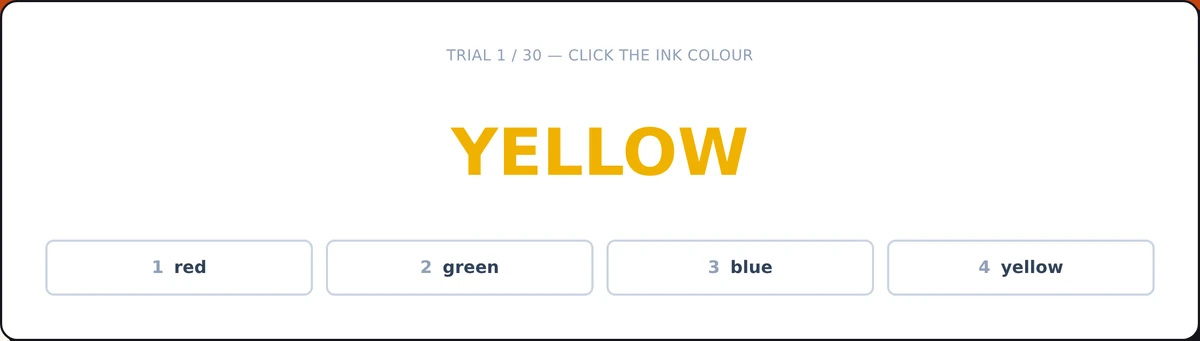
The Stroop test measures attention control and cognitive inhibition: you see a colour word like RED printed in a different ink and must name the ink, not read the word. Because reading is automatic, your brain has to suppress the wrong answer, and how quickly and accurately you do that is your score. It cannot really be "aced", but familiarity and a steady rhythm noticeably reduce errors.
The Stroop test is a classic measure of attention and cognitive control. You see a colour word, say RED, printed in a different ink colour, and you must name the ink, not the word. Because reading is so automatic, your brain has to actively hold back the answer it wants to give. That small act of self-control, repeated fast under time pressure, is what the test captures.
What does the Stroop test measure?
Employers and assessment vendors use the Stroop task because it isolates something hard to fake: inhibitory control, your ability to override a strong automatic response in favour of the correct one. That skill maps onto real work like ignoring distractions, catching your own errors, and staying accurate when things move quickly. It reads as focus under pressure, which is why it shows up in prep for detail-heavy and fast-paced roles.
What is the Stroop effect?
Naming the ink of an incongruent word (RED printed in blue) is reliably slower and more error-prone than a congruent one (RED printed in red). That gap in speed and accuracy is the Stroop interference effect. The bigger the gap, the more the automatic reading is winning over your intended answer. A well-controlled response shows a small, stable gap even as the trials speed up.
Play it on the Stroop practice game and watch your own congruent-versus-incongruent gap.
What counts as a good Stroop result?
There is no single universal number, because scoring depends on the exact version, but the shape of a strong result is consistent:
- High accuracy on incongruent trials — ideally above 90%. Errors here cost the most.
- A small interference gap — your incongruent responses only modestly slower than congruent ones.
- Stable performance over time — you do not fall apart as the test gets faster or longer.
Chasing raw speed at the expense of accuracy usually backfires, because most scoring punishes errors harder than it rewards a few saved milliseconds.
How do you beat the interference?
- Look at the colour, not the text. Slightly softening your focus so the word is harder to read helps many people. Some find it useful to look just below or beside the word.
- Answer in a steady rhythm. Rushing spikes errors on incongruent trials. Find a pace you can sustain accurately, then hold it.
- Name the colour before you read. Train yourself to let the ink colour arrive first. With practice the ink "pops" before the word does.
- Practise until incongruent feels normal. The interference cost shrinks measurably with a few sessions as the conflict becomes familiar.
A worked example
A card shows the word GREEN printed in blue ink. The automatic pull is to say "green". The correct answer is "blue". If you read first and correct yourself, you lose time and sometimes blurt the wrong word. Instead, fix your attention on the ink, let "blue" form, and say it in the same beat you have used for every other card. Do that consistently and your incongruent trials stop being special events, they become just more of the same rhythm, which is exactly what a small interference gap looks like.
What mistakes cost the most points?
- Reading the word first, then correcting. The correction is where errors and lost time come from. Aim to perceive the colour first.
- Speeding up to beat the clock. Accuracy usually matters more than raw speed; a burst of errors on incongruent trials sinks the score.
- Tensing up. Interference gets worse when you are stressed. A calm, even pace helps inhibition work.
- Ignoring the accuracy signal. If your error rate climbs, slow down slightly rather than pushing harder.
- Over-practising the day of. A few relaxed sessions beforehand beat a frantic cram right before the assessment.
Its cousin: the flanker game
The flanker "arrows" game measures the same inhibitory control with a different stimulus: respond to the middle arrow and ignore the flanking ones. If you find Stroop hard, practising both builds the same underlying skill, and the transfer between them is real. The reaction time test is a gentler warm-up for the quick, controlled responding both tasks demand.
What do people actually score?
Across first attempts on this site the middle score is 60 out of 100, and the strongest tenth reach 74 — measured on 57 players. Players who came back three or more times improved by a median of 40 percentiles between their first run and their best, the largest gain of any game here.
FAQ
What does the Stroop test actually measure? It measures inhibitory control and selective attention: how well you suppress a strong automatic response (reading) in favour of the correct one (naming the ink), especially under time pressure.
Can you improve your Stroop score with practice? Yes, modestly. Familiarity shrinks the interference cost and cuts careless errors. You will not eliminate the effect entirely, because it is baked into how reading works, but you can make your response steadier and more accurate.
Should I focus on speed or accuracy? Accuracy first. Most Stroop scoring penalises errors more than it rewards speed, so a steady, accurate rhythm usually beats a fast, error-prone one.
Why do incongruent trials feel so much harder? Because reading is automatic and hard to switch off. On incongruent trials your brain generates the wrong answer first, and you have to override it, which takes extra time and occasionally slips through as an error.
Is the Stroop test the same as the flanker task? They are cousins. Both test inhibitory control, but the Stroop uses word-versus-colour conflict while the flanker uses conflicting arrows. Practising one tends to help the other.
GamePrep is an independent practice platform, not affiliated with any assessment vendor. We provide practice only — no leaked questions or answers. For where this fits in the wider battery, see the complete guide.