McKinsey Solve Game: How It Works + Free Skill Practice
McKinsey's Solve assessment (ecosystem, plant defense, redrock) filters applicants before case interviews. What it measures, plus free skill practice.
Are you actually ready for this one?
See where you stand overall and which game to fix first — free, no sign-up.
Want this whole assessment as one timed run, one attempt per game? We're deciding whether to build it — get early access.
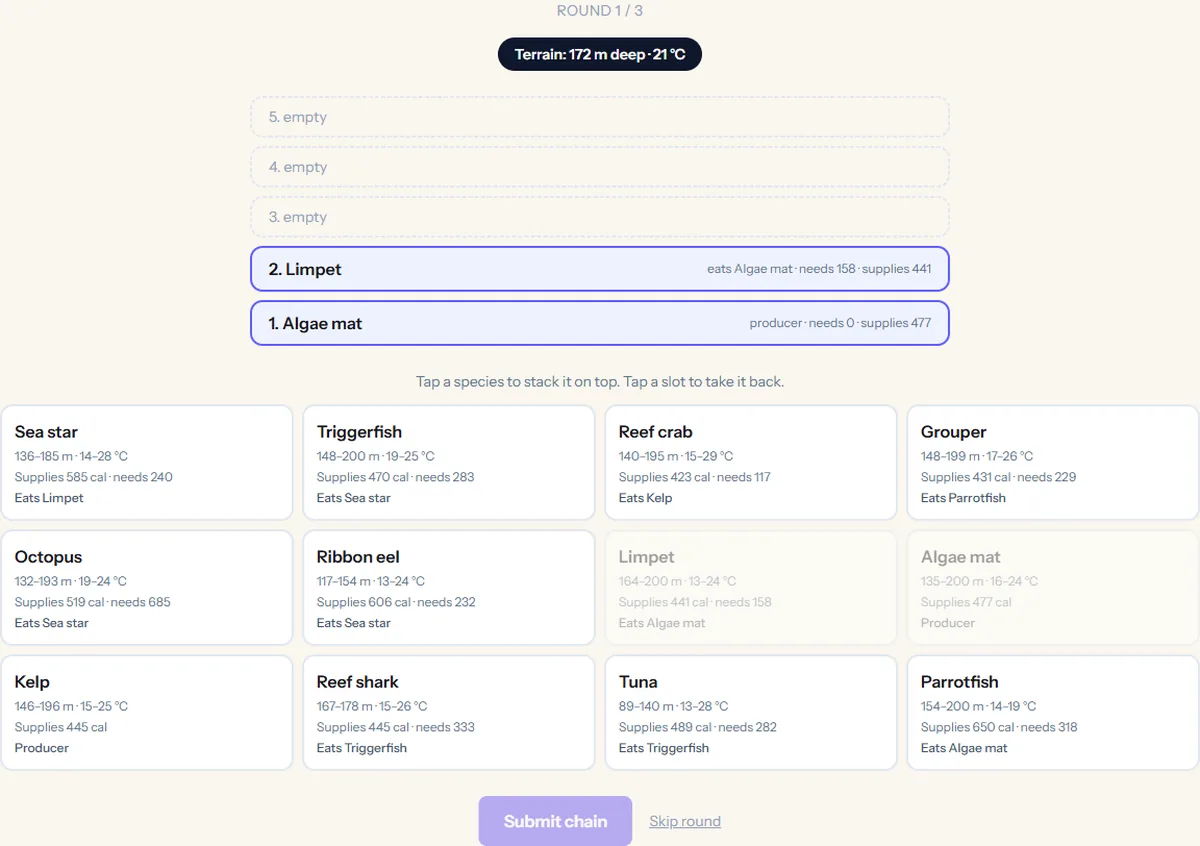
McKinsey screens a huge share of its consulting applicants with Solve — a gamified assessment (you may know it as the "Problem Solving Game" or the "ecosystem game") completed online before any case interview. Unlike a classic aptitude test, Solve drops you into scenarios and watches how you think, not just what you answer. As of 2026 the scenario set evolves regularly (ecosystem building, disaster/disease management and other variants have rotated through), so memorising walkthroughs is a losing strategy — training the underlying skills is not.
What Solve actually is
You get roughly 65 minutes for two modules, or about 85 for three — the length of your invitation is the clearest hint at which set you are sitting.
What candidates report in 2026: Redrock, then Sea Wolf, and on longer invitations Sustainable Futures Lab. Sea Wolf unlocks only after Redrock is finished. The ecosystem scenario — build a self-sustaining food chain from a species menu — is the game most older guides describe, but McKinsey began phasing it out around mid-2025. If your preparation so far has been about ecosystems, check your invitation before spending more time there.
Two layers are scored:
- Product score — did your solution work (did the ecosystem survive)?
- Process score — how you got there: how you explored data, how systematically you tested constraints, how you handled time. McKinsey has been open that process telemetry matters, which is why "someone told me the answer" does not transfer.
There is no published pass mark; your performance feeds into the interview-invite decision alongside your application (the benchmark logic works like every other game-based screen — see can you fail a game assessment). For why the bar moves by office and cycle, and what "good" means when nothing is published, see how the McKinsey Solve score is judged.
The Solve games, one by one
McKinsey rotates the scenarios and doesn't publish the rules, so your invite is the source of truth. Split by what candidates are actually sitting now:
Current (2026)
- Redrock Study — a research and data-interpretation simulation. Comes first, and gates access to the next module.
- Sea Wolf — constraint-solving and optimisation. A separate game from ecosystem building, despite what many older guides claim.
- Sustainable Futures Lab — reported on longer (≈85-minute) invitations: judgement, prioritisation and stakeholder trade-offs under ambiguity. No answer key exists for this one; it reads how you decide.
Legacy, still worth understanding
- Ecosystem Building — the classic food-chain scenario (coral reef / mountain habitats, and the one people mean by the "armadillo" or "habitat protection" game). Being phased out since mid-2025.
- Plant Defense — a tower-defense-style task: planning and adapting under time pressure.
The trainable core skills
Solve is deliberately unfamiliar, but it leans on a stable set of cognitive muscles:
Constraint-based planning. The ecosystem puzzle is a chain of dependencies you must order correctly before committing. The ecosystem building trainer runs that task directly — terrain tolerances, calorie supply and who eats whom, checked link by link — and the pathfinder puzzle drills the same plan-before-you-act habit on a route instead of a food chain.
Working memory under load. You juggle calorie numbers, terrain rules and species relationships simultaneously. Train capacity with the n-back test — the closest lab analogue to "hold several changing facts while reasoning" — and Corsi block for the spatial layer.
Fast, accurate arithmetic. Calorie provided vs. calorie needed comparisons are simple maths done many times under a clock. Ten minutes a day on mental math makes those checks automatic, freeing attention for the actual logic.
Calm time allocation. Most failed attempts are time-management failures: perfectionism on the first half, panic on the second. Every timed practice game teaches the same meta-skill — decide, commit, move.
How to prepare (one week)
- Days 1–2: Read McKinsey's official Solve materials (they publish a candidate guide) so zero minutes are spent decoding the interface. Play the four games above cold; note weak spots.
- Days 3–5: Daily 20-minute sessions on your two weakest skills. For ecosystem-style logic, practice building dependency chains on paper: pick any system (a supply chain, a food web) and map what depends on what.
- Day 6: Full timed dress rehearsal of the practice games back-to-back — the point is pacing under fatigue.
- Day 7: Rest. Solve rewards fresh working memory more than one more cram session.
FAQ
Can I retake Solve? Generally only with a new application after the standard waiting period (historically around two years for reapplication). Treat your attempt as final.
Do I need to finish everything? No — partial but systematic beats complete but sloppy, because process is scored.
Is it beatable by memorising walkthroughs? Scenario details rotate and telemetry watches your process. Skill preparation transfers; script-following does not.
GamePrep is an independent practice platform, not affiliated with McKinsey & Company. Assessment formats change — verify details against your official candidate instructions.