Deloitte Immersive Online Assessment 2026: Every Stage + Free Practice
Deloitte screens most early-career applicants with an online immersive assessment before anyone reads your CV. What the situational and cognitive halves each measure, how member firms differ, the mistakes that cost strong candidates, and free practice for every skill involved.
Are you actually ready for this one?
See where you stand overall and which game to fix first — free, no sign-up.
Want this whole assessment as one timed run, one attempt per game? We're deciding whether to build it — get early access.
TL;DR: Deloitte's early-career screen is the Immersive Online Assessment, built by Cappfinity — situational-judgement scenarios mixed with short numerical and verbal tasks, untimed, roughly 32 questions — sat after the application form. The exact format differs by member firm and by year, so your invitation is the authority. You are matched to a profile rather than ranked on one score, and the cognitive half is trainable.
Applying to a Deloitte graduate scheme, internship or apprenticeship? In most regions the first hurdle after the application form is an online immersive assessment — a blend of situational-judgement scenarios and short cognitive mini-tasks, completed in your own time.
As of 2026 the exact format differs by member firm: Deloitte UK, US, Poland and others run their own variants and sometimes their own vendors. Treat your invitation email as the source of truth. This guide covers what is consistent across them, and flags where things vary.
Why Deloitte screens this way
Worth understanding, because it shapes what "doing well" means.
Deloitte receives early-career applications at a volume no human sift can process fairly, and the traditional first filter — university, degree class, CV polish — correlates heavily with background rather than potential. The immersive assessment is placed early precisely so the assessment, not the CV, decides who advances.
Two consequences for you:
Your academic record is not doing the work at this stage. A strong one does not carry you through the tasks, and a modest one does not sink you.
You are matched to a profile, not ranked on a single score. The output is a shape — judgement, numerical fluency, working memory, attention — compared against what predicts success in the role. This is why an uneven profile reads worse than a level one at the same average.
The two halves of the assessment
1. Situational judgement
You watch or read workplace scenarios — a client asks for something out of scope, a senior is offline, a deadline slips, a junior colleague is struggling — and rank or rate possible responses.
This half measures judgement and alignment with how Deloitte actually works. It is not trainable in the cognitive sense, but it is absolutely preparable, and most candidates prepare for it badly.
What consistently reads well in a professional-services context:
- Clarify before assuming. The response that gathers the missing information usually beats the one that acts decisively on a guess.
- Escalate appropriately, not reflexively. Neither "handle everything alone" nor "push every decision upward". Show that you know which is which.
- Protect the client relationship and the team. Deloitte sells trust; answers that quietly sacrifice either read badly even when they solve the immediate problem.
- Take ownership without heroics. "I'd fix it myself overnight and tell nobody" is the classic wrong answer.
The trap: answering as an idealised superhuman. These instruments measure consistency across scenarios, and a flawless-employee persona is internally inconsistent — it contradicts itself the moment two scenarios trade off against each other. Answer as the colleague you would actually want on your team.
2. Cognitive mini-games
Short timed tasks measuring numerical reasoning, working memory, attention and planning. This half behaves exactly like other game-based batteries — percentile scoring against other applicants, no visible pass mark — and it is very trainable.
Two things about the format that catch people out:
- They are usually adaptive. Correct answers make the next item harder. That means almost everyone finishes at the edge of their ability, missing the final rounds. Walking away feeling stretched is the intended experience, not a verdict — see can you fail a game assessment.
- Accuracy generally beats volume. Rushing to attempt more items while your error rate climbs usually produces a lower estimate than a steadier run through fewer.
The cognitive skills to train, and where
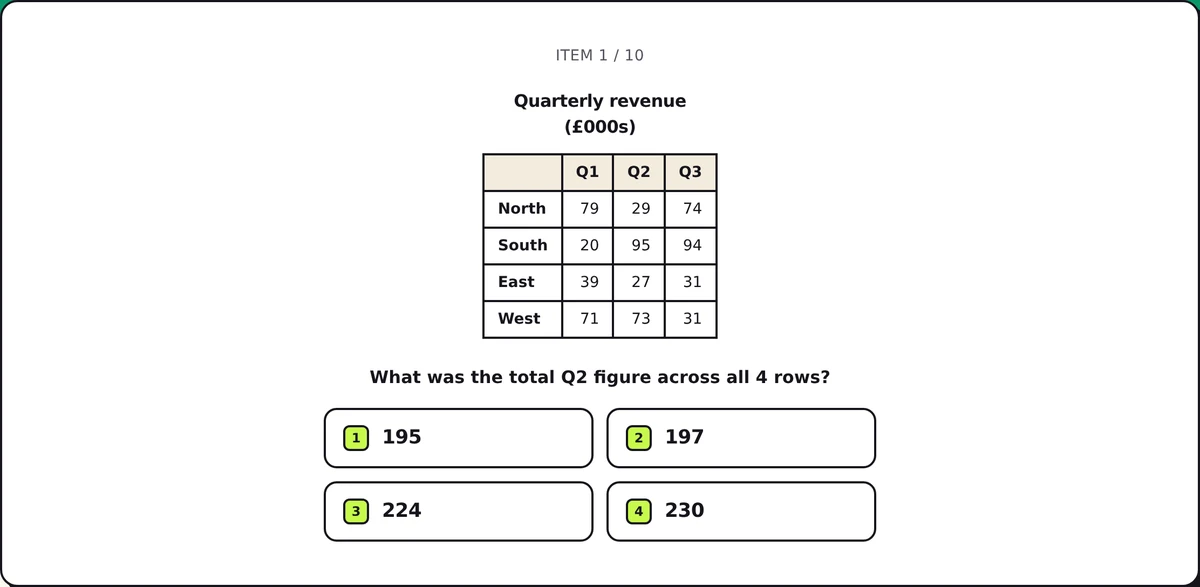
Numerical fluency. Quick arithmetic, percentages, reading small charts under time pressure — consulting maths, essentially. The winning habit is deciding what the question actually needs before touching any numbers. The mental math game trains the raw reflex; numerical reasoning adds the data-interpretation layer on top. Aim for accuracy first, speed second.
Working memory. Holding instructions and intermediate numbers in your head while working. Build capacity with digit span and stretch it with backward digit span, which forces you to hold and manipulate at once.
Planning under a timer. Some variants include route-planning or sequencing puzzles. The pathfinder puzzle is the matching drill — it teaches the look-before-you-move habit that timed planning tasks reward, and punishes the improvising that feels faster.
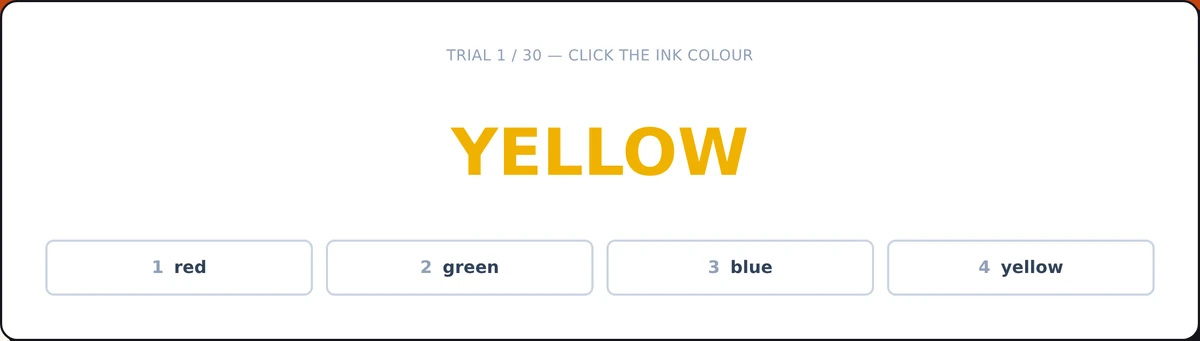
Attention control. Interference tasks punish autopilot answers. A few rounds of the Stroop test each day sharpens exactly that muscle.
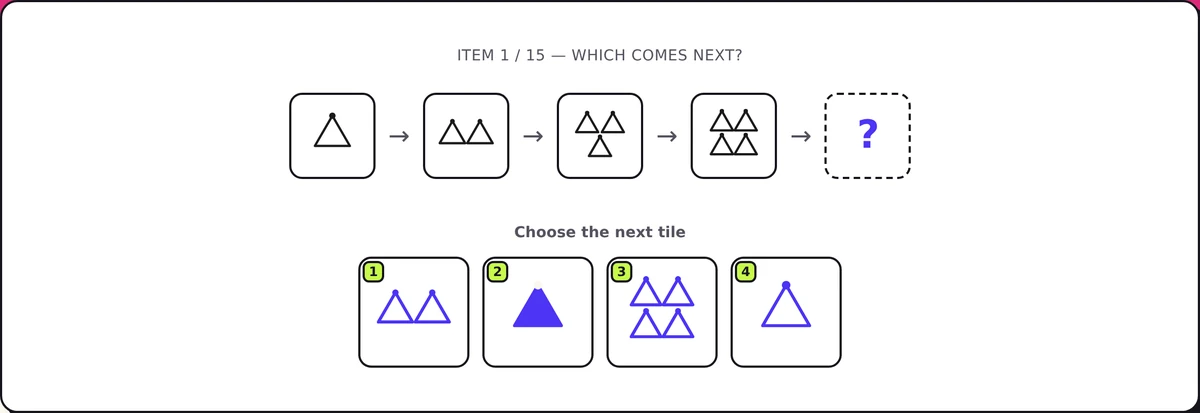
Abstract reasoning. Where a variant includes pattern or sequence items, inductive reasoning is the direct equivalent — spotting the governing rule quickly without over-theorising it.
Every run here is scored server-side against fixed norms and returns a percentile, so one cold pass across these tells you which is your weakest in about twenty minutes. That is where the rest of your time belongs — not in whichever one you enjoy most. Not sure what a percentile means here? How we score sets out the method, and what counts as a good score explains why no employer publishes a threshold.
The Deloitte process and timeline
A common route runs: online application → immersive online assessment → video or on-demand interview → assessment centre or final-stage interviews → offer. Ordering, naming and the number of stages shift by member firm, service line (Audit, Consulting, Tax, Technology) and year.
Expect gaps of one to several weeks between stages, with the longest wait usually before an assessment centre because those run in cohorts. Silence inside the first fortnight is normal batching, not a rejection — and a chasing email does not move you up the queue.
Applying across the Big Four? Our EY, KPMG and PwC guides cover their equivalents, and Accenture is the closest consulting comparison. For the wider landscape, start from the complete guide to game-based assessments.
Mistakes that cost strong candidates
- Meeting the format live. The most expensive and most avoidable error. Seconds spent decoding a task are seconds not spent on it, and no amount of ability recovers them.
- Reading "I ran out of time" as failure. Adaptive tasks are built so you do not finish. Treating that as evidence of disaster leads people to rush and damage the accuracy that actually counts.
- Answering the situational half as a perfect employee. Consistency is measured. A superhuman profile contradicts itself.
- Skipping the values research. For the situational half, twenty minutes on Deloitte's stated purpose and values is genuinely worth more than another hour of maths drills.
- Practising your strongest game. Your result is a profile. The cheapest points are in your weakest area.
- Sitting it on a phone, or with notifications live. Several tasks are timed to the millisecond.
- Submitting at 1 a.m. on the deadline. Working memory and reaction speed are both sleep-sensitive, and that is when the least prepared part of the pool submits.
A 5-day preparation plan
- Day 1: Play all the related games cold and note your percentiles — that is your diagnostic, and it takes about twenty minutes. Guessing at your weak spot without measuring is how people drill the wrong thing.
- Days 2–4: 15–20 minutes daily on your two weakest games only. Short and frequent beats long and occasional; these tasks degrade with fatigue and a tired session teaches bad pacing.
- Day 5: One full simulation — quiet room, the laptop you will actually use, all games back-to-back. Then stop and read Deloitte's values pages for the situational half.
On the day: read every instruction twice — several tasks change rules mid-way — and do not dwell on a botched round. The battery scores you as a whole, not per game.
Shorter runway? The 24-hour prep plan compresses it, and the readiness check shows which games this kind of assessment draws on and where you currently stand on each.
What are Firefly Freedom and the other named modules?
Invitations and candidate reports use names this guide does not: Firefly Freedom is one of the immersive scenarios people describe, and older accounts mention Talegent as a platform Deloitte has used. Names differ by member firm, by year and by programme, and Deloitte does not publish a list — so treat any name you have been given as the authority over any guide, including this one. What does not change is the shape: a scenario you move through, with situational judgement and short numerical and verbal tasks embedded in it.
If your invitation names a module we have not covered, tell us what it said and we will add it.
FAQ
Is there a pass mark for the Deloitte assessment? No published one. Your profile is compared against the role's benchmark, and below it you quietly do not advance. Because the bar is relative to other applicants — most of whom prepare very little — familiarity alone moves you up.
Can I retake the Deloitte online assessment? Within one application cycle, generally no. Documented technical failures are the exception and should be raised with the recruitment team immediately; see the retake guide. Reapplication windows vary by country — check your local careers portal.
Does every Deloitte role use games? No. Experienced-hire routes often go straight to interviews. Game-based screens are concentrated in early-career pipelines — graduate schemes, internships and apprenticeships.
How long does the immersive assessment take? It varies by member firm, but budget an uninterrupted hour rather than squeezing it between other commitments. The cognitive tasks themselves are short; the situational half is what stretches the sitting.
Is the assessment the same in every country? No. Deloitte member firms run their own variants and sometimes their own vendors, so a description from a UK candidate may not match a US or Polish process. Your invitation email is the only authoritative description of what you will sit.
Can I prepare for the situational judgement part? Partly. There is no answer key to learn, but you can read Deloitte's stated values beforehand and think about what good judgement looks like in a client-facing firm — clarify, collaborate, escalate appropriately, take ownership.
Will I see my results? Generally not in any detail. Most candidates receive an advance-or-not outcome rather than a score report.
GamePrep is an independent practice platform, not affiliated with Deloitte or its assessment vendors. Formats vary by country and member firm and change over time — verify against your invitation. We provide practice only — no leaked questions or answers.