Pymetrics Games: All 12 Games Explained (and How to Practice Each)
All 12 pymetrics (now Harver) games explained: what each one measures, which you can actually train, and a free practice game for each trainable one.
Pymetrics — acquired by Harver, but recruiters and candidates still say "the pymetrics games" — is one of the most widely used game-based screens in corporate hiring. Banks, consultancies and consumer companies use it to profile early-career applicants before any interview. The battery takes 25–35 minutes, contains roughly a dozen short games, and measures traits rather than knowledge: memory, attention, speed, risk appetite, planning, fairness.
Two facts shape any smart preparation:
- Results follow you. A pymetrics profile is typically valid across employers for around a year — your first attempt can be the one every application sees. Practice before the first invite.
- Half the battery is skill, half is style. Cognitive games (memory, attention, speed, math) reward training. Trait games (risk, generosity) reward calm consistency, not strategy — they cross-check each other, and gaming them tends to backfire.
Which pymetrics games can you train for?
Keypress / reaction game. Press space as fast as possible on the signal; hold back on decoys. Measures processing speed and impulse control. Free equivalent: the reaction time test. A stable average beats one lucky round.
Digits / memory game. Recall ever-longer digit strings — a textbook span task. Free equivalents: digit span, then backward digit span once forward feels comfortable. Realistic targets in what is a good digit span score.
Arrows / attention game. Flanker-style: identify the middle arrow's direction while its neighbours mislead you. Measures selective attention. Free equivalent: the flanker arrows test.
Math / money exchange tasks. Fast arithmetic judgements. Free equivalent: mental math — ten minutes daily makes the calculations automatic.
Sequence / pattern tasks. Spot the rule, predict the next element, or track positions. Free equivalents: n-back for updating memory, Corsi block for spatial sequences.
Which pymetrics games should you just play straight?
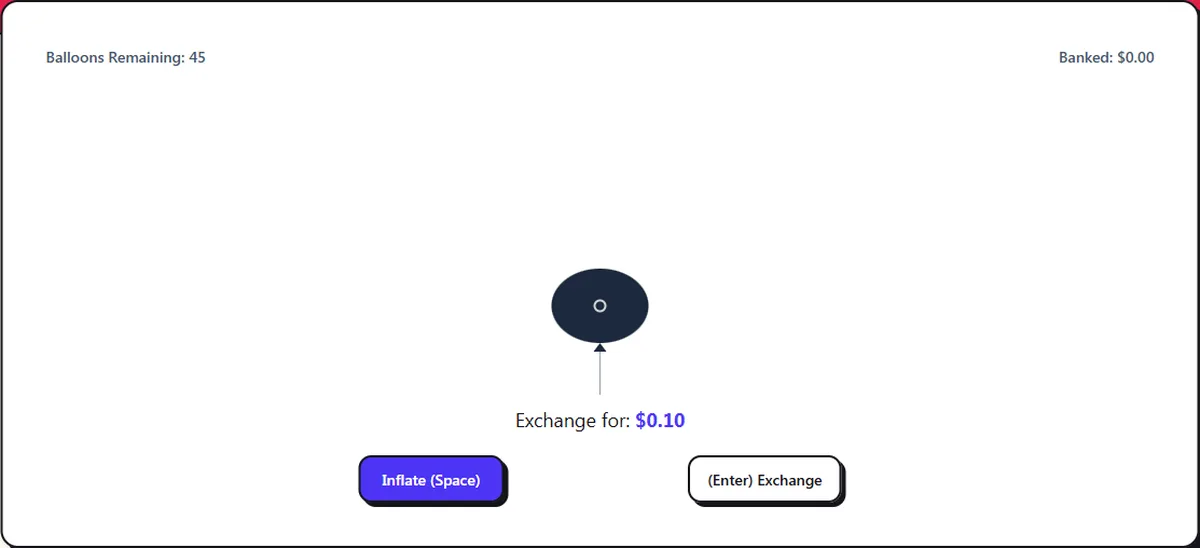
Balloon (risk) game. Pump for money, cash out before it pops. Measures risk calibration. There is no "correct" aggression level — different roles want different profiles, and erratic play reads worse than either cautious or bold play.
Money exchange (trust/fairness) games. Split or return money with a virtual partner. Measures fairness and trust dispositions. Answer as yourself on a professional day.
Tower / planning game. Rearrange discs in minimum moves — planning efficiency. Genuinely trainable, because most of the gain is a habit rather than a capacity: plan the whole sequence before you move. Full breakdown in the tower game guide; drill it with the pathfinder puzzle.
Effort / slider tasks. Choose between easy low-reward and hard high-reward work. Measures effort allocation. Just be consistent.
How is the pymetrics test scored?
No pass/fail screen. Your trait profile is matched against a model for the specific role; matching candidates advance, others quietly do not (full mechanics in can you fail a game assessment). Recruiters see fit summaries, not your clicks.
What preparation actually moves your result?
- Remove unfamiliarity — one cold run of each practice game kills the biggest score leak for free.
- Train the trainable four (speed, span, attention, math) in short daily sessions for 3–7 days.
- Simulate once — all games back-to-back, laptop, quiet room, instructions read twice.
- Sleep before the real thing. Span and reaction scores drop measurably on bad sleep — it is the cheapest performance boost available.
FAQ
Is pymetrics the same thing as Harver? Yes. Harver acquired pymetrics in August 2022 and folded the games into its own platform. The battery is the same; your invitation may carry either name.
How long is the pymetrics battery? Around 25–35 minutes for roughly twelve short games. There is no pause button, so start it when you have a clear half hour.
Can I retake it if I do badly? Not freely. A result is reported to stand for about 330 days and to be shared with every employer on the platform, so a weak attempt follows you rather than disappearing.
Which of the twelve games can I actually practise? The cognitive half — memory span, attention, processing speed and arithmetic. The trait games read disposition and have no score to improve, so playing them differently only makes your profile inconsistent.
GamePrep is an independent practice platform, not affiliated with pymetrics or Harver. Game sets evolve — treat your invitation and its official practice materials as the source of truth. If your invite names Harver rather than pymetrics, Harver vs pymetrics explains why they are now the same company and which modules that leaves you facing.