How to Pass HireVue Game Assessments in 2026 (10 Tips)
Ten evidence-based tips to raise your HireVue game-assessment score — chunking, pacing, setup — plus a free practice game for every skill. No sign-up.
You cannot revise facts for a game-based assessment, but you can absolutely raise your score. These ten tips are the ones that move the needle most — a mix of in-game technique and the boring setup details candidates forget. None of them require special talent; they reward preparation, and preparation is the one variable you fully control. For the full picture of how the battery fits together, start with the complete guide to HireVue game-based assessments.
First, understand what you are being scored on
Before the tips, a quick model of the machine you are trying to beat. Game-based assessments do not grade "right answers" the way a school test does. Your raw performance — how long a sequence you can hold, how fast you react, how accurate you stay under pressure — is converted into trait estimates (working memory, processing speed, attention control, numerical reasoning) and then compared against other applicants for the same role. You are ranked into a percentile, and most games are adaptive: they get harder as you succeed and easier as you slip, homing in on the edge of your ability. Two things follow from that. First, everybody ends most games missing rounds — that is the design, not failure. Second, small, consistent gains in accuracy and pace compound into a meaningfully higher rank. The tips below are built around those two facts.
1. Practise the exact mechanics first
The fastest points come from never being surprised. Play each game — Numerosity, the Stroop test, reaction time and the rest — until you could explain the rules to a friend. New in the room = slow in the room. The first 20–30 seconds of a two-minute game spent decoding instructions is pure score loss, and it is the single most common way strong candidates land below the bar. Practice does not "cheat" the test; it removes the noise so your actual ability shows through.
2. Prioritise accuracy, then speed
Most games punish wrong answers more than slow ones. Get into a rhythm where you are almost always right, then gently push the pace. Reckless speed tanks scores because errors in an adaptive game don't just cost that round — they drag the difficulty down and shrink the ceiling you can reach. A useful mental rule: fast-and-right beats fast-and-wrong, and steady-and-right beats both. Aim for a pace you can sustain at roughly 90%+ accuracy, then nudge it.
3. Chunk numbers and sequences
In memory games like digit span and backward digit span, group digits into pairs or triplets ("phone-number style"). Chunking is the single most effective memory technique and it is fully learnable. Worked example: the sequence 4 9 2 7 1 5 8 is seven separate items — near most people's raw limit — but as 492 · 715 · 8 it is three chunks, well within reach. For visuo-spatial memory like the Corsi block task, chunk by shape of the path instead: see the taps as a route ("up the left side, then a hook right") rather than isolated squares. Calibrate your targets with what a good digit span score is and the Corsi block test explained.
4. Work from the last digit in maths games
In Numerosity and mental arithmetic, the units digit of the target eliminates most candidate pairs instantly. Scan endings first, whole numbers second. Worked example: if the target ends in 3, then a pair summing to it must have units digits that add to 3 or 13 — so …6 + …7 stays in play while …4 + …4 is out, without your ever computing the full sum. For multi-step arithmetic, work left to right (tens first, then units) rather than the right-to-left method you learned in school — it lets you start narrowing the answer before you've finished reading the problem. The mental math speed guide drills this.
5. Look, do not read, in the Stroop test
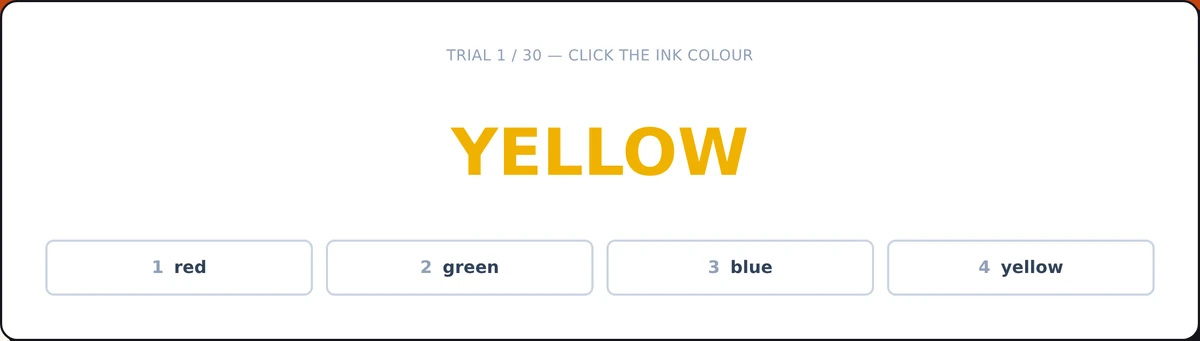
In the Stroop game, respond to the ink colour and actively ignore the word. Softening your focus so the word blurs — almost looking "through" the screen rather than at the letters — helps many people beat the interference. The same "attend to one feature, suppress the obvious one" muscle powers the flanker arrows test, where you answer the centre arrow and treat the flanking arrows as noise. Both are trained interference-control tasks; see the Stroop test explained and the flanker test explained.
6. Keep a steady rhythm
Streaky bursts cause errors. A metronome-like pace — especially in the flanker and disco numbers games — beats sprint-and-stall. When you sprint, your error rate spikes exactly when the game is hardest; when you stall, you leak easy points to hesitation. Find the tempo where responses feel automatic but unhurried and hold it. In continuous-response games like reaction time, resist the urge to anticipate the signal — a jump-the-gun early click is scored as an error, and chasing speed past your real reaction floor just adds them. Check yourself against typical reaction time norms.
7. Do not panic after a mistake
Adaptive games expect errors; one slip is not the end. Chasing a lost point usually costs you the next two. Reset and carry on. This matters most in the n-back memory test, where a single missed match can rattle you into second-guessing the next three — and the second-guessing, not the original miss, is what tanks the run. Treat every new trial as independent. If you feel the spiral starting, take one deliberate breath and re-anchor on the current stimulus. See the n-back test explained for the working-memory logic behind it.
8. Fix your environment
A quiet room, no notifications, a real mouse (not a laptop trackpad for grid games), and a stable connection. These quietly decide close scores. A quick pre-flight checklist:
- Laptop on power, not battery — some machines throttle performance to save power, adding input lag.
- Wired or strong Wi-Fi. A dropped connection mid-game is one of the few things that genuinely warrants asking for a retake, and it is avoidable.
- One screen, one tab. Close everything else; background downloads and video calls steal responsiveness.
- Notifications off — phone on silent and face-down, desktop alerts muted. A single popup at the wrong moment is a missed round.
- A real mouse for grid and spatial games (Corsi blocks, mental rotation, pathfinder) — trackpads cost precision and time.
- Comfortable seat, screen at eye level, decent light. Physical fidgeting is lost milliseconds.
9. Sleep and time your caffeine
Reaction speed and working memory are both sleep-sensitive — more than any last-minute cramming. Take the assessment rested, with caffeine timed to peak during it (your usual dose, roughly 30–45 minutes before you start). Do not attempt a heroic double espresso if you don't normally drink coffee — the jitter costs more than the alertness buys. The all-nighter instinct is exactly backwards here: there are no facts to cram, only a brain to keep sharp.
10. Warm up right before
Play two or three quick games immediately before the real thing to get your hands and attention online. A cold start wastes your fastest early rounds. Warm up on the games you find easiest, not the ones you're worried about — the goal is to be online and confident, not to spook yourself with a hard run minutes before it counts.
Common mistakes that sink strong candidates
Even capable people lose rank to a handful of avoidable errors:
- Treating the real assessment as their first look at the games. You usually get one attempt — spend it on execution, not discovery. See can you fail a HireVue game assessment for how retakes actually work.
- Over-practising their strongest game. Your battery score is a profile; the cheapest points are in your weakest category, not your favourite. Find it and train it.
- Sprinting for speed and eating errors. In an adaptive test, accuracy protects your ceiling. Speed without accuracy lowers it.
- Spiralling after one bad round. Feeling stretched at the end of a game is the design working as intended, not a verdict.
- Ignoring the setup. A trackpad, a notification, or a laptop in power-save mode can quietly cost more points than any technique gains.
Put it into practice
Work these tips on the free games — they all run the way the assessment versions do — and read what a good digit span score is to calibrate your targets. If your assessment is tomorrow, the 24-hour prep plan sequences all of this into an hour-by-hour schedule. And if you want proof it works, read how I passed my HireVue game assessment.
FAQ
Can practising really change my score, or is this just a fixed IQ test?
Practice won't turn you into a different person, but it reliably removes the friction that hides your real ability — unfamiliar mechanics, wasted setup seconds, panic after a mistake. Since most of the applicant pool walks in cold and you are ranked against them, closing that familiarity gap alone moves your percentile. It is legal, expected, and the one lever you fully control.
Should I prioritise speed or accuracy?
Accuracy first, then speed. Most games penalise wrong answers more heavily than slow ones, and in an adaptive game errors also lower the difficulty ceiling you can reach. Settle into a pace you can hold at roughly 90%+ accuracy, then push gently.
How much practice is enough?
Enough that no game surprises you and you have one clear technique per weak category. For most people that's a few focused sessions, not weeks. Diminishing returns set in quickly once the mechanics feel automatic — beyond that, rest and setup matter more than more repetitions.
What if I make an obvious mistake mid-game?
Let it go and play the next round as if it never happened. The games expect errors; chasing a lost point usually costs you two more. One slip rarely decides your result — spiralling after it does.
Do these tips only apply to HireVue?
No. HireVue-style game batteries share mechanics with pymetrics/Harver and Arctic Shores assessments — memory spans, interference control, reaction time, numerical reasoning. The technique and setup advice transfers across all of them.
GamePrep is an independent practice platform and is not affiliated with HireVue or any assessment vendor. We provide practice only — no leaked questions or answers.