Odd One Out (Singularity Game): How to Find the Different Shape Faster
The Singularity game hides one subtly different shape in a grid of identical ones. Why "looking harder" is the wrong strategy, and the visual-search technique that actually speeds you up.
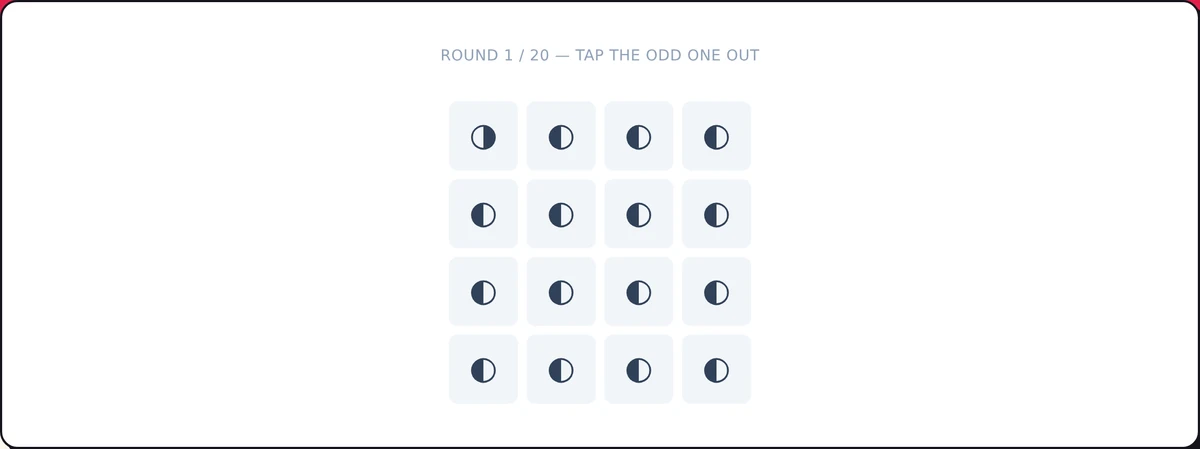
A grid of near-identical shapes appears — triangles, blobs, tiles — and exactly one of them is different: rotated, flipped, or slightly misshapen. Tap it before the timer runs out, then do it again on a busier grid. That is the Singularity game, the visual-search task of HireVue-style batteries.
What the odd-one-out game measures
Selective visual attention and scanning efficiency — how quickly your visual system rejects "same" and locks onto "different". It predicts performance in quality control, monitoring, proofreading and other detail-heavy work, which is why assessment vendors are fond of it. Scoring combines speed (time to find the odd shape) with accuracy (wrong taps are punished hard), across rounds that grow larger and subtler.
Pop-out vs searching: the two modes
Vision research splits these puzzles into two regimes, and knowing which one you are in decides your strategy:
- Pop-out. When the difference is strong (a reversed triangle among upright ones), your visual system finds it pre-attentively — the odd item jumps out in a fixed ~quarter-second regardless of grid size. You do not search; you receive.
- Serial search. When the difference is subtle (a slightly thinner blob), nothing pops, and you must scan item by item. Time now grows with every extra shape on the grid.
The game's early rounds are pop-out; the later, high-scoring rounds slide toward serial search. Most candidates lose their points in the transition, because they keep using the wrong mode.
Strategy: soften first, scan second
- Start every round with a soft gaze. Defocus slightly and take in the whole grid for a beat. If the odd shape pops, tap it — fastest possible answer, no scanning. Staring hard at individual shapes disables pop-out.
- If nothing pops, switch to an S-path. Sweep the grid in a fixed serpentine — left-to-right, drop a row, right-to-left. A systematic path visits every shape once; random darting revisits some and misses others, and misses are catastrophic when only one item is odd.
- Compare neighbours, not memories. Judging each shape against the one beside it is faster and more reliable than judging it against your mental template of "the normal one".
- Commit to your first candidate. On odd-one-out tasks, first impressions are right far more often than deliberation — second-guessing is usually slower and less accurate. One clean look, tap, move on.
- Mind fatigue on long grids. Visual search degrades quickly with tired eyes. Blink, and let the soft-gaze reset between rounds do double duty as a micro-rest.
Sister skills in the battery
Singularity's "ignore the identical noise" demand is the visual twin of the flanker test's response-conflict control, and its shape judgements warm up the same machinery as mental rotation — batteries frequently include two of the three. The complete guide maps the whole spatial/attention block.
Practise the two modes
Play the free Singularity odd-one-out game and pay attention to which rounds pop and which force a scan — once you feel the difference, the mode switch becomes automatic, and your percentile follows.
Where you'll meet this game
Visual-search tasks like Singularity turn up in several employers' game batteries. If you're preparing for a specific process, KPMG's online assessment includes attention-and-scanning games of this type, and Arctic Shores' assessment builds its profile from tasks that probe the same selective-attention skill. Both guides show where it fits their process.
What do people actually score?
First attempts here land at a median of 77 out of 100, with the strongest tenth at 87, across 38 players.
FAQ
Why does looking harder make me slower? Because staring narrows your field of view. Visual search rewards a broad sweep that lets the difference pop out, not a careful item-by-item inspection.
Is there a pattern to where the odd one hides? No usable one. Positions are randomised, and hunting for a pattern costs the seconds you would otherwise spend scanning.
What happens if I guess? Wrong answers cost more than a slow correct one in most scoring models, so guessing to save time usually backfires.