Rolls-Royce Assessment: cut-e Aptitude Tests & How to Practice
Rolls-Royce screens engineering and graduate applicants with cut-e (Aon) aptitude tests — numerical and mechanical reasoning under tight timers. Here's what they measure and how to build the speed to pass.
Are you actually ready for this one?
See where you stand overall and which game to fix first — free, no sign-up.
Want this whole assessment as one timed run, one attempt per game? We're deciding whether to build it — get early access.
TL;DR: Rolls-Royce uses cut-e (now Aon) aptitude tests for its graduate, apprentice, and internship programmes, typically covering numerical reasoning and, for engineering routes, mechanical or spatial reasoning. These are timed, adaptive tests where speed and accuracy both count. You can't rehearse the exact items, but you can train number sense, mental arithmetic, and spatial rotation so the clock stops being your enemy.
If you've applied to a Rolls-Royce degree apprenticeship, graduate scheme, or summer placement, the cut-e online tests usually follow shortly after your application is accepted. Rolls-Royce recruits heavily for engineering, so expect an aptitude battery weighted toward numerical and technical reasoning. The cut-e format is distinctive: short, sharp, and adaptive, with question difficulty adjusting to your performance. Exact steps vary by programme and region, and Rolls-Royce tweaks its process each cycle — always trust the instructions in your invitation over any general guide, including this one.
What the assessment looks like
cut-e tests are unusual in style. The numerical test ("scales numerical") presents data and asks whether a statement is true, false, or can't be determined — under a very tight per-question timer. The mechanical or spatial tests use diagrams, gears, shapes, and rotations rather than words. Because the tests are adaptive, you rarely see the same question twice and there's little value in memorising items. What helps is being fast and accurate at the underlying operations so you're not burning your time budget on basic calculation or slow mental rotation. GamePrep trains those cognitive foundations — the reasoning skills — not any specific cut-e question.
The skills you can train
Number sense lets you read a data table and immediately gauge which figures matter. Numerosity sharpens your instinct for quantity and comparison, so in cut-e's true/false/can't-tell numerical items you spend your seconds reasoning rather than deciphering.
Mental arithmetic is the core of the numerical test. Mental math drills the percentages, ratios, and quick calculations that cut-e leans on, making the maths automatic so you can keep pace with the timer instead of racing it.
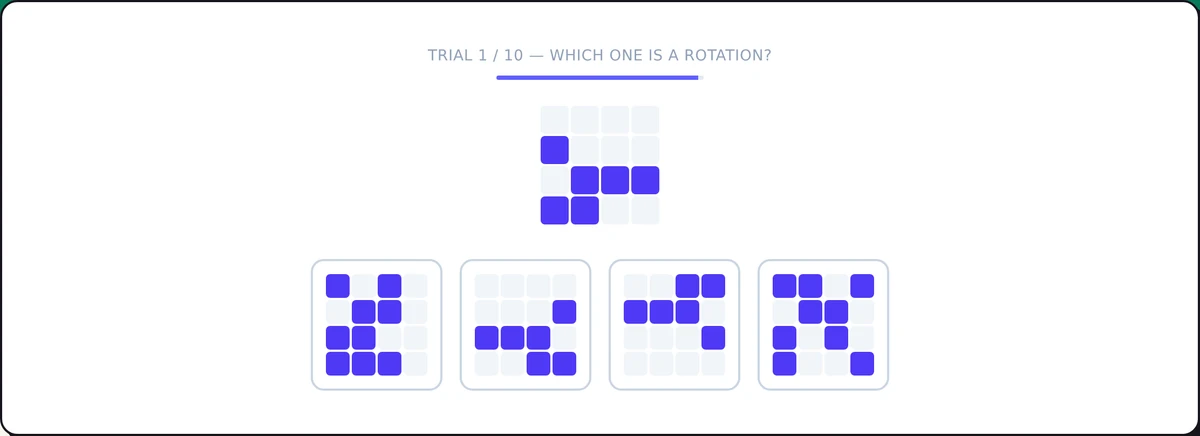
Mental rotation matters for engineering-route spatial tests. ShapeDance trains you to rotate shapes in your head and judge whether two forms match, which is exactly the skill cut-e's spatial and mechanical diagrams demand.
Selective attention keeps you accurate when tests are dense and fast. The flanker arrows test rehearses locking onto the right signal and ignoring distractors, so careless errors don't creep in when the pressure builds.
The Rolls-Royce process & timeline
A typical path runs: online application, the cut-e aptitude tests, a video or telephone interview, then an assessment centre with technical exercises, group tasks, and a final interview. Engineering programmes often add a technical or motivational questionnaire. Turnaround varies but usually spans one to three weeks between stages. The aptitude tests are your clearest opportunity to bank points through preparation, since raw reasoning speed is genuinely trainable. For broader context on gamified and aptitude-based hiring, read our pillar guide on HireVue game-based assessments, and for provider detail see our cut-e / Aon assessment guide.
How to prepare in 3 days
Day one: play each of the four games once and note where you lose time — usually either arithmetic speed or mental rotation. Day two: hammer your weak area for 20 minutes, then run a mixed set to hold accuracy under pressure. Day three: one light round of each, then rest — a fresh mind beats a crammed one on adaptive tests. Before you sit the real thing, set up somewhere quiet with a reliable connection, a charged device, scrap paper, and a basic calculator (cut-e numerical tests usually permit one — check your instructions). Read each question fully; the true/false/can't-tell format punishes skim-reading harder than slow answers.
FAQ
Can I use a calculator on the Rolls-Royce numerical test? cut-e numerical tests generally allow a basic calculator, but confirm in your invitation. Even with one, mental-arithmetic speed still helps — you won't have time to calculate every step by hand.
What's the mechanical reasoning test like? For engineering routes, expect diagram-based questions on gears, levers, forces, and shape rotation rather than word problems. Practising mental rotation and spatial reasoning builds the right instincts.
Are the cut-e tests adaptive? Yes — difficulty adjusts to your performance, so questions get harder as you succeed. Don't panic when they do; that's a sign you're doing well. Focus on steady accuracy, not a flawless run.
GamePrep is an independent practice platform and is not affiliated with Rolls-Royce. We provide practice only — no leaked questions or answers. Hiring processes change — verify against your invitation.