cut-e / Aon Assessment Solutions: The Adaptive Ability Tests & How to Practice
cut-e is now Aon's Assessment Solutions, best known for very short adaptive ability tests like scales and switch. Here is how each test type works, why timing is brutal, and free practice for the cognitive skills.
cut-e — now branded as Aon's Assessment Solutions after Aon acquired it — is the go-to publisher for employers who want extremely short, tightly timed online ability tests. You will meet it across aviation, engineering, finance, retail and graduate schemes, often as the very first sift. The hallmark is the "scales" family of adaptive tests: bite-sized modules like scales numerical, scales verbal, scales cognitive (deductive/inductive) and the well-known switch task, each usually lasting only a handful of minutes. Because they are adaptive, the questions get harder as you get them right, and the tests are calibrated so almost nobody finishes every item — the design assumes time pressure. Unlike some vendors, cut-e/Aon leans heavily cognitive rather than behavioural, so most of what you face here is genuinely trainable ability, which is good news for anyone willing to prepare.
The cognitive tasks — train these
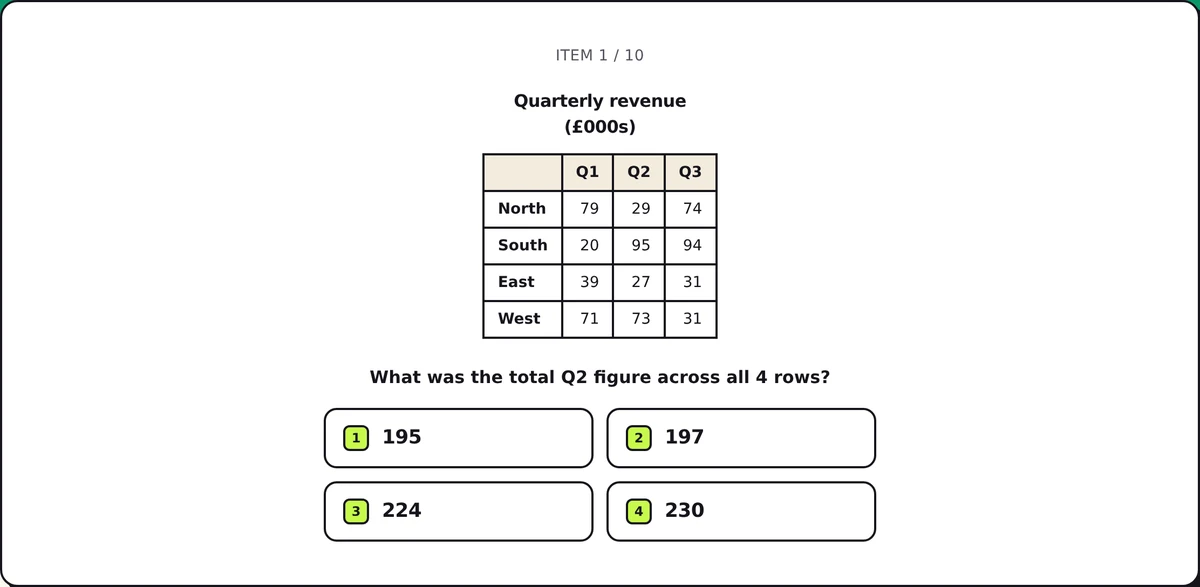
Numerical ability (scales numerical). Short, sharp numerical items using tables and figures under severe time limits. The winning skill is fast, accurate calculation with zero hesitation. Free equivalent: mental math.
Number estimation and combining. Some numerical work rewards estimating and combining values quickly to judge an answer rather than computing every digit — useful when the clock is unforgiving. Free equivalent: numerosity.
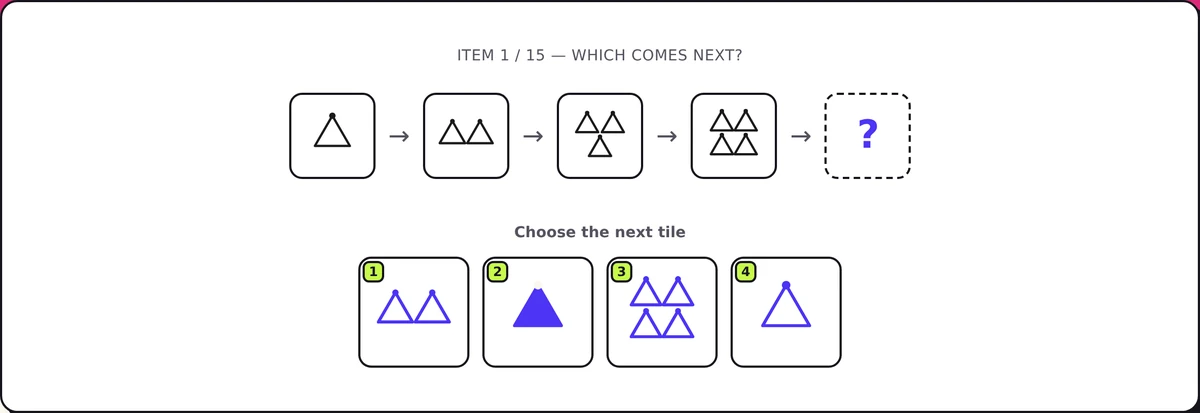
Logical reasoning (switchChallenge). Despite the name, this is not a task-switching test: abstract symbols pass through an operator and change, and you identify which operator explains the transformation. Aon classes it as logical reasoning. Free equivalent: inductive reasoning. Full breakdown in the switchChallenge guide.
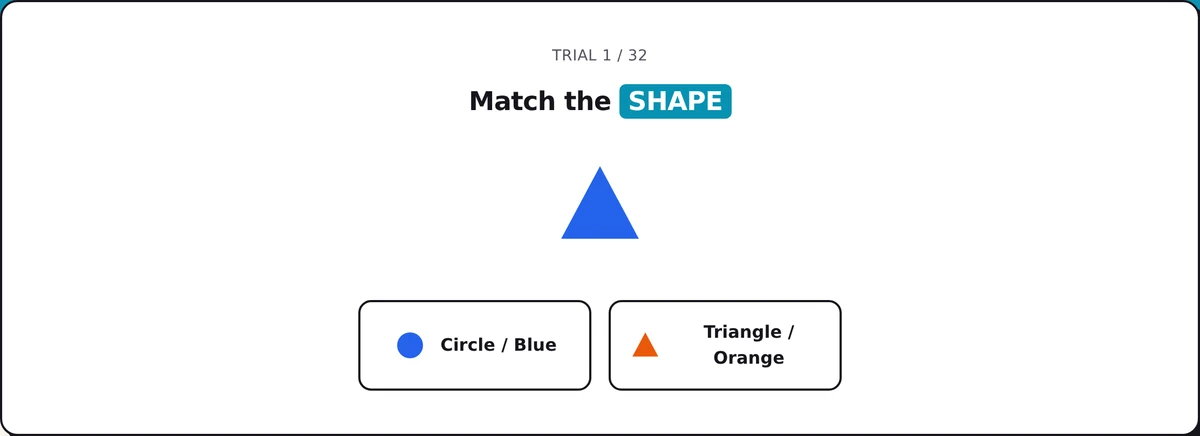
Attention and inhibition. Separately, Aon's batteries do reward staying accurate while distractors pull at you. Free equivalents: flanker arrows and the task-switching test — useful supporting work, but not a clone of switchChallenge.
Working memory (grid-style). Patterns appear on a grid, vanish, and you reproduce them — harder every round, sometimes with an interfering task in between. See the grid challenge guide; free equivalent: Corsi block visual memory.
Working memory under load. Adaptive cognitive items increasingly ask you to hold and manipulate information in your head; a backward-span drill trains exactly that reversal-and-hold demand. Free equivalent: backward digit span.
Try each once, then pour your practice into the two slowest.
The ability scales and adaptive timing — what to expect
Because cut-e/Aon is almost purely cognitive, there is no big personality element to "play straight" — the challenge is the adaptive engine and the clock. Each scales module targets a narrow ability and adjusts difficulty item by item, so a run of correct answers quickly pushes you into harder territory that counts for more. The tests are engineered so that finishing everything is not expected; your job is to balance speed and accuracy, not to race blindly. Do not panic at unfinished items — that is normal and built into the scoring. The two levers you control are how fast you can compute and how cleanly you avoid careless errors, and both improve with practice.
How scoring works
Aon's scales tests are norm-referenced and adaptive: your score reflects the difficulty of the items you answered correctly, benchmarked against a comparison group, and comes out as a percentile rather than a raw right/wrong count. Getting harder questions right lifts you more than plowing through easy ones. There is no fixed universal pass mark — each employer sets its own threshold for each module. For a fuller take on what "failing" means, see can you fail a game assessment.
How to prepare
- Run each cognitive game above once so the short, fast format stops rattling you.
- Across 3-7 days, drill your two weakest modules in brief daily sprints — cut-e's speed demand rewards little-and-often practice.
- Rehearse a steady rhythm: quick but not reckless, since accuracy is weighted by difficulty.
- Do one timed simulation so the ticking clock feels routine, not alarming.
- Sleep well beforehand — under severe time pressure, tired mistakes are costly.
For context on the wider landscape, see the game-based assessment pillar; the SHL guide covers another adaptive cognitive publisher.
FAQ
Can I retake a cut-e / Aon test? Typically one attempt per application, though employers sometimes reuse a recent valid result or allow a retest later. Practising the underlying skills in advance is always permitted.
Is cut-e the same at every employer? The scales modules are standardised, but each employer selects which tests to use, the norm group and the pass threshold, so the effective bar differs. Read every invitation on its own terms.
Can you really practise for it? Yes — cut-e/Aon is heavily cognitive, and numerical, attention and working-memory tasks all improve with a few focused days. The gains come from faster, cleaner computation, not from any shortcut.
GamePrep is an independent practice platform and is not affiliated with cut-e or Aon. Assessment formats evolve — treat your invitation and the official practice materials as the source of truth. We provide practice only — no leaked questions or answers.