Cappfinity Assessments: Strengths, Situational and Cognitive Tasks Explained
Cappfinity built its name on strengths-based assessment, blended with situational judgement and numerical and verbal reasoning. Here is how each part works and free practice for the cognitive tasks.
Cappfinity (formerly Capp / Capp & Co) is best known for pioneering strengths-based assessment — an approach that asks what energises you and what you naturally do well, rather than only what you can do. You will encounter it across graduate schemes, professional-services firms, retail and public-sector employers, frequently blended with situational judgement tests and cognitive modules covering numerical and verbal reasoning. A Cappfinity assessment can therefore feel more varied than a pure ability test: one moment you are weighing realistic work scenarios, the next you are doing timed calculations. Two framing points. The strengths and situational components are about authenticity — they profile your natural style and judgement, so honesty travels further than tactics. The cognitive numerical and verbal parts, though, are ordinary trainable ability, and those are where a few days of practice pays off.
The cognitive tasks — train these
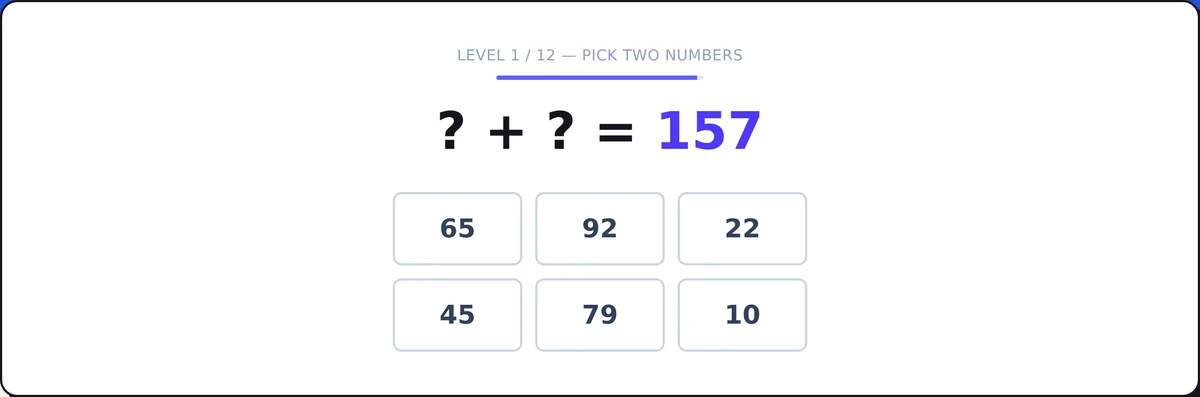
Numerical reasoning. Cappfinity numerical items ask you to interpret figures and calculate under time limits. The skill that shifts your result is fast, dependable arithmetic without second-guessing. Free equivalent: mental math.
Number estimation and combining. Some numerical work rewards estimating and combining values to reach a target quickly rather than labouring over exact figures. Free equivalent: numerosity.
Processing speed. Timed elements reward quick, controlled responses — moving fast while keeping your accuracy up and resisting rushed errors. Free equivalent: reaction time.
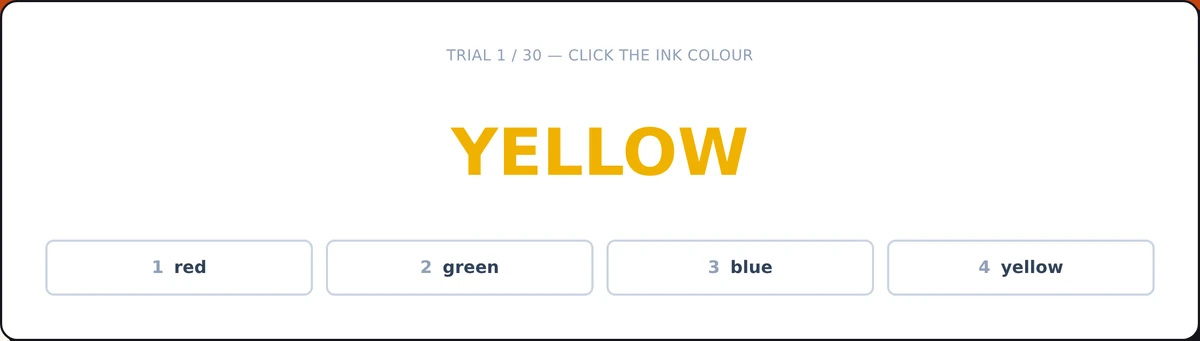
Attention control. Tasks that make you override an automatic response and choose the correct one train the focus that timed testing demands. Free equivalent: Stroop test.
Take each for one cold run, then concentrate on the two that feel slowest.
The strengths and situational side — play it straight
Cappfinity's signature strengths questions ask which activities energise or drain you and how you prefer to work. There is no universally "right" strength, and trying to reverse-engineer the employer's ideal profile usually produces a flat, inconsistent picture — strengths assessments are built to detect enthusiasm and authenticity, which are hard to fake convincingly at speed. Answer genuinely and at a natural pace. On situational judgement items, respond as the reliable, considerate colleague you would want beside you, and keep your choices consistent across similar scenarios. The honest version of you is both easier to sustain across the whole assessment and more likely to land you in a role that actually suits you.
How scoring works
Cappfinity does not produce a simple pass or fail. Strengths and situational responses build a profile matched against what the role calls for, while numerical and verbal modules are norm-referenced — your performance is expressed as a percentile against a comparison group. Some strengths formats also weight how quickly and consistently you respond. Because the target profile and cognitive cut-offs are set per role and employer, the same answers can clear one bar and not another. For more on what "failing" really means, see can you fail a game assessment.
How to prepare
- Do one relaxed run of each cognitive game above so the timed format is familiar.
- Over 3-7 days, practise your two weakest cognitive tasks in short daily blocks.
- Reflect honestly beforehand on your genuine strengths and working style, so the strengths section flows naturally rather than feeling like a guess.
- Run one full timed simulation to settle your pacing across the mixed format.
- Sleep well the night before — tired minds are slower and more error-prone under time pressure.
For neighbouring formats, see the SHL guide and the broader game-based assessment pillar; the Unilever game assessment guide shows how one employer combines styles and ability.
FAQ
Can I retake a Cappfinity assessment? Usually one attempt per application, though some employers allow a retest after a period. Practising the cognitive skills and reflecting on your strengths in advance is always fine.
Is Cappfinity the same at every employer? The building blocks are standardised, but each employer chooses which components to include, the target strengths profile and the cognitive thresholds — so the experience and the bar differ by role. Read each invitation freshly.
Can you really practise for it? For the numerical and verbal cognitive parts, yes — they improve with a few focused days. For the strengths and situational side, "practice" means knowing yourself and answering honestly and consistently, not engineering a persona.
GamePrep is an independent practice platform and is not affiliated with Cappfinity. Assessment formats evolve — treat your invitation and the official practice materials as the source of truth. We provide practice only — no leaked questions or answers.