Mental Rotation (Shapedance): How to Beat the Decoys
How the Shapedance mental-rotation game works, the rotation-versus-mirror trick that kills decoys, and why spatial reasoning is so trainable.
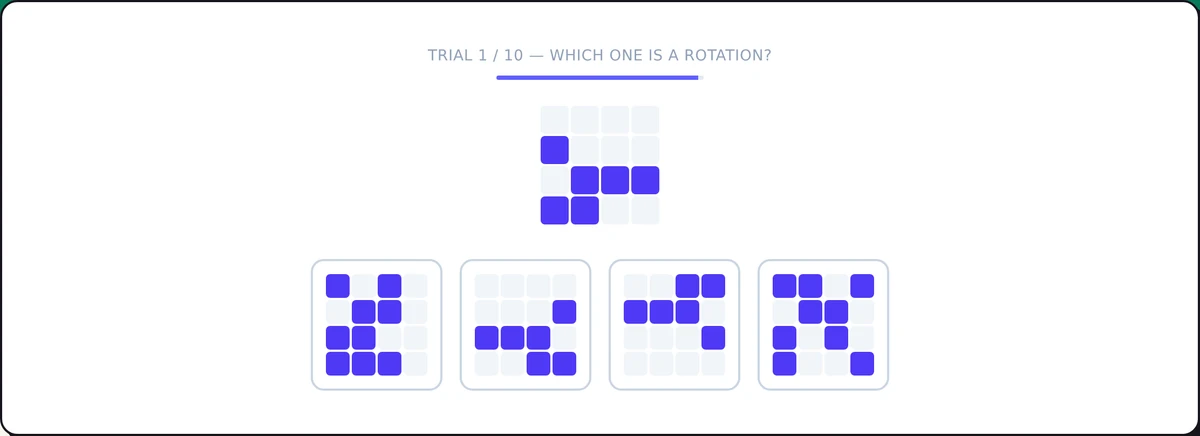
Shapedance is a mental-rotation game: you see a target shape and several candidates, and you pick the one that is the same shape simply turned to a new angle, while rejecting lookalikes that are secretly mirror images. It measures spatial reasoning — a strong predictor for technical, engineering, and logistics roles — and, unlike many aptitudes, it responds fast to practice.
Mental rotation is the core of HireVue's Shapedance game. You are shown a reference figure and asked, under a tight timer, which of the options is that figure "rotated" rather than "flipped". Practise a faithful version on the mental rotation game.
What each round looks like
A typical round shows one target shape and three to five candidates. Usually exactly one is a genuine rotation of the target; the rest are mirror images or subtly different shapes. Some versions turn the figures in the flat plane only (2D rotation); harder versions tumble them in depth (3D), so a face that pointed toward you now points away. You commonly get 10 to 20 seconds per item, and difficulty ramps as you go — more candidates, larger rotation angles, and 3D depth cues that make mirrors harder to spot.
Why it is hard
Telling a rotation from a reflection is exactly the skill being measured, and it is genuinely counter-intuitive under pressure. Mirror decoys share every feature with the correct answer — the same number of arms, the same corners, the same overall silhouette — they are just flipped. Your brain wants to match on silhouette, and the silhouette lies. The larger the rotation angle, the longer your mind takes to "turn" the shape, which is precisely why the timer bites.
The trick that kills decoys
Do not rotate the whole shape in your head — it is slow and it is what the test is stress-testing. Instead pick one distinctive feature — a hook, an L-corner, a notch — and check its curl or handedness:
- A rotation preserves the direction of the curl (clockwise stays clockwise).
- A mirror image flips it (clockwise becomes anticlockwise).
Checking one feature's handedness is far faster than rotating the whole figure, and it eliminates most wrong answers instantly.
Worked example
Say the target is an arrow-like shape whose tail bends up and to the right, with a small notch on the left edge. Scan the candidates for that same notch, then read only the tail:
- Candidate A: tail bends up-and-right, notch on the left — same handedness, so it is a rotation. Likely correct.
- Candidate B: tail bends up-and-left, notch on the right — the handedness flipped. That is a mirror. Reject.
- Candidate C: same handedness but the notch is missing — different shape entirely. Reject.
You never mentally rotated anything. You read one feature's direction and eliminated two decoys in seconds.
How to improve
- Play twice to learn the format, then start timing yourself. First exposure removes the "what am I even looking at" tax.
- Anchor on one feature every round instead of the whole shape — build the habit until it is automatic.
- Say "same-handed or flipped?" in your head. Naming the check keeps you from drifting back to slow whole-shape rotation.
- Push pace only once accuracy is solid. Speed built on guessing does not transfer to the real assessment.
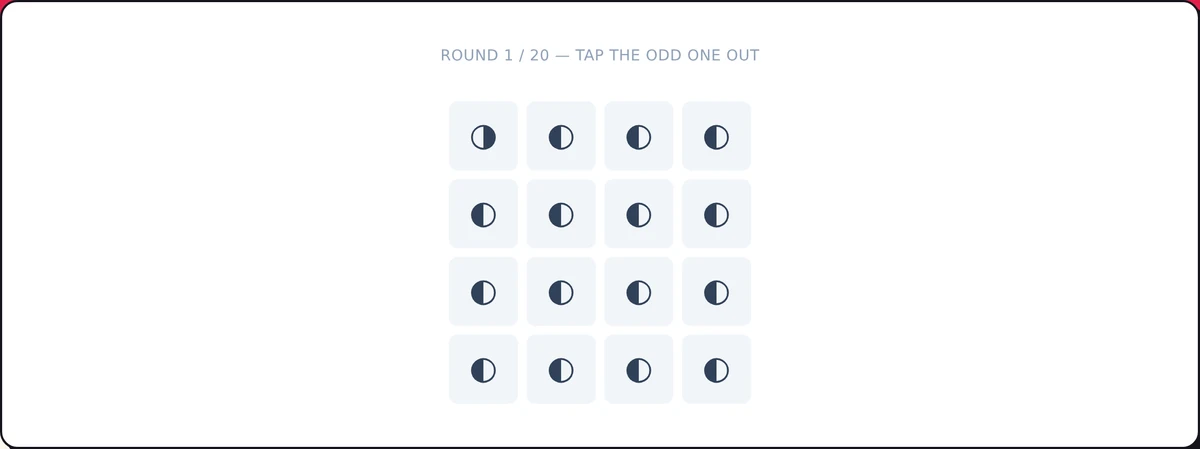
- Round out your spatial prep with the odd-one-out visual search and the Pathfinder path puzzle, which train the same rapid-scanning muscle from different angles.
Common mistakes
- Matching on silhouette. The overall outline is identical for a mirror image. It tells you nothing — read a directional feature instead.
- Rotating the entire shape. It works, but it is slow, and slow loses on a timer. Handedness is the shortcut.
- Second-guessing after a run of "mirrors". The correct answer being a mirror-looking layout does not make it wrong. Trust the handedness check, not a feeling that you are "due" a different answer.
- Ignoring the tutorial round. Use it to confirm whether the game rotates in 2D or tumbles in 3D — your feature-reading changes when depth is involved.
Good news: it is trainable
Mental rotation is one of the most trainable spatial skills. Regular practice — and, in published studies, even action video games — measurably improves both speed and accuracy within weeks. That is unusually good news for candidates: a few focused sessions genuinely move your score, in a way that cramming rarely does for other traits. Most people who practise a handful of times walk in noticeably faster at telling a turn from a flip.
Spatial reasoning turns up again in route-planning tasks, where you hold a shape and a sequence at once — the pathfinder puzzle guide covers that variant.
What do people actually score?
First attempts here reach a median of 5 rotations spotted, with the strongest tenth at 10, across 52 players. The median gain between first run and best is 35 percentiles — second only to the Stroop task, and a sign that this one rewards familiarity heavily.
FAQ
Is Shapedance the same as the HireVue mental-rotation game? It is an independent practice clone built to mirror the same mechanic — pick the rotated shape, reject the mirror — so the format feels familiar on test day. It is not the employer's actual test and contains no real questions.
Does mental rotation actually predict job performance? For spatial and technical roles — engineering, logistics, skilled trades, some analytical jobs — spatial reasoning is a reasonably strong predictor. For roles with little spatial component, the link is weaker, which is one reason employers usually pair it with other games.
How many rounds should I practise before a real assessment? There is no magic number, but because the skill is so trainable, several short sessions across a week typically beat one long cram. Stop each session while you are still accurate rather than grinding until you are guessing.
Is 2D or 3D rotation harder? 3D is harder for most people, because depth rotation hides features on the far side of the shape. The handedness trick still works — just anchor on a feature you can still see after the turn.
Can I improve if I have always been "bad at spatial stuff"? Yes. Self-rated spatial ability is a poor guide to how much you can improve. Speed and accuracy on rotation tasks rise with practice for almost everyone, regardless of starting point.
GamePrep is an independent practice platform, not affiliated with HireVue or any assessment vendor. We provide practice only — no leaked questions or answers.
See the complete assessment guide for how spatial games fit the wider profile.