P&G PEAK Assessment: What It Measures & How to Practice the Games
Preparing for Procter & Gamble's PEAK Performance Assessment for an internship or full-time role? Here is what P&G's own online assessment measures and the cognitive skills you can sharpen beforehand.
Are you actually ready for this one?
See where you stand overall and which game to fix first — free, no sign-up.
Want this whole assessment as one timed run, one attempt per game? We're deciding whether to build it — get early access.
Procter & Gamble asks internship and full-time early-career applicants to complete its PEAK Performance Assessment after the initial application. Unlike firms that outsource to Aon or pymetrics, P&G uses its own online assessment, so the experience is P&G-specific: a blend of situational judgement tied to its leadership principles and cognitive/reasoning components. Whether you sit every part, and exactly when in the funnel, depends on the function (Brand, Finance, Supply Network, R&D, Sales), the programme and your region. Read this as a general guide — P&G refines PEAK over time, and exact steps vary by role and location, so always follow the instructions in your own invitation email.
What the assessment looks like
PEAK combines two threads. The situational side presents realistic work scenarios and asks how you would respond, mapping your choices against P&G's expectations around leadership, ownership and collaboration. The cognitive side tests reasoning under time pressure — numerical, figural/abstract and logical items with tight limits that reward quick, accurate thinking. It is designed to predict on-the-job performance, not to check what you already know about P&G's products.
Two consequences follow. You cannot memorise the answers — the situational items have no single "correct" key, and the cognitive items are generated fresh — but you can train the reasoning skills so the timed sections feel manageable rather than frantic. And PEAK does not show you a pass mark; your results are benchmarked, which is why the outcome feels less transparent than an exam grade. If that uncertainty gets to you, can you fail a game assessment offers a steadier perspective.
The games that decide most, and how to train them
Mental math and numerical fluency is the backbone of PEAK's numerical items. Fast, accurate arithmetic — percentages, ratios, quick calculations under a timer — is what lets you finish sections instead of stalling on the clock. Drill it at /practice/mental-math-numerical.
Numerosity trains rapid number sense: combining and estimating quantities against a target at speed. That intuition makes data-and-figure questions feel less like a scramble. Practise at /practice/numerosity.
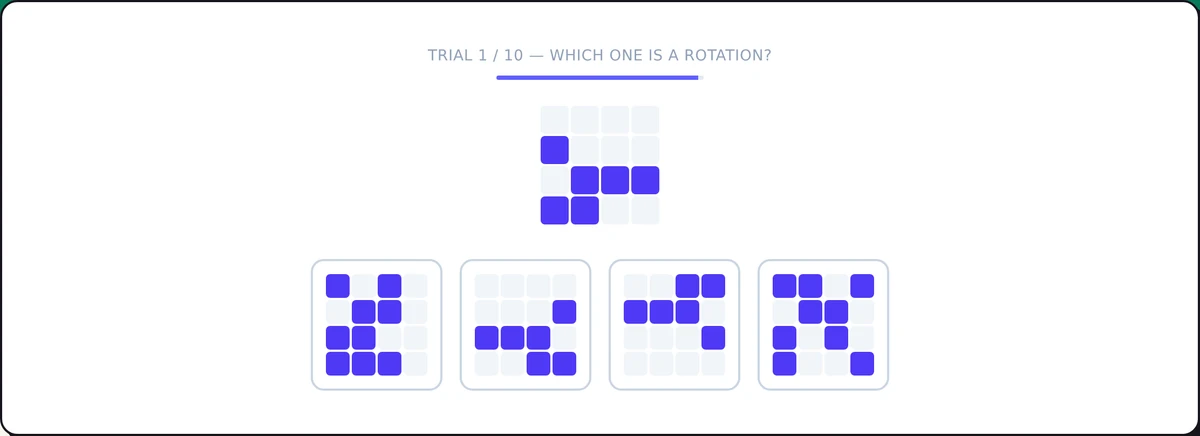
Mental rotation (ShapeDance) covers the figural and abstract-reasoning items — rotating and matching shapes in your head quickly. It is a trainable reflex that pays off directly on pattern questions. Build it at /practice/shapedance-mental-rotation.
The flanker "arrows" test sharpens selective attention — responding to the relevant signal and tuning out distractors. That focus keeps careless errors low when you are working at pace. Try it at /practice/flanker-arrows-test.
Working memory (the grid challenge). Some candidates report a grid-based memory task in P&G's online assessment — patterns light up, disappear, and you reproduce them, harder each round. It is one of the most trainable things in any battery once you stop memorising cell by cell and start chunking shapes. The grid challenge guide covers the strategy; practise the mechanic at /practice/visual-memory-corsi-block.
The P&G process and timeline
A common P&G path runs: online application, then the PEAK Performance Assessment, then an on-demand or live interview built around P&G's behavioural questions, and finally a final interview and offer decision. Function and region shift the order and the exact stages. Because PEAK is P&G's own assessment rather than a vendor product, there is no single third-party vendor guide to lean on — instead, ground your reasoning practice with the complete guide to HireVue game-based assessments and, if a video stage appears, the HireVue games explained guide. For a nearby consumer-goods employer, our Nestlé walkthrough pairs well; for the situational-judgement style more broadly, the Unilever game assessment guide is a useful comparison.
How to prepare in 3 days
Sort a quiet room, a device you trust and a steady connection before anything else. Day one: take a cold run at mental math and numerosity with no warm-up, and mark exactly where accuracy dips or time runs out — that is your target. Day two: work that weakness in short, focused sets; if numerical fluency is the gap, do timed arithmetic blocks with breaks, and add a few flanker rounds to keep your attention crisp. Day three: complete one calm full pass across all four games, then stop and rest well. For the situational parts, read up on P&G's leadership principles so your answers ring true, and go in fresh — a clear head reads scenarios far better than a fried one.
FAQ
Is the PEAK assessment the same for every P&G role? No. Brand, Finance, Supply Network and other functions can weight the situational and cognitive parts differently. Your invitation email specifies what you will actually sit.
Can you fail the P&G PEAK assessment? There is no published pass mark — results are benchmarked. Strong, accurate cognitive performance and situational answers that align genuinely with P&G's principles both help; the aim is a coherent, honest showing, not a gamed one.
Are these the exact P&G games? No. These are independent practice versions that train the same underlying reasoning and attention skills, not copies of PEAK's live content.
GamePrep is an independent practice platform and is not affiliated with Procter & Gamble or the PEAK Performance Assessment. Hiring processes change — verify details against your assessment invitation. We provide practice only — no leaked questions or answers.