Nestlé Game Assessment 2026: The Tests, the Stages + Free Practice
Sitting a Nestlé online assessment for a graduate programme, internship or Nestlé Needs YOUth role? What each module measures, how the stages differ by function and market, the mistakes that cost candidates, and free practice for every skill involved.
Are you actually ready for this one?
See where you stand overall and which game to fix first — free, no sign-up.
Want this whole assessment as one timed run, one attempt per game? We're deciding whether to build it — get early access.
Nestlé invites graduate-programme, internship and apprenticeship applicants — including routes under its Nestlé Needs YOUth initiative — to an online assessment. Some routes, notably the Nesternship programme, use C-Factor, a gamified business simulation rather than a cognitive battery — see the Nestlé C-Factor guide if your invitation names it. Others go through once the application clears the first screen. Nestlé has used Aon's cut-e ability tests alongside its own gamified and situational stages, so the exact mix depends on the function (Marketing, Supply Chain, Finance, Technical), the market you are applying in, and the year's design.
Take this as a general orientation rather than a fixed timetable. Nestlé's steps and time limits vary by programme and region and the process changes over time — always trust the instructions in your own invitation email.
What the assessment looks like
Expect two threads running together.
The cut-e ability portion is a set of short, separately timed adaptive tests — numerical, logical/inductive, sometimes a checking or verbal module — each on a tight per-question timer that rewards fast, accurate reasoning.
Gamified and situational elements sit around it: interactive tasks and work-scenario judgements that read how you decide, prioritise and respond, rather than what you have memorised about the company.
Because these tools measure aptitude and behaviour instead of knowledge, two things follow. You cannot revise the answers — the gamified and situational parts have no key to learn — but you can train the underlying skills so your speed, memory and attention hold up under pressure. And you generally will not see a pass mark; results are benchmarked against other candidates, which is why the outcome feels opaque. If that unsettles you, can you fail a game assessment puts it in proportion and what counts as a good score explains why no threshold is published.
One thing worth knowing before you start: cut-e's ability tests are built so that almost nobody finishes them. Running out of items is the normal experience, not evidence you did badly — the cut-e / Aon guide explains the adaptive mechanics in full, and it is worth five minutes of your time before you sit down.
What Nestlé is actually screening for
Different from a consultancy, and it shapes how to approach the situational parts.
Nestlé is a consumer-goods business running long, complex supply chains across many markets. The behaviours that matter are reliability, care with detail, and working across functions and cultures rather than individual brilliance. On situational items, the answers that score well tend to involve consulting the people affected, respecting a process that exists for a reason, and flagging problems early rather than heroically fixing them alone.
Its early-careers positioning matters too. Nestlé Needs YOUth exists to open routes to candidates without conventional backgrounds, which is part of why the assessment sits so early in the funnel — it is meant to let the assessment speak before the CV does. Practically: this stage is genuinely winnable regardless of your university or grades, and it is worth preparing for accordingly.
The skills that decide most, and how to train them
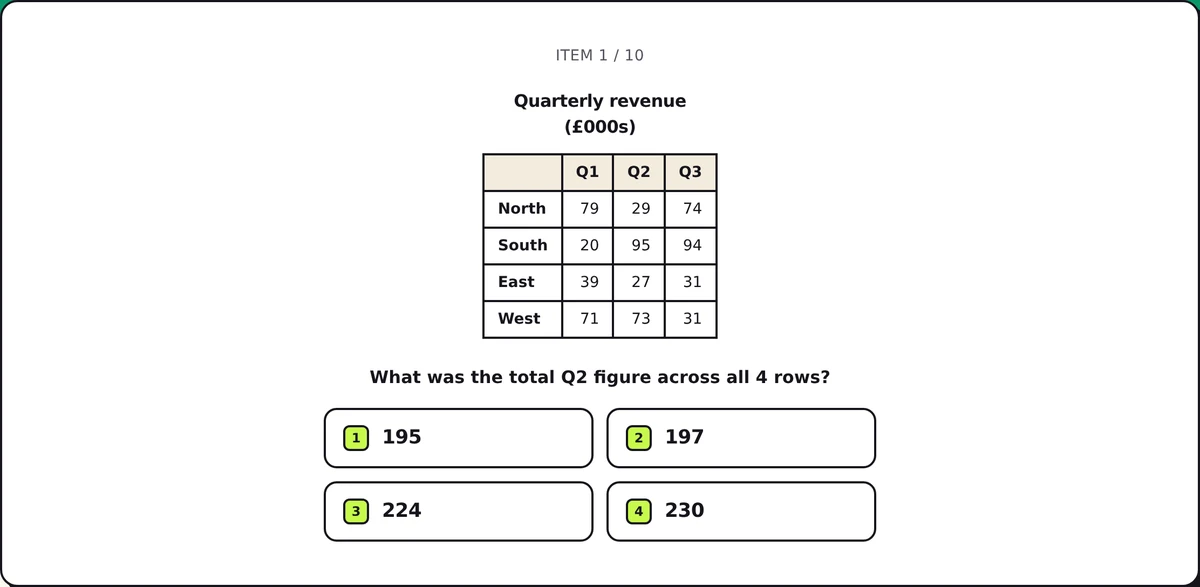
Numerical fluency. The workhorse for cut-e numerical items — quick, accurate arithmetic under a timer is what lets you keep moving instead of stalling. Drill it at /practice/mental-math-numerical, and practise the data-interpretation layer on top at /practice/numerical-reasoning.
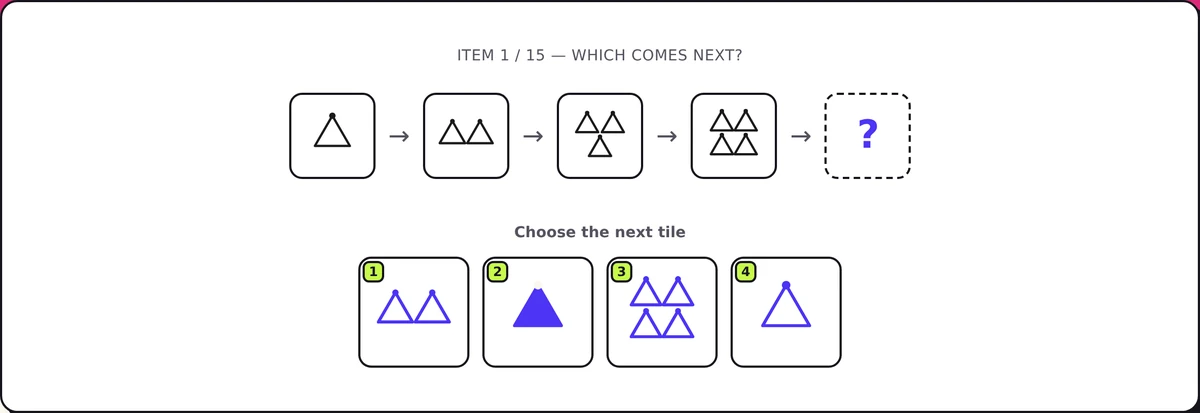
Logical and inductive reasoning. Spotting the governing rule quickly without over-theorising it. Practise at /practice/inductive-reasoning.
Processing speed and impulse control. Responding fast without jumping early. Speeded and gamified tasks reward that combination, and they measure the two separately — pace without restraint scores poorly. Train it at /practice/reaction-time-test.
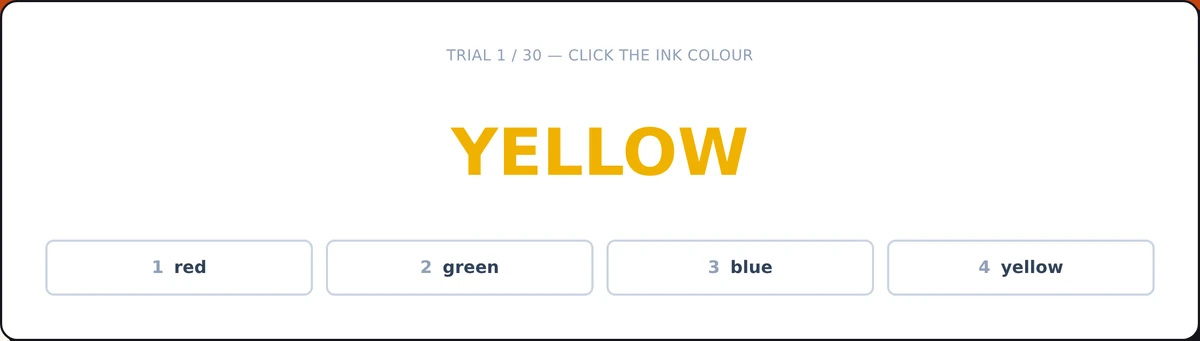
Attention control. Naming the ink colour while ignoring the word forces you to suppress an automatic response, which is exactly what keeps errors low on interference-heavy and checking tasks. Practise at /practice/stroop-test.
Working memory. Holding and repeating a growing string keeps you composed when a task stretches what you have to hold in mind. Build it at /practice/digit-span-memory.
One cold pass across these five takes about twenty minutes and returns a percentile for each, which tells you where your remaining preparation time actually belongs — not in whichever one you find most satisfying.
The Nestlé process and timeline
A typical route runs: online application → cut-e and gamified/situational online assessment → video or on-demand interview → virtual or in-person assessment centre with group and case exercises → final interview and offer. Ordering shifts by function, market and year.
Expect gaps of one to several weeks between stages, with the longest wait usually before an assessment centre because those run in cohorts. Silence inside the first fortnight is normal batching, not a rejection.
For nearby employers, our P&G PEAK walkthrough pairs well, as does the Unilever game assessment guide — both consumer-goods giants running comparable early-careers funnels. The complete guide to game-based assessments gives the wider picture, and the HireVue games explained guide covers the video stage if one appears.
Mistakes that cost candidates
- Meeting the format live. The most expensive and most avoidable error, and the reason a single free practice run pays for itself.
- Reading "I ran out of time" as failure. The tests are calibrated so nearly nobody finishes. Rushing the remaining items to feel complete damages the accuracy that actually counts.
- Answering situational items as an implausibly perfect employee. Consistency is measured, and a superhuman profile is internally inconsistent.
- Practising the module you are already good at. Your result is a profile; the cheap points are in your weakest area.
- Using a phone, or leaving notifications on. Several tasks are timed to the millisecond.
- Submitting at 1 a.m. on the deadline. Reaction speed and working memory both degrade measurably when you are tired.
How to prepare in 3 days
First, set up a quiet space, a device you trust and a stable connection — remove the avoidable stress.
Day one: run the reaction-time test, mental math and numerical reasoning cold, with no warm-up, and note where you rush, misfire or run out of time. That is your weak spot, and guessing at it without measuring is how people end up drilling the wrong thing.
Day two: attack the gap in short focused sets. If numerical fluency is shaky, do timed arithmetic blocks with real rests between them and add Stroop rounds to sharpen control. If memory is the gap, do little-and-often digit-span work — long sessions teach bad pacing because the task degrades with fatigue.
Day three: one relaxed full pass across everything, then stop early and rest. Arriving sharp and unhurried lifts your speed and accuracy more than one more hour of grinding ever will.
Less time than that? The 24-hour prep plan compresses it.
FAQ
Does Nestlé use the same assessment everywhere? No. Markets and functions can draw on different cut-e modules and gamified stages, and Nestlé Needs YOUth routes may differ again. Your invitation email lists what you will actually sit.
Can I retake the Nestlé online assessment? Usually not within the same application cycle — results generally stand for that application. Documented technical failures are the exception and should be raised with the recruitment team immediately; see the retake guide.
Are these the exact Nestlé games? No. These are independent practice versions that train the same underlying skills — speed, numerical fluency, attention, memory — not copies of Nestlé's live tasks.
I could not finish the timed sections. Is that bad? Almost certainly not on its own. cut-e's adaptive tests are designed so that nearly nobody completes every item; the software is locating your ceiling rather than scoring completion.
What score do I need to pass? None is published. Results are benchmarked against other applicants and against a profile for the role and market, so aim to be comfortably above a largely unprepared field and consistent across modules.
Do I need experience in food or consumer goods? For the assessment stage, no — it reads aptitude and behaviour, not sector knowledge. Save the commercial awareness for the interview stages.
How long does the whole Nestlé assessment take? The cut-e modules are individually short, often only a few minutes each, with the full sitting typically well under an hour. Budget uninterrupted time rather than squeezing it between other commitments.
Does Nestlé Needs YOUth use a different process? It can differ by market and route. The underlying skills assessed are broadly the same, which is why skill-level practice transfers even when the specific stages do not.
GamePrep is an independent practice platform and is not affiliated with Nestlé, Aon or cut-e. Hiring processes, modules and timings change between programmes, markets and years — verify details against your assessment invitation. We provide practice only — no leaked questions or answers.