Accenture Game Assessment 2026: Every Stage, Every Test + Free Practice
Accenture's gamified assessment for graduate and apprentice roles, built on cut-e: what each game measures, how timing works, and free practice for each skill.
Are you actually ready for this one?
See where you stand overall and which game to fix first — free, no sign-up.
Want this whole assessment as one timed run, one attempt per game? We're deciding whether to build it — get early access.
Accenture invites graduate, degree-apprenticeship and off-cycle applicants to an online assessment once the application form clears the first screen. The firm has used Aon's cut-e engine together with its own gamified and situational modules, so what you see depends on the practice area (Technology, Strategy & Consulting, Operations, Song), the specific programme, and your location.
Read this as a general orientation rather than a fixed script. Accenture reworks its assessment stages fairly often, and exact modules, time limits and stage names vary by programme and region — trust your own invitation email above anything else here.
What the assessment looks like
Expect a mix rather than a single test.
The cut-e ability portion is a set of short, separately timed adaptive tests — numerical, logical/inductive, and often a checking module — each with a tight per-question timer that rewards fast, accurate reasoning.
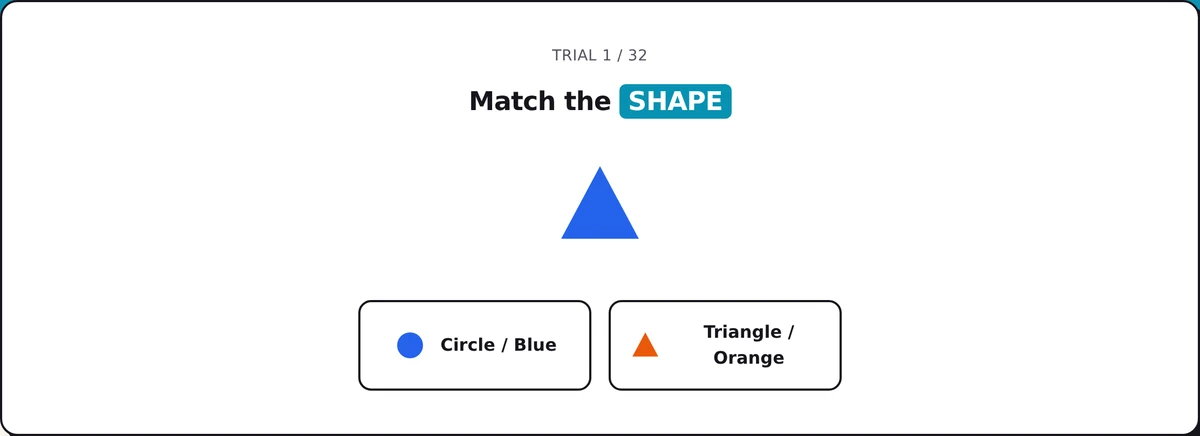
Gamified and situational elements sit around it: interactive tasks and scenario judgements that probe how you work, decide and prioritise rather than what you have memorised.
An immersive or "digital" experience appears on some routes, blending several task types into one sitting.
Because these tools read aptitude and behaviour rather than knowledge, two things follow. You cannot revise the answers — a situational or gamified task has no answer key to learn — but you can train the underlying skills so your attention, speed and planning hold up under time pressure. And you usually will not see a pass mark: results are benchmarked, not graded against a fixed line. If that ambiguity nags at you, can you fail a game assessment reframes it usefully, and what counts as a good score explains why no target number exists.
How cut-e's adaptive timing actually works (and why it feels brutal)
This is the part that ambushes people, and understanding it changes how you should play.
cut-e's ability tests are adaptive and deliberately unfinishable. Get items right and they get harder; the test is calibrated so that almost nobody completes every item in the time allowed. That is by design — the software is triangulating your ceiling, not counting your total.
Three practical consequences:
- Running out of time is normal, not failure. Candidates routinely walk away convinced they bombed because they did not finish. Almost nobody finishes.
- Accuracy usually matters more than volume. Rushing to attempt more items while your error rate climbs typically produces a lower estimate than a steadier, more accurate run through fewer items.
- A weak start is expensive. Early misses can drag the difficulty down before the test has your measure, while late misses are just your ceiling being found. Warm up before you press start so your first items are not also your cold ones.
The cut-e / Aon assessment guide covers the module family in more depth, including the switch challenge and the grid challenge if your battery includes them.
The skills that decide most, and how to train them
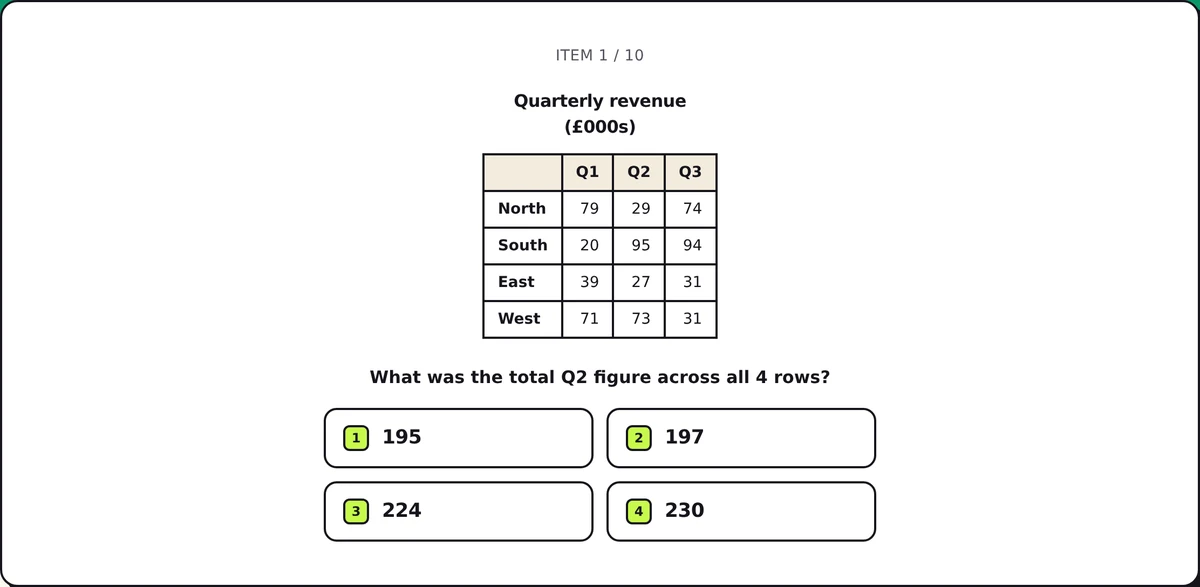
Numerical reasoning under a timer. The cut-e numerical modules present data — tables, charts, ratios — and ask for fast, correct judgements rather than elaborate calculation. The winning habit is deciding what the question actually needs before touching any numbers. Train it at /practice/numerical-reasoning, and build the raw arithmetic speed underneath it at /practice/mental-math-numerical.
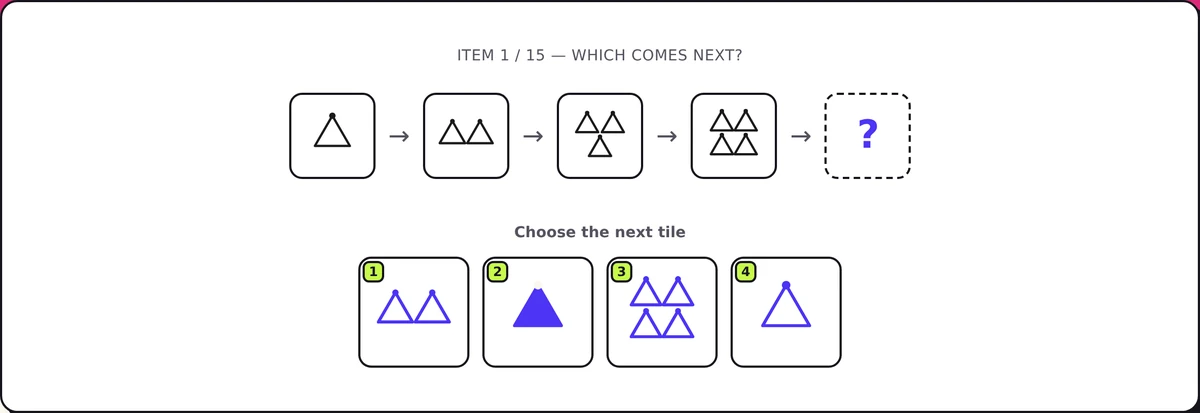
Logical and inductive reasoning. Spotting the rule that governs a sequence or set, quickly, without over-theorising. Practise at /practice/inductive-reasoning.
Processing speed and impulse control. Acting quickly without misfiring. Speeded gamified tasks reward exactly this blend of pace and restraint, and the two are separately measurable — being fast is worth little if you fire on everything. Train it at /practice/reaction-time-test.
Selective attention. Locking onto the relevant signal while ignoring flanking distractors keeps your error rate down on checking-style and interference tasks. Practise at /practice/flanker-arrows-test.
Rapid visual search. Finding the one element that breaks the pattern, against the clock. This sharpens the scanning and discrimination that checking modules lean on. Try /practice/singularity-odd-one-out.
Planning and sequencing. Mapping a route to a goal while thinking several moves ahead — deliberate problem-solving that pays off in logical and scenario tasks. Build it at /practice/pathfinder-puzzle.
Every run here is scored server-side against fixed norms and returns a percentile, so one pass across these six tells you which is your weakest in about twenty minutes. That is where the rest of your preparation belongs — not in the one you find most enjoyable.
The situational and gamified modules
These are the ones candidates most often try to outsmart, and it rarely works.
Situational judgement items present a realistic work scenario and ask what you would do. There is no key to learn, but there is a consistent signal that scores well: collaborate before escalating, clarify before assuming, and take ownership without going it alone. Accenture is a consultancy — the behaviours it rewards are the ones that keep a client relationship and a delivery team functioning.
Two honest warnings. First, answering as an idealised superhuman produces an internally inconsistent profile, and consistency is measured. Second, if a module reads behavioural traits rather than judgement, there is no high score at all — play it naturally and hold the same approach throughout.
The Accenture process and timeline
A typical route runs: online application → cut-e and gamified/situational online assessment → digital or video interview → assessment centre (often virtual, with group and case exercises) → final interview and offer. Ordering and naming shift by programme and year.
Gaps of one to several weeks between stages are normal, and the assessment centre is usually scheduled in cohorts, which stretches the wait before it. Silence inside the first fortnight is not a rejection signal — screening runs in batches, and a chasing email does not move you up the queue.
Applying to nearby consulting and professional-services firms too? Our PwC, Deloitte, EY and KPMG guides pair naturally with this one, and the complete guide to game-based assessments covers the wider landscape.
Mistakes that cost strong candidates
- Meeting the format for the first time in the live test. The most expensive and most avoidable error. Seconds spent decoding a task are seconds not spent on it.
- Panicking about unfinished items. The tests are built so you cannot finish. Treating that as evidence of failure leads people to rush the remaining items and damage the accuracy that actually counts.
- Chasing volume over accuracy. On adaptive tests this usually lowers your estimate.
- Sitting it on a phone, or with notifications live. Several modules are timed to the millisecond.
- Doing it at 1 a.m. on the deadline. Reaction speed and working memory are both sleep-sensitive, and this is when the least prepared part of the pool submits.
- Skipping the tutorial screens. They are the only authoritative description of the version you are sitting; every second-hand account, including this one, is at least a cycle behind.
How to prepare in 3 days
Sort a quiet space, a trusted laptop and a stable connection first — you want zero surprises on the day.
Day one: play the reaction-time, flanker, numerical-reasoning and inductive-reasoning tests cold. Note where you rush, drift, or let distractors pull your attention, and write down your percentiles. That is your priority list.
Day two: drill the gap in tight, focused rounds. If selective attention is weak, alternate flanker and singularity blocks. If planning is, work pathfinder puzzles from slow-and-careful up to at-speed. If it is numerical, do short timed sets rather than long leisurely ones — the skill you need is decision speed, not endurance.
Day three: one relaxed full pass through everything as a rehearsal, on the device you will actually use. Then stop and rest properly. A sharp, unhurried mind beats a fatigued, over-crammed one every time on speeded tasks.
Shorter runway than that? The 24-hour prep plan compresses it.
FAQ
Does Accenture use the same assessment for every programme? No. Technology, Consulting and apprenticeship routes can draw on different cut-e modules and gamified stages. Your invitation email tells you what you will actually sit.
Can I retake the Accenture online assessment? Usually not within the same application cycle — results generally stand for that application. Documented technical failures are the exception and should be reported to the recruitment team immediately; see the retake guide.
Are these the exact Accenture games? No. They are independent practice versions that train the same underlying skills — attention, speed, reasoning, planning — rather than copies of Accenture's live tasks. Anyone claiming to sell you the real ones is not being straight with you.
How long does the Accenture assessment take? It varies by programme, but the cut-e ability modules are individually short — often only a handful of minutes each — with the full sitting typically well under an hour. Budget uninterrupted time rather than squeezing it between other things.
I ran out of time on every section. Did I fail? Almost certainly not on that basis alone. cut-e's adaptive tests are calibrated so nearly nobody finishes; the software is finding your ceiling, not scoring completion.
What is a good score on the Accenture assessment? None is published. Results are benchmarked against other applicants and to a profile for the role and programme, so aim to be comfortably above a largely unprepared field and consistent across modules.
Is the situational judgement part something I can prepare for? Partly. You cannot learn an answer key, but you can think in advance about what good judgement looks like in a client-facing consultancy — clarify, collaborate, take ownership — and you can avoid the trap of answering as an implausibly perfect employee.
Does Accenture tell me my results? Generally not in any detail. Most candidates receive an advance-or-not outcome rather than a score report.
GamePrep is an independent practice platform and is not affiliated with Accenture, Aon or cut-e. Hiring processes, modules and timings change between programmes, regions and years — verify details against your assessment invitation. We provide practice only — no leaked questions or answers.