Arctic Shores Direction Game: How the Arrows Task Works & How to Practice
The Arctic Shores direction game is an arrows task — answer the middle arrow with Q or P while the rest of the row points elsewhere, faster every round. How it works, the X rounds some candidates report, and a free practice version.
TL;DR: The Arctic Shores direction game is an arrows task. A row of arrows appears and you answer with the direction of the middle arrow — Q for left, P for right, as Arctic Shores' own help centre puts it — whatever the arrows around it are doing. Candidates describe about eighty rounds that speed up, flanking arrows that point the other way or turn into dashes, and answers that come too early or too late counting as errors. It reads attention and focus. Play the free direction game.
What is the Arctic Shores direction game?
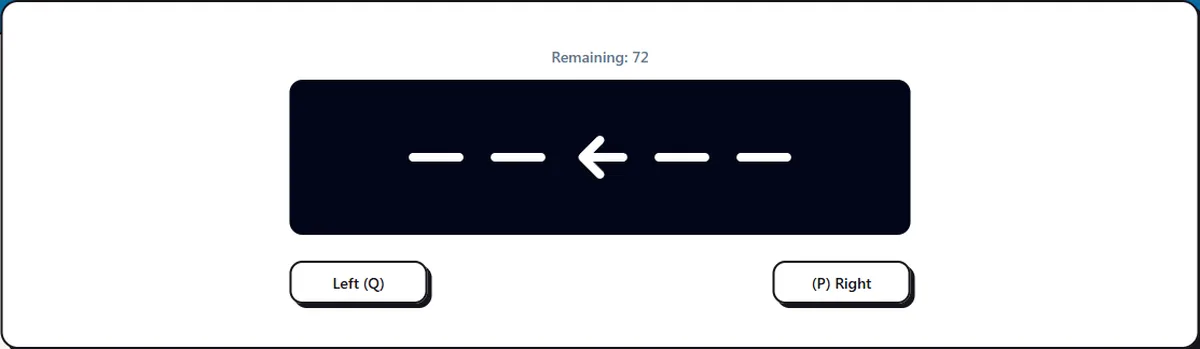
It is a version of a classic attention test (the flanker task). Each round shows a row of symbols with an arrow in the middle. Sometimes the arrows around it point the same way, sometimes the opposite way, and sometimes they are plain dashes. Only the middle arrow counts. Arctic Shores' own promotional footage shows exactly this: white arrows and dashes on a black panel, a "Remaining" counter starting at 80, and Left (Q) / (P) Right buttons.
What candidates and prep providers report:
- Keys: Q when the middle arrow points left, P when it points right — confirmed by Arctic Shores' help centre.
- Around 80 rounds, roughly two to three minutes, with the pace quickening as you go. A 2021 screen recording of the real task shows both — some rounds a single row of five, some a block of three rows of five — with the centre symbol as the target.
- Timing counts: pressing too early or too late is an error, so there is a window for each answer.
- Flankers change: they point the opposite way or turn into other symbols.
- Feedback every round: a green tick for a right answer, a red cross for a wrong one, and "too slow" or "too early" (seen in the 2021 recording).
- Rounds with Xs: the middle arrow is surrounded by Xs and the right response is to press nothing — the 2021 recording's instructions say exactly that ("don't press any button").
An honesty note: Arctic Shores does not publish its rules or scoring, and employers choose which tasks to include. Your invitation and its practice screens are the source of truth.
What does the direction game measure?
Sources agree on attention and focus — acting on the one signal that matters while the rest of the screen pulls the other way. Some add response inhibition (not pressing on the X rounds, not reacting to the flankers) and processing speed. Mechanically it has right and wrong answers; Arctic Shores then reports it as part of a trait profile against what the employer's role looks for, not as a pass mark.
How do you get better at it?
- Eyes on the centre, before the row appears. Fix your gaze where the middle arrow will be. Most wrong answers come from glancing at the edge of the row.
- Fingers resting on Q and P. Speed should come from seeing, not from moving your hands to the keys.
- Don't guess early. An answer before you have seen the middle arrow is an error even when it happens to be right — and as the window shrinks, guessing gets tempting.
- Hold back on X rounds. If your version has them, the habit to build is a tiny pause to check the flankers before the press.
- Accept the odd miss. At the end the window is short; one slow answer costs one round. Panicking costs the next three.
How do you practise for it?
- Play the direction game. Eighty rounds with Q/P (or the arrow keys, or on-screen buttons on a phone), single rows and 3 × 5 blocks, a window that shrinks from 1.5 to 0.65 seconds, flankers that agree, disagree or turn into dashes, X rounds, and a tick or a cross after each answer. The result splits your errors into wrong way, too slow, too early and pressed on X.
- Build the core skill on the flanker test — the same middle-arrow task without a time limit, good for getting accuracy first.
- Train ignoring the louder cue with the Stroop test.
What else is in the Arctic Shores assessment?
Direction is usually one of several tasks. The Arctic Shores assessment guide covers the full set and how the benchmark works; the balance, order, lock and predict guides cover the other tasks candidates describe.
FAQ
What is the Arctic Shores direction game? An arrows task: answer with the direction of the middle arrow — Q for left, P for right — ignoring the arrows around it, over about eighty rounds that speed up.
Is it a spatial reasoning or navigation test? No. Despite the name, nothing rotates and there is no route to plan; it is about attention and fast, accurate responses.
What happens if I answer too slowly? Candidates report that late (and early) answers count as errors, so each round has a time window. In our practice version a round with no answer in time counts as wrong.
Do I have to press something every round? No — when the middle arrow is surrounded by Xs, the right response is to press nothing.
GamePrep is an independent practice platform and is not affiliated with Arctic Shores. Arctic Shores does not publish its game rules; the mechanics above are as reported by candidates, prep providers and Arctic Shores' help centre, and assessments change — verify everything against your invitation. We provide practice only — no leaked questions or answers.