Arctic Shores Lock (Security) Game: How It Works & How to Practice
The Arctic Shores lock game — the Security task — is a safe of four locks with five-digit codes, a shade sweeping a ring of digits, and one miss sends you back to the start. How it works, from candidates' recordings, and a free practice version.
TL;DR: The Arctic Shores lock game is the task the vendor calls Security: a safe with four locks, each with a five-digit code. The digits sit still on a ring while a shaded sector sweeps round it; you press Stop while the shade covers the highlighted digit. The shade narrows and speeds up, and one miss sends you back to the first digit of the first lock. There is no skip — only Exit. Arctic Shores says it reads processing speed, perseverance and how you respond to negative feedback. Play the free lock game.
What is the Arctic Shores lock game?
Candidates' recordings of the real task (2026) show the same thing:
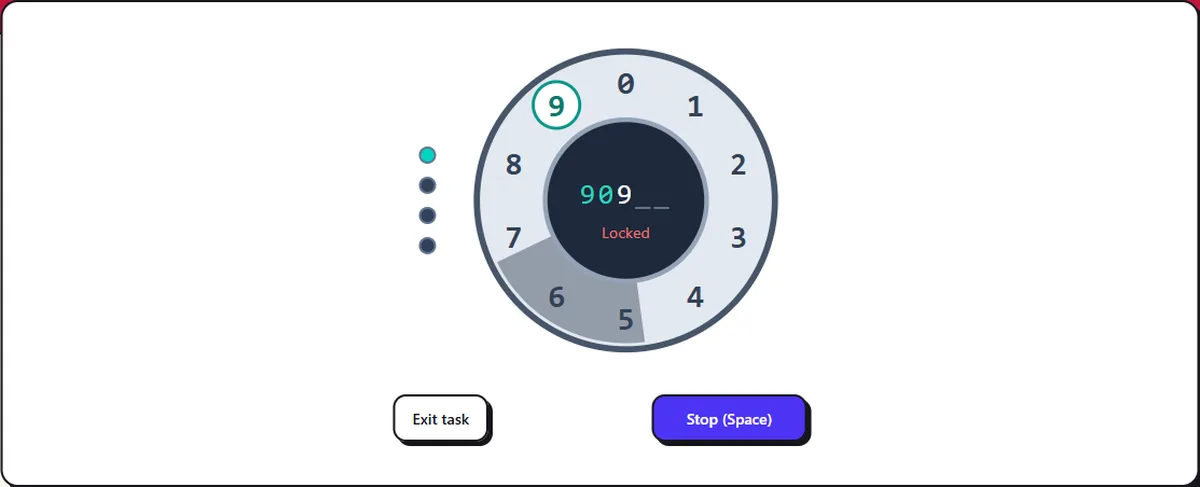
- A safe of four locks. Four lamps on the left light up as locks open; a display in the middle shows the current code — digits you have entered, the one you need now, blanks for the rest — with "Locked" underneath.
- Five digits per lock, twenty in total. Only the current digit is shown; it lights up on the ring.
- A shade, not a hand. The digits 0–9 never move. A dark sector sweeps round the ring, and you press Stop (Space) while it covers the highlighted digit.
- It gets harder. The shade is about three digits wide on the first lock and about one digit wide by the third; later it moves fast and swings back and forth.
- One miss and you start again. A miss — even on the very last digit of the fourth lock — sends you back to the first digit of the first lock, with the same codes.
- Exit, no skip. There is no time limit and no way to skip a lock; the only other button is Exit task. Candidates describe spending far longer than the stated time, and very few report opening the safe.
Arctic Shores has also described the task in a podcast with an occupational psychologist: candidates stop the dial on a number to unlock a series of codes, the dial moves at varying speeds and changes with how the candidate interacts, and what it looks at includes processing speed, perseverance and response to negative feedback.
An honesty note: Arctic Shores does not publish its rules or scoring, recordings show one candidate's version, and employers choose which tasks to include. Your invitation and its tutorial screens are the source of truth.
What does the lock game measure?
Two different things, and it helps to keep them apart:
- Timing and processing speed — a skill. Stopping a fast, narrow shade on a digit is something you get better at with practice.
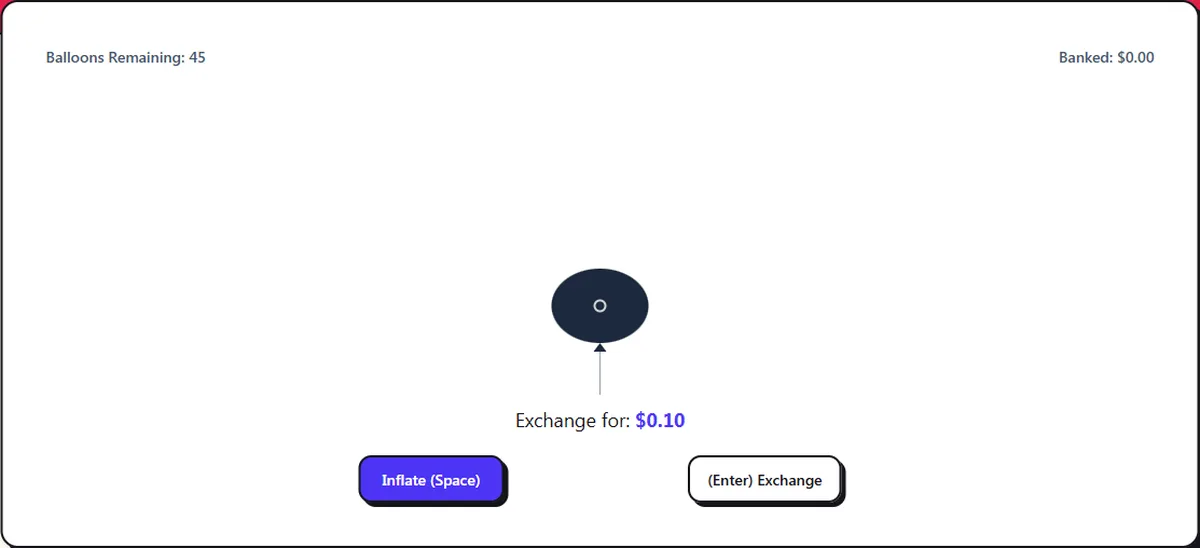
- Perseverance and response to setbacks — traits. A task where one slip undoes everything is built to show how you react to repeated failure and when you decide to stop. That is not right or wrong; it is read against what the employer's role profile looks for, as with the balloon game.
That is why the free practice version scores only your timing and simply reports how far you got, how many restarts you went through, and whether you left with Exit.
Should you keep trying or exit?
There is no published right answer, and trying to game a trait task tends to backfire — you end up playing a character instead of yourself, and the profile looks inconsistent across tasks. Candidates who have talked it through mostly describe it as a test of persistence against pragmatism. Play the way you would actually approach a frustrating problem at work: keep at it while you are making progress, and leave when you would leave.
What you can control is not being thrown by the format. A restart after a miss is built in and expected; it is not you failing the assessment.
How do you get better at stopping the shade?
- Aim for the shade's centre. On the first lock the shade is wide and forgiving; later it is one digit wide, so build the habit early.
- Press a touch early. Your finger takes time. At speed the shade crosses a digit in a few dozen milliseconds, so anticipate it rather than react to it.
- Watch for the swing. On later locks the shade changes direction; wait for a clean pass rather than pressing as it turns.
- Breathe after a restart. The first lock is the easy one — a rushed press after a restart is the most common second miss.
- Practise the format on the lock game: four locks of five digits, a shade that narrows from three digits to one, a restart on every miss, and an Exit button. The reaction time test trains the raw speed underneath.
What else is in the Arctic Shores assessment?
The lock task is usually one of several. The Arctic Shores assessment guide covers the full set and how the benchmark works; the balance, order, predict and direction guides cover the other tasks candidates describe.
FAQ
What is the Arctic Shores lock game? The Security task: a safe of four locks with five-digit codes. A shade sweeps round a ring of digits and you press Stop while it covers the highlighted one. One miss sends you back to the first digit of the first lock; you can leave with Exit.
Is the lock game a memory test? No. The code is shown one digit at a time; the task is timing, plus how you handle repeated restarts.
Is it possible to open the safe? In principle, but candidates describe it as extremely hard — the later locks are fast and narrow, and any miss restarts everything. It is built to be.
Is leaving early bad? Not in itself. Arctic Shores reads perseverance and response to setbacks as traits matched to a role profile, not as a score where more is always better.
GamePrep is an independent practice platform and is not affiliated with Arctic Shores. Arctic Shores does not publish its game rules; the mechanics above are as seen in candidates' recordings and Arctic Shores' own public commentary, and assessments change — verify everything against your invitation. We provide practice only — no leaked questions or answers.