KPMG Online Assessment Games: What to Expect & How to Prepare
KPMG's early-career online assessment blends Arctic Shores-style behavioural games with cut-e ability tests. Here is what each stage measures and the cognitive skills you can rehearse first.
Are you actually ready for this one?
See where you stand overall and which game to fix first — free, no sign-up.
Want this whole assessment as one timed run, one attempt per game? We're deciding whether to build it — get early access.
KPMG invites graduate-scheme, apprenticeship and internship applicants to an online assessment shortly after the application form is submitted and passes initial checks. The firm has used Arctic Shores gamified behavioural assessments alongside Aon's cut-e ability tests, so your experience depends on the programme (Audit, Deal Advisory, Tax, Technology), the year's intake design, and where you are based. Everything here is a general map — KPMG updates its process regularly, and exact steps and timings vary by programme and region, so always follow the instructions in your own invite email rather than any external guide.
What the assessment looks like
Arctic Shores runs as a roughly 16-minute gamified behavioural assessment. There are no right or wrong answers: the games measure traits and tendencies — how you respond to risk, how you adapt, how you handle attention and decisions — from the way you play, not from a score you can chase. The cut-e side is different: short, separately timed adaptive ability tests (numerical, logical, sometimes checking) with tight per-question timers that reward speed and accuracy.
Because both tools read behaviour and aptitude rather than knowledge, two things are true. You cannot cram "the answers" — a behavioural game has none — but you can train the cognitive skills (attention, control, planning, processing speed) that make you calmer and sharper on the day. And there is usually no visible pass mark; you are compared against a benchmark group, which is why the uncertainty can feel unsettling. The piece can you fail a game assessment puts that worry in perspective.
The games that decide most, and how to train them
The reaction-time test measures processing speed and impulse control — responding fast without jumping the gun. Behavioural games often watch how quickly and how consistently you act, so a steadier reaction reflex helps. Train it at /practice/reaction-time-test.
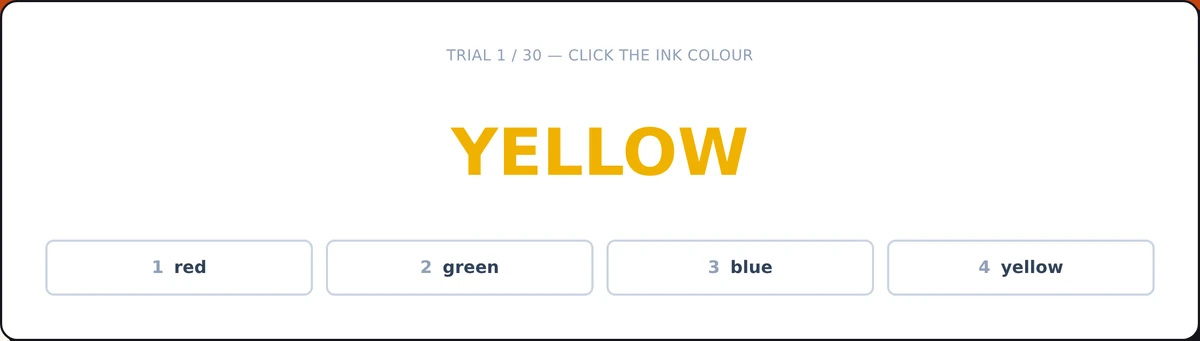
The Stroop test builds attention control: naming the ink colour while ignoring the word fights your automatic response. That ability to suppress the obvious wrong move is exactly the self-control these assessments surface. Practise at /practice/stroop-test.
Singularity (odd-one-out) is rapid visual search — spotting the one item that breaks the pattern under time pressure. It sharpens the scanning and discrimination that speeded tasks lean on. Try it at /practice/singularity-odd-one-out.
The pathfinder puzzle trains planning: building a route to a goal while thinking a few moves ahead. That deliberate, sequenced problem-solving is a genuine strength these games can pick up on. Build it at /practice/pathfinder-puzzle.
The KPMG process and timeline
KPMG's route typically runs: online application, then the online assessment (Arctic Shores behavioural plus cut-e ability), then a Launch Pad or virtual assessment centre with a group exercise and interviews, and finally an offer decision. The order and naming shift year to year and by programme. Since KPMG uses Arctic Shores and cut-e, keep the Arctic Shores assessment guide and the cut-e / Aon assessment guide open, and anchor everything with the complete guide to HireVue game-based assessments for the broader landscape. Applying across the Big Four? Our PwC and Deloitte walkthroughs are natural next reads.
How to prepare in 3 days
Set up somewhere quiet with a reliable device and connection — mirror the conditions you will actually test under. Day one is a diagnostic: play the reaction-time test and Stroop cold, and honestly log where you rush, freeze, or lose focus. Day two targets the gap — if impulse control is your weak point, alternate short Stroop and flanker-style focus blocks; if planning is, work pathfinder puzzles slowly then at speed. Day three is a single relaxed full run through all four games, then a real break. Being rested and unhurried does more for a behavioural assessment than any last-minute grind, because your natural, consistent responses are what it reads.
FAQ
Can you actually fail the KPMG behavioural game? Not in a pass/fail-the-quiz sense — it profiles traits, not correct answers. The aim is to play honestly and consistently so your profile is a fair read; trying to game it usually backfires.
How long does the KPMG online assessment take? The Arctic Shores portion is around 16 minutes; the cut-e ability tests add more time on top. Your invite email gives the specifics for your programme.
Are these the exact KPMG games? No. These are independent practice versions built to train the same underlying skills — attention, control, planning, speed — not copies of KPMG's live assessment.
GamePrep is an independent practice platform and is not affiliated with KPMG, Arctic Shores, Aon or cut-e. Hiring processes change — verify details against your assessment invitation. We provide practice only — no leaked questions or answers.