Numerical Reasoning Test Practice: Get Fast and Accurate Under a Timer
Numerical reasoning test practice that actually moves the needle. You can't memorise the answers, but speed and accuracy with numbers improve fast — here's what to drill and how.
Numerical reasoning tests measure how quickly and accurately you work with numbers, ratios and data under time pressure. You cannot memorise the answers — the questions are freshly generated — but the underlying speed and accuracy are trainable, and they improve faster than most candidates expect. A week of focused practice is usually the difference between finishing flustered and finishing with time to check.
What a numerical reasoning test actually measures
"Numerical reasoning" is a broad label that covers two fairly different things, and it's worth being honest about the split.
The first is raw numerical fluency: how cheaply your brain retrieves number facts and runs small calculations — additions, subtractions, multiplications, percentages, quick magnitude judgements. This is the cognitive layer, and it's the part that shows up in game-based batteries (HireVue, pymetrics, Arctic Shores) as fast arithmetic or number-comparison games.
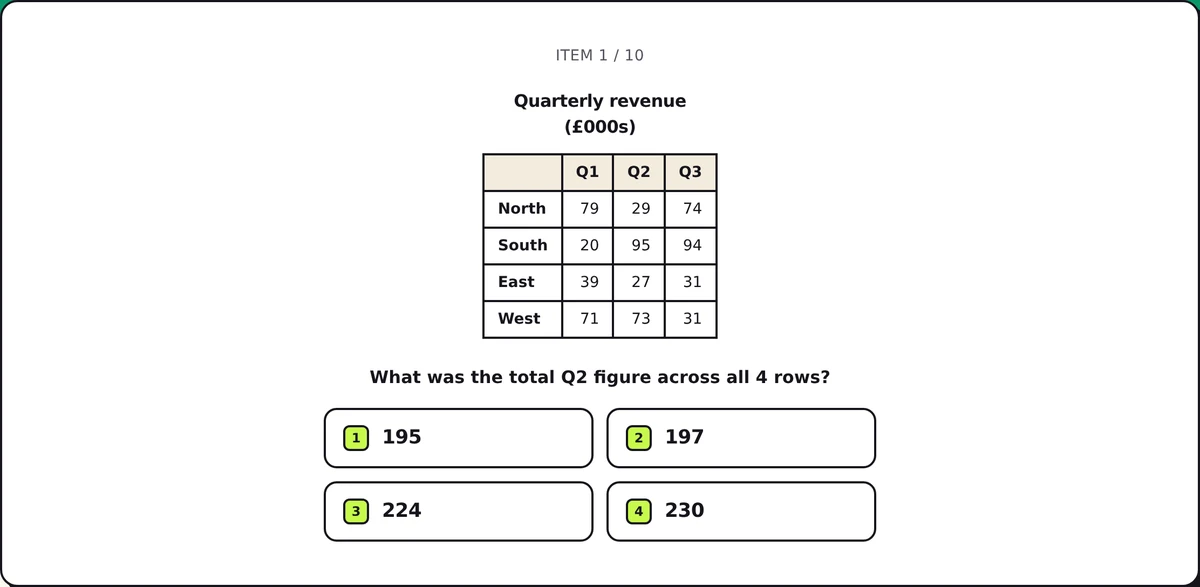
The second is data interpretation: reading a table, chart or short passage, working out which numbers you need, and applying a formula (percentage change, ratio, per-unit cost). SHL, Cut-e/Aon and graduate-scheme numerical tests lean heavily on this.
GamePrep trains the first layer — the speed, accuracy and number-sense engine — with free playable games. It does not replace a full data-interpretation question bank. If your test is table-and-chart heavy, pair this practice with a proper question set for the reading-and-formula side. What we do well is make the arithmetic underneath feel automatic, so interpretation questions don't stall on the maths.
The skills you can train here (free)
Rapid mental arithmetic — Mental Math. A stream of questions like 54 − 48 or 7 × 13 against a short timer. This is the closest analogue to the pure-arithmetic sections of a numerical test, and the single highest-value drill: it rebuilds the times-table and complement-to-100 retrieval that most adults have gone rusty on. Scored on throughput and accuracy, with percentiles after each run.
Number sense and pair-finding — Numerosity. You scan for digit pairs that hit a target, which trains "endings-first" thinking — checking the units digit before committing. That habit catches a surprising share of arithmetic slips on the real test, where a wrong final digit is an instant tell.
Magnitude comparison under rhythm — Disco Numbers. Each round is a single "which is larger / how many" judgement at pace. It trains the quick estimation that data-interpretation questions rely on — knowing roughly what the answer should be before you compute it, so a wildly-off calculation gets caught.
How to improve
- Left-to-right, not column arithmetic. For
47 + 38, do40 + 30 = 70, then7 + 8 = 15, answer85. School's carrying method is built for paper; left-to-right gives you the big digits first and finishes faster in your head. - Round, then repair.
54 − 48is54 − 50 = 4, then +2 = 6.9 × 99is9 × 100 − 9 = 891. Most questions sit near a round number. - Learn percentage shortcuts cold. 10% is a decimal shift; 5% is half of that; 15% is 10% + 5%. A "20% increase" is
× 1.2. These three habits clear most data-interpretation arithmetic. - Check the units digit first.
13 × 7must end in 1. If your candidate answer ends in anything else, you've caught the error before typing. - Find your no-error pace. The most common mistake is sprinting. Hold a steady rhythm slightly below maximum speed — the pace at which you're almost never wrong — and let the clock do the rest. Error clusters cost far more than a slightly slower correct answer, and adaptive tests punish sloppy patches.
As a rough gauge, strong candidates on fast-arithmetic games clear questions in roughly two to four seconds each with high accuracy — but treat any single number cautiously, because norms vary by test and your own baseline is what matters. Run the game, note your starting percentile, and watch it move.
Where this shows up
Numerical sections appear across most graduate and early-career assessments. If you're preparing for a named process, see the SHL game assessment guide, the Cut-e / Aon assessment guide and the J.P. Morgan pymetrics games guide, all of which include numerical challenges. For the arithmetic techniques in more depth, the mental math speed guide goes deeper on drills. For how numerical games sit alongside memory and attention tasks, start with the complete HireVue game-based assessments guide. Employers and vendors that use these tests are listed on the employers page.
FAQ
Can I practise numerical reasoning tests for free? Yes. The mental math, Numerosity and Disco Numbers games are free and score you into percentiles, so you can track speed and accuracy without paying for a question bank.
Does GamePrep replace a full numerical question bank? No, and we won't pretend otherwise. We train the cognitive speed-and-accuracy layer. For table- and chart-heavy data-interpretation tests, pair us with a dedicated question set for the reading-and-formula practice.
How much can I realistically improve in a week? The arithmetic-fluency side moves fast — often a clear percentile jump in a few days of short daily sessions — because you're rebuilding retrieval, not learning new maths.
Are calculators allowed on numerical tests? It depends on the test. Some allow an on-screen calculator; the fast-arithmetic games generally don't. Practising mental speed helps either way, because it frees attention for the actual reasoning.
Do I need to memorise formulas? Only the everyday ones — percentage change, ratios, averages. The tests generate fresh numbers, so there's nothing to memorise beyond method.
GamePrep is an independent practice platform, not affiliated with any assessment vendor. We provide practice only — no leaked questions or answers.