How to Improve Working Memory for Assessments
How to improve working memory for hiring assessments. What working memory training can and can't do, plus the exact memory games that map to the tests you'll actually face.
Working memory is your brain's mental scratchpad — how much information you can hold and manipulate at once. Hiring assessments (HireVue, pymetrics, Arctic Shores) probe it directly with digit-span and pattern-recall games, and while you can't hugely expand your raw capacity in a week, you can train the strategies and familiarity that let you use the capacity you have far more effectively. That alone shifts scores.
What a working memory test actually measures
Two things, usually. The first is capacity: how many items — digits, positions, shapes — you can hold. The second, and often the harder one, is manipulation: holding items and doing something to them at the same time, like repeating a sequence backwards or tracking what appeared two steps ago.
Assessments care about working memory because it predicts how well you'll juggle instructions, numbers and context in a real role without dropping things. The games are deliberately short and adaptive: they push the sequence length up until you fail, then settle on your span.
Here's the honest part. Serious cognitive science is sceptical that you can permanently raise your working-memory capacity through games — the transfer to unrelated tasks is weak. What training reliably does is: remove the novelty (so nerves don't cost you a point or two), teach encoding strategies like chunking, and warm you up so you perform at the top of your natural range on the day. GamePrep trains exactly that — strategy, familiarity and warm-up — with the specific game formats you'll meet. It does not claim to make you smarter. It makes you test-ready.
The skills you can train here (free)
Forward digit span — Digit Span. A sequence of digits flashes; you type them back in order. This is the canonical capacity test and the one most batteries include in some form. It's where you'll feel chunking pay off fastest.
Backward digit span — Backward Digit Span. Same sequence, typed in reverse. This adds the manipulation load and is a purer test of working memory than the forward version. Many assessments favour it precisely because it's harder to game.
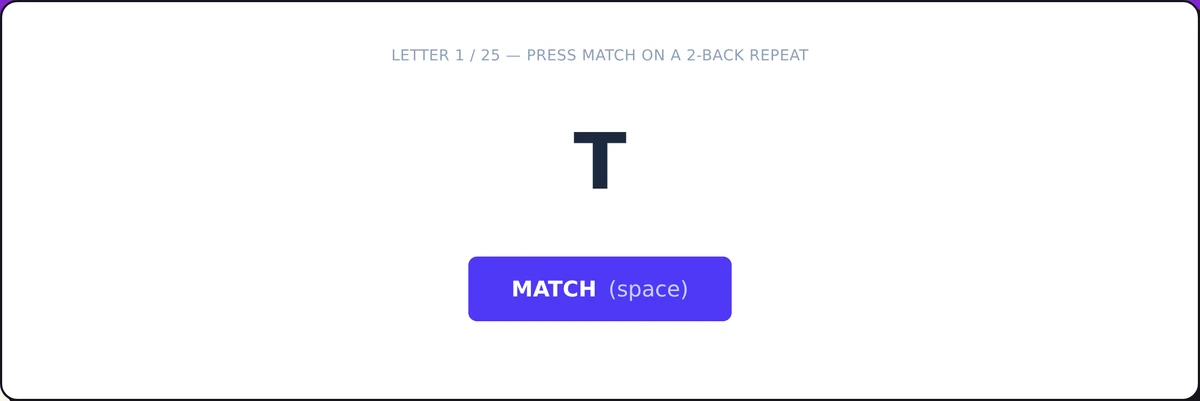
Updating and tracking — N-Back Test. You watch a stream and flag when the current item matches the one from N steps back. It's the toughest of the set because it requires constant updating — dropping old items as new ones arrive — which mirrors real cognitive load better than static recall.
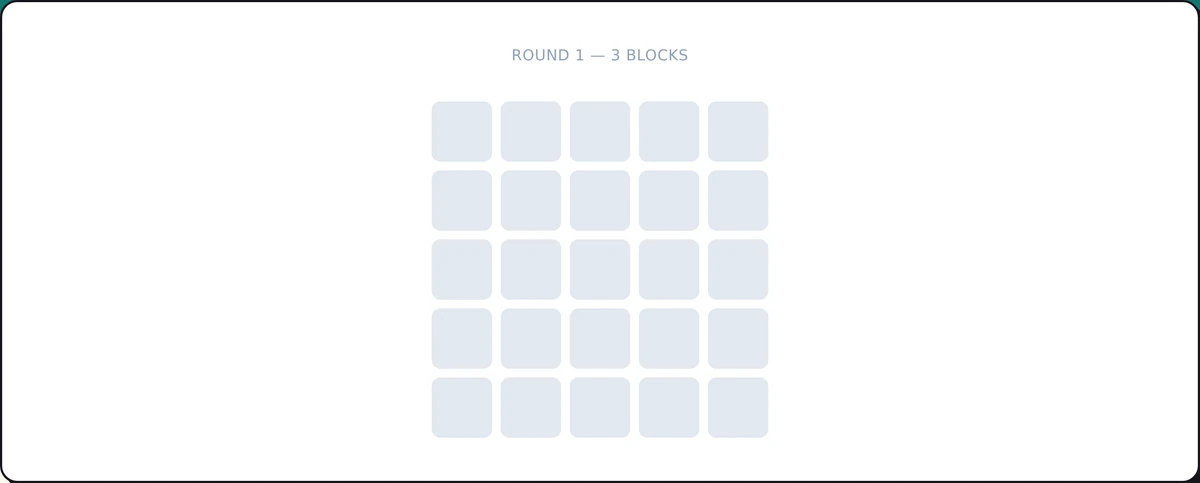
Spatial working memory — Corsi Block. Blocks light up in sequence; you reproduce the pattern by tapping. This is the visual-spatial counterpart to digit span, and it shows up in assessments that test pattern memory rather than verbal memory.
How to improve
- Chunk relentlessly. Don't hold seven separate digits; hold two or three groups.
4 9 2 7 1 5becomes492and715. Chunking is the single biggest lever on digit span — it effectively multiplies your capacity by packing more per slot. - Use a rehearsal loop. Quietly repeat the sequence in a steady rhythm as it comes in. The rhythm keeps items alive in the phonological loop; silence lets them fade.
- For backward span, build the reverse as you go. Don't wait for the sequence to finish and then flip it — that's two hard tasks stacked. Prepend each new digit to a growing reversed string.
- For N-back, commit to a fixed lag and don't second-guess. The failure mode is losing track of position. A calm, metronomic pace beats frantic scanning every time.
- Warm up before the real test. Two or three short runs on the morning of an assessment measurably lift performance — cold starts cost points. Sleep matters more than any drill; working memory is one of the first things a bad night degrades.
As a rough anchor, an average adult forward digit span is around seven items and backward span a couple lower — but ranges are wide, and your own baseline and trajectory matter far more than any headline number. Play a round, note the span, and track it.
Where this shows up
Memory games appear across most game-based batteries. For a specific process, see the pymetrics games complete guide and the Arctic Shores assessment guide, both of which include working-memory-style tasks, and the J.P. Morgan pymetrics games guide for a named example. For scoring context, what is a good digit span score and the n-back test explained go deeper. To see how memory sits alongside the other games, start with the complete HireVue game-based assessments guide. The employers page lists who uses these tests.
FAQ
Can you actually improve working memory, or is it fixed? Your raw capacity is fairly stable, and the science on permanently expanding it through games is weak. But strategy, familiarity and warm-up genuinely lift your measured performance — and that's what the assessment records.
Which game should I start with? Digit Span — it's the most common format and where chunking pays off fastest. Then add backward digit span for the harder manipulation load.
How long before a test should I practise? Short daily sessions across a week to build strategy, plus a brief warm-up on the morning itself. Both help; cramming the night before doesn't.
Is backward span really different from forward span? Yes. Forward span mostly tests storage; backward span forces you to hold and reorder, so it's a truer working-memory measure and often scores a little lower.
Does GamePrep have the exact questions from my assessment? No. We provide practice in the same game formats only — never leaked questions or answers. The value is readiness, not shortcuts.
GamePrep is an independent practice platform, not affiliated with any assessment vendor. We provide practice only — no leaked questions or answers.