Arctic Shores Balance Game: How the Scales Puzzle Works & How to Practice
The Arctic Shores balance game is a scales puzzle — shapes with hidden weights, a few balanced scales, and an empty pan to fill. How it works, the unit trick that solves it, and a free practice version.
TL;DR: The Arctic Shores balance game is a scales puzzle. Each shape has a hidden weight; a few scales are shown balanced, and you work out which shapes put on the empty pan of the last scale make it balance too. Candidates and prep providers describe about ten puzzles at roughly a minute each, getting harder when you solve one and easier when you miss. It is a numerical and logical reasoning task with right answers — so it is one of the parts of the assessment where practice genuinely helps. Play the free balance game.
What is the Arctic Shores balance game?
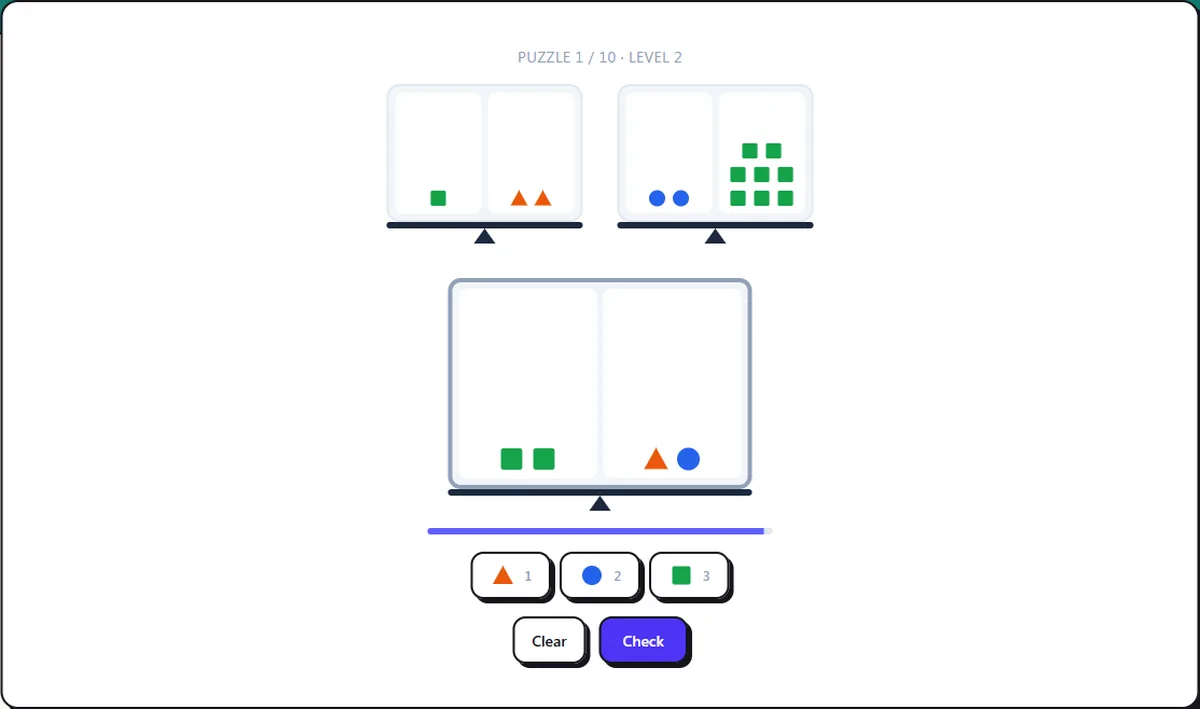
A candidate's recording of the real task (2026) shows the screen: each scale is a pair of tall columns side by side over a beam on a triangular pivot, holding abstract 3D shapes. One or more scales are already balanced, which tells you how the shapes' weights relate — say, a triangle balances two circles. The last scale, outlined more heavily, has one column filled (in the recording, seven of one shape and one of another) and the other empty, and a tray underneath offers every shape, including the ones already on the full side. Your job is to fill the empty column so the scale balances. A timer runs at the top.
Prep providers who have reconstructed the task report:
- About ten puzzles, with roughly a minute per puzzle (some describe ten minutes for the set).
- Adaptive difficulty: a correct answer makes the next puzzle harder, a wrong one makes it easier.
- More shapes and more scales as it gets harder, so you have to combine scales rather than read a ratio off one.
Candidates who have sat it add detail: one calls it "simultaneous equations but with shapes"; another says later puzzles show three or four scales, of which one or two are usually enough, that the same shape can sit on both sides of a scale (A + B + A = A + A + C + C, so B = C + C), and that the instructions allow pen and paper. Others confirm ten puzzles with a one-minute limit — and that the minute goes fast.
An honesty note: Arctic Shores does not publish its tasks or rules, and employers choose which tasks to include. The description above is what candidates and prep companies report, not a specification; your invitation and its tutorial screens are the source of truth.
What does the balance game measure?
Prep providers list numerical and logical reasoning, pattern recognition and analytical problem solving. In plain terms: can you turn a few relationships into a consistent picture and use it under time pressure? It is a cognitive task — unlike the balloon game, there is a right answer, and getting more of them right is better.
How do you solve a balance puzzle?
One method works on every level: pick a unit — usually the lightest shape — and rewrite everything in it.
- Find a scale that relates two shapes directly — "1 triangle = 2 circles". Now triangle = 2.
- Use what you know to unlock the next scale — "1 square = 1 triangle + 1 circle" means square = 2 + 1 = 3.
- Harder puzzles hide a shape on a scale with two unknowns. Substitute the one you know, and the other falls out: if "1 diamond + 1 circle = 1 square + 1 triangle", then diamond + 1 = 3 + 2, so diamond = 4.
- If a ratio is not whole — "2 triangles = 3 circles" makes a triangle 1.5 — make the unit smaller (half a circle) and double everything: circle 2, triangle 3.
- Add up the full pan in units, then build the same total from the tray. Any combination that weighs the same balances — but simply copying the full side across is not an answer.
Two habits save the most time. Write the units down — candidates report the task allows pen and paper, so have them ready — instead of holding four weights in your head. When the same shape is on both sides of a scale, cross it off both sides first. And check the total before you submit: most misses are an addition slip on the last step, not a wrong method.
How do you practise for it?
- Play the balance scales game. Ten adaptive puzzles at a minute each, from two shapes and one scale up to four shapes and four scales you have to combine, some with the same shape on both sides — scored against fixed norms, so you can see whether your level is climbing.
- Speed up the arithmetic. The method is easy; doing it fast is the test. The mental math game trains quick, accurate sums.
- Practise reading relationships from data with the numerical reasoning test — the same skill of turning given facts into the number you need.
- Set up cleanly: quiet room, charged device, no notifications. A minute per puzzle punishes interruptions.
What else is in the Arctic Shores assessment?
Balance is usually one task among several the employer picks. The Arctic Shores assessment guide covers the full set and how the scoring benchmark works; the predict, order and lock guides cover the other tasks candidates describe.
FAQ
What is the Arctic Shores balance game? A scales puzzle: shapes with hidden weights, a few scales shown balanced, and an empty pan to fill so the last scale balances. Candidates report about ten puzzles at roughly a minute each, harder as you get them right.
Is there one right answer? There is one right total weight. In our practice version, any combination from the tray that reaches it is accepted except a copy of the full side; Arctic Shores does not publish how its version marks answers.
Can you practise the balance game? Yes. It is a reasoning task, and the unit method above plus a few timed runs make a real difference — mostly in speed and in avoiding arithmetic slips.
Is it a maths test? Only light arithmetic — addition and small multiplications. The hard part is combining several scales in the right order, under a minute.
GamePrep is an independent practice platform and is not affiliated with Arctic Shores. Arctic Shores does not publish its game rules; the mechanics above are as reported by candidates and prep providers, and assessments change — verify everything against your invitation. We provide practice only — no leaked questions or answers.