Arctic Shores Predict (Day & Night) Game: How It Works & How to Practice
The Arctic Shores predict game — the "day and night" game — shows a pair of icons, gives you three seconds to click Night or Day, then reveals the outcome. How it works, from a candidate's recording, and a free practice version.
TL;DR: The Arctic Shores predict game is the one candidates call the day and night game. Each round shows a pair of icons, you have three seconds to click Night or Day (you can change your mind until the time runs out), and then the actual outcome fills the screen. No pair is certain — each one leans one way most of the time — so the task is not finding a rule but learning from feedback which way each pair usually goes. Our free Predict (Day & Night) game is a practice version of exactly that.
What is the Arctic Shores predict game?
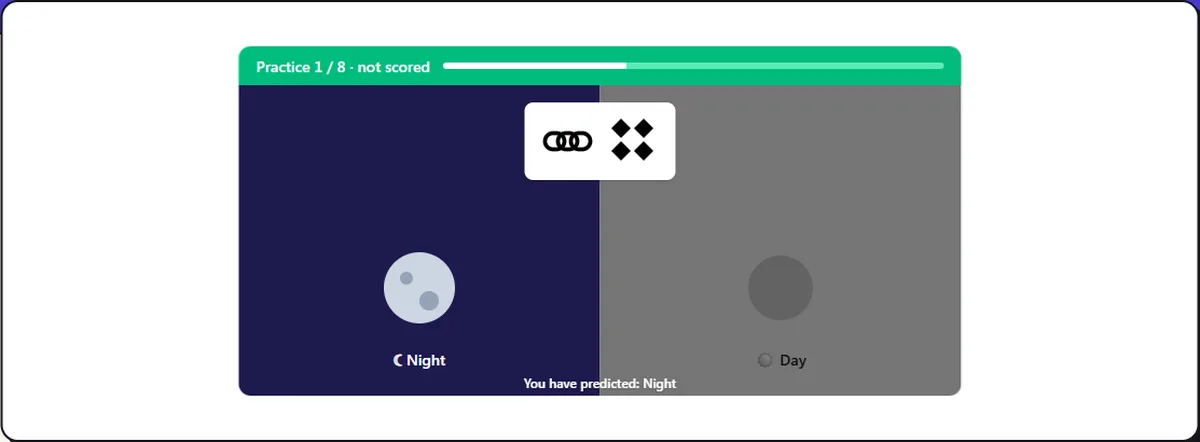
A candidate's screen recording of the real task (taken in September 2026) shows exactly how it runs:
- The screen is split: Night on the left, Day on the right, with the pair of icons on a card at the top, a round counter and a timer.
- Eight abstract icons, shown two at a time. Only eight fixed pairs ever appear, each icon belonging to two of them, and the left–right order within a pair never changes — the tutorial says to ignore it.
- Three seconds per round. You click a side; the other goes grey and "You have predicted: Day" appears. You can switch sides until the timer ends — whatever is selected then is recorded.
- Then the outcome: the winning scene fills the screen for about two seconds ("The actual outcome is: Night"). There are no points, ticks or crosses.
- Eight practice rounds that are not scored, then eighty that count.
- On the last eight rounds, after each choice, a slider asks: "On a scale of 0–10, how confident are you in your prediction?"
The twist is that the outcomes are probabilistic. The tutorial says so outright: the same pair won't always lead to the same outcome, so predict the one that seems most likely. A pair that is usually Day will still come up Night some of the time. Getting a round "wrong" after a sensible choice is normal and tells you very little.
This is a well-known kind of task in psychology — probabilistic category learning, of which the classic example is the "weather prediction" task (Knowlton et al., 1994; Gluck et al., 2002). Arctic Shores does not publish its rules, icons, probabilities or scoring, and its task sets change; one recording is one candidate's version, so treat your invitation and its tutorial screens as the source of truth.
What does it measure?
How quickly you learn from feedback and how sensibly you act on uncertain evidence: whether you build up a picture of each pair over time, whether you stick with the likelier answer after a surprise, and whether your sense of your own performance matches reality. It is closer to a skill than a trait — people get measurably better at it once the format is familiar.
Can you practise for it?
Yes. You cannot learn the real symbols in advance (they are not public, and they would not help — the pairs and their leanings are what you learn during the task). What you can practise is the strategy, and the format itself:
- Play the Predict (Day & Night) game: built to the recording — eight icons in eight fixed pairs, three seconds with changes allowed, eight practice rounds and eighty that count, and a 0–10 confidence rating on the last eight. It scores how often you back the likelier side after the first sixteen scored rounds, and shows your confidence next to how often those rated choices were right.
- If you want more rule-spotting under time pressure, the inductive reasoning game trains a related muscle, although Predict itself is about probabilities rather than fixed rules.
How do you do well on the day and night game?
- Keep a rough tally per pair. "This pair has been Day most times" beats reacting to whatever happened last round.
- Don't flip after one surprise. If a pair has gone Day four times and Night once, the Night was the 1-in-5. Stay with Day.
- Always have a side selected. Click early, then change if you need to — whatever is selected when the timer ends counts, and an empty round is a wasted bet.
- Use the early rounds to learn. You will be guessing at first — that is expected. Pay attention to which pair is which.
- Rate your confidence honestly. On the last rounds, a pair you have tallied well deserves a high rating and a pair you are unsure about a low one. Because feedback is noisy, even a strong run feels shaky — rate on your tally, not on the last surprise.
What else is in the Arctic Shores assessment?
Predict is usually one task among several. The Arctic Shores assessment guide covers the wider mix, the balloon game guide explains the risk task (with a free balloon game), and the lock game guide covers the Security task, a four-lock safe where one miss sends you back to the start.
FAQ
Is the day and night game luck or skill? Both, by design. Any single round is partly luck, but backing the likelier answer for each pair is a skill, and over eighty rounds the skill dominates.
Why do I keep getting it wrong even when I'm sure? Because no pair is certain. Being wrong on a reliable pair one time in five is the task working as intended — the mistake would be to change your answer because of it.
Do the icons mean anything? Not in any way you can know in advance. Treat them as labels and learn each pair from the feedback.
Is GamePrep's version the real one? No — it is an independent practice version that follows the structure seen in a candidate's recording. The icons and probabilities are our own; Arctic Shores publishes none of them, and we have no access to them.
GamePrep is an independent practice platform and is not affiliated with Arctic Shores. Arctic Shores does not publish its game rules and its assessments change — verify everything against your invitation. We provide practice only — no leaked questions or answers.