McKinsey Redrock Study: How It Works & How to Practice
The McKinsey Redrock Study is a newer Solve module built around gathering and interpreting research data to answer questions. Here is what candidates report, what it really measures, and how to train the data interpretation and working memory it demands for free.
TL;DR: The McKinsey Redrock Study is a newer module in the McKinsey Solve assessment (formerly Imbellus). It plays like a research simulation: you collect and read data about a scenario, then answer questions that hang on interpreting that data correctly. It measures data interpretation, numerical reasoning, and working memory — and Solve records how you work, not just your answers. You cannot rehearse the exact study, but the underlying data and memory skills are very trainable for free.
What the Redrock Study is
Candidates describe Redrock as more analytical and less "gamey" than the Ecosystem or Plant Defense tasks. You are dropped into a scenario — often framed around a population or environment to investigate — and asked to gather information, read charts and tables, and answer a linked series of questions. Later questions tend to build on earlier data, so you have to hold findings in mind as you go rather than treating each item in isolation.
Redrock is part of McKinsey Solve, the assessment that replaced what applicants once called the Imbellus test or the Problem Solving Game. Being a newer addition, accounts of it vary and the format is still evolving. McKinsey does not publish the rules, so treat your invitation and its tutorial as the only reliable description — not this page or any forum.
What it actually measures
At its core Redrock is a data interpretation and quantitative reasoning task. Can you read a chart or table accurately, pull the relevant number, do sound arithmetic, and draw a conclusion the data actually supports rather than one it merely suggests? That is the daily bread of consulting work, which is why McKinsey tests it directly.
There is also a real working memory load. Because questions build on information you gathered earlier, you need to retain and manipulate several facts at once — the same juggling act that separates careful analysts from people who lose the thread halfway through a problem.
And as across all of Solve, process data is captured. The tool can see how you approach the data, whether you check before answering, and how you handle a question that depends on an earlier one. So the goal is not a memorised answer key — it is demonstrating clean, careful analytical working.
How to practise the skills (free)
You cannot practise the real Redrock Study, but its two engines — data interpretation and working memory — respond well to training.
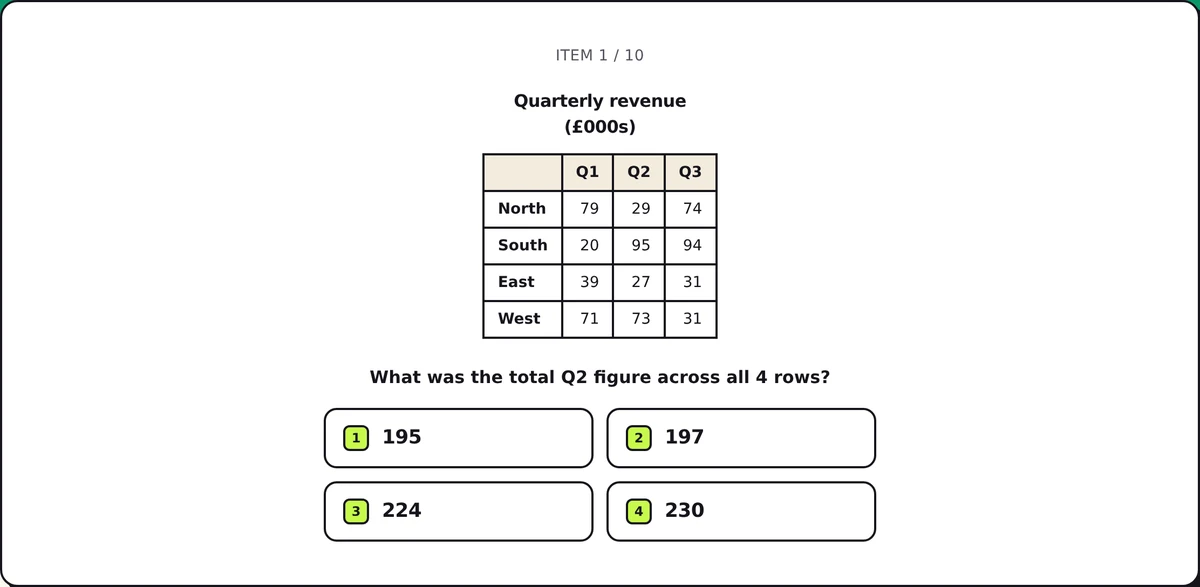
For the analytical half, use numerical reasoning. It gives you charts and tables to interpret under time pressure and drills the exact loop Redrock rewards: find the relevant figure, reason about it, and answer only what the data supports. For the memory half, visual memory (Corsi block) and the n-back memory test build your capacity to hold and update several pieces of information at once — so that when a later question leans on something you saw earlier, it is still there to use.
These train the underlying skills, not a replica of the McKinsey study. What transfers is the habit of reading data precisely and keeping your findings in mind as a problem unfolds.
The rest of McKinsey Solve
Redrock is one module among several. The McKinsey Solve game guide covers the whole assessment and how it is scored, and the complete guide to game-based hiring assessments puts McKinsey in context next to HireVue, pymetrics, and Arctic Shores.
If your Solve invite also includes the famous food-chain task, the McKinsey Ecosystem Building game guide explains that one — a very different, more spatial kind of problem.
FAQ
Is Redrock a maths test? Partly. It leans harder on reading and interpreting data than on heavy calculation, but sound arithmetic and confidence with charts and tables both matter. It is closer to a data-interpretation task than a pure numbers drill.
Can I get the answers to Redrock? No. The scenario and data vary between sittings, and Solve grades your process — how you gather, check, and reason — alongside your answers. A leaked answer key could not match a changed dataset or reproduce the careful working the tool is designed to observe.
How do I stop losing track of earlier data? Train working memory directly. Short regular sessions on n-back and Corsi-block tasks build the capacity to retain and update facts, which is exactly what Redrock's build-on-earlier-questions structure demands.
Is Redrock on every McKinsey Solve invite? Not necessarily. Solve's module mix changes, and Redrock is a newer addition. Your invitation is the only reliable guide to what you will actually face.
GamePrep is an independent practice platform and is not affiliated with McKinsey & Company. McKinsey does not publish its game rules and the Solve assessment changes — verify everything against your invitation. We provide related skills practice only — no leaked questions or answers.