MindmetriQ Games (Test Partnership): All Six Explained + Free Practice
MindmetriQ is Test Partnership's six-game gamified assessment — Pipe Puzzle, Shape Spinner, Word Logic, Like Swipe, Link the Numbers and Number Racer. What each one measures, why the adaptive scoring means you will not finish, and free practice for the ones that are trainable.
TL;DR: MindmetriQ is a six-game series from Test Partnership, each game running roughly 4–7 minutes, together measuring general cognitive ability. It is computer-adaptive: get an item right and the next is harder, get one wrong and it eases off. That design means almost nobody finishes at their ceiling feeling comfortable — which is normal, not a bad sign. Most of these games map onto skills you can genuinely train.
The six games
Test Partnership names them, which is unusually helpful — most vendors do not:
| game | what it loads |
|---|---|
| Pipe Puzzle | spatial planning and routing |
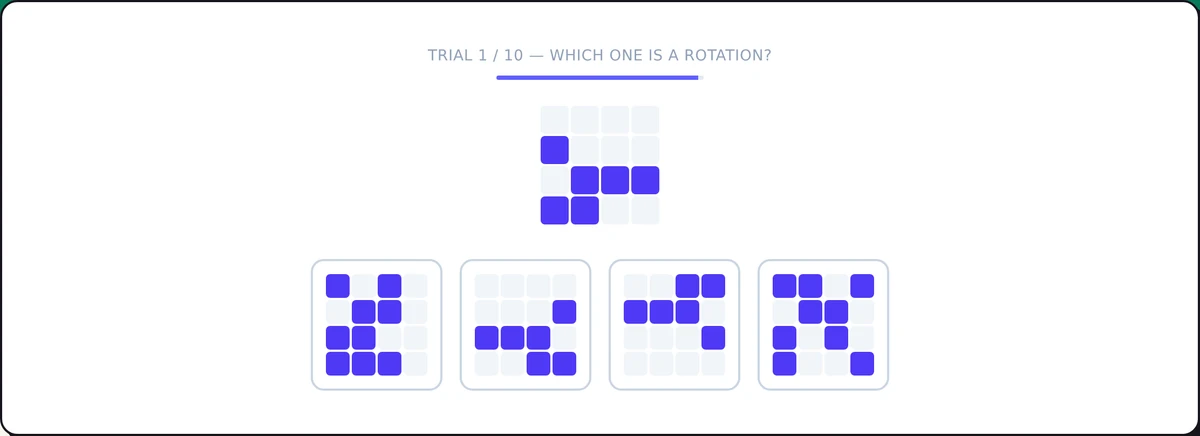
| Shape Spinner | mental rotation |
| Word Logic | verbal and logical reasoning |
| Like Swipe | rapid judgement under time pressure |
| Link the Numbers | numerical sequencing and attention |
| Number Racer | numerical fluency at speed |
Together they are designed to measure general cognitive ability — the single broad factor that predicts job performance better than any narrow skill. That is why the set spans spatial, verbal and numerical rather than testing one thing deeply.
Test Partnership does not publish the item internals and the series evolves, so your invitation and its tutorial screens are authoritative, including over this page.
The adaptive scoring changes how you should play
This is the part worth understanding before you sit down.
MindmetriQ uses computer adaptive testing: each correct answer nudges the difficulty up, each incorrect one nudges it down. The software is not counting how many you got right — it is triangulating the level you can sustain.
Three consequences:
- Feeling stretched at the end is the design, not a verdict. Adaptive tests converge on your ceiling, so nearly everyone finishes on items they cannot comfortably solve.
- A weak start costs more than a weak finish. Early misses drag the difficulty down before the test has your measure; late misses are just your ceiling being found. Warm up before you begin.
- Accuracy beats volume. Rushing to attempt more while your error rate climbs produces a lower estimate than a steadier, more accurate run.
One genuinely encouraging finding Test Partnership reports: a large majority of candidates found MindmetriQ less anxiety-provoking than traditional tests. The game framing is doing real work — but the measurement underneath is a serious psychometric instrument, not a toy.
Which ones you can actually train, and where
Four of the six map cleanly onto skills that respond to practice.
Shape Spinner → mental rotation. Rotating and matching figures in your head is a trainable reflex, and one of the fastest to improve. Practise at /practice/shapedance-mental-rotation.
Pipe Puzzle → spatial planning. Routing under constraints rewards the look-before-you-move habit and punishes improvising. The pathfinder puzzle is the matching drill.
Number Racer and Link the Numbers → numerical fluency and speed. Fast, accurate work with numbers under a clock. Drill the arithmetic reflex at /practice/mental-math-numerical, rapid quantity judgement at /practice/numerosity, and sequencing under distraction at /practice/disco-numbers.
Word Logic → verbal and logical reasoning. Partly trainable through general rule-inference — inductive reasoning trains spotting the governing rule — but we do not have a verbal clone, and we would rather say so than pretend.
Like Swipe is the one we will not characterise in detail. Candidate descriptions vary and Test Partnership does not publish the mechanics, so anything specific we wrote would be guesswork. Treat the tutorial screen as your briefing.
Every run here is scored on the server against fixed norms and returns a percentile, so one cold pass across the matching games takes about fifteen minutes and tells you which is weakest. See how we score for what those percentiles are and are not.
Preparing for test day
- Baseline first, cold. Play each matching game once before reading any strategy. That number is your honest starting point, and it stops you drilling the wrong thing.
- Short, spaced sessions. Ten focused minutes a day beats one long grind. These tasks degrade with fatigue, and a tired session teaches bad pacing.
- Warm up immediately before the real thing. Two or three quick rounds, so the assessment is not also your cold start — which matters more than usual on an adaptive test.
- Read every tutorial slowly. Six short games means six sets of rules, and seconds lost decoding one are seconds not spent on it.
- Use a stable device with notifications off. Timed games punish friction and interruption more than almost anything else in a battery.
For the wider picture, see the Test Partnership cognitive guide and the complete guide to game-based assessments. For why no employer publishes a pass mark, see what counts as a good game assessment score.
FAQ
What is MindmetriQ? A series of six gamified cognitive assessments from Test Partnership, each lasting roughly 4–7 minutes, together measuring general cognitive ability.
What games are in MindmetriQ? Pipe Puzzle, Shape Spinner, Word Logic, Like Swipe, Link the Numbers and Number Racer.
How long does the whole thing take? Each game runs about 4–7 minutes, so a full series is well under an hour. Employers may use a subset — your invitation is the reliable guide.
Is MindmetriQ adaptive? Yes. Difficulty rises after correct answers and falls after incorrect ones, so the test converges on your ceiling. Finishing on items you cannot solve is expected.
Can you practise for MindmetriQ? For most of it, yes. Mental rotation, spatial planning and numerical speed all respond measurably to short daily practice. Verbal reasoning is partly trainable; we do not have a direct verbal clone.
Is there a pass mark? None is published, and you will not see a score. Results are compared against other applicants and against a profile the employer sets for the role.
Is it easier than a traditional aptitude test? Candidates consistently report it as less stressful, which is not the same as easier. The psychometrics underneath are as serious as any conventional test.
GamePrep is an independent practice platform and is not affiliated with Test Partnership. Game names, formats and combinations vary by employer and change between cycles — verify everything against your invitation. We provide related practice only — no leaked questions or answers.