Data Entry Test
KPH, Accuracy Targets and How to Prepare
A data entry test measures keystrokes per hour (KPH) and accuracy while you copy records into a form. Commonly cited targets, how KPH is counted, and how to get faster without errors.
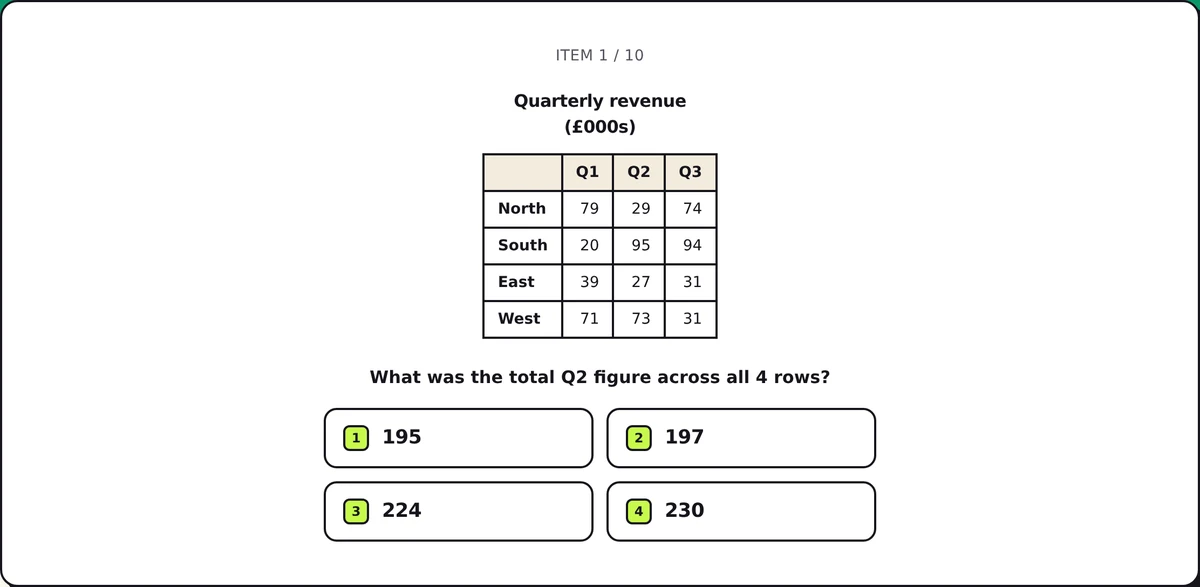
A data entry test measures how fast and how accurately you copy records into a form, reported as keystrokes per hour (KPH) and an accuracy percentage. Figures commonly cited in job ads and by test vendors put 8,000 to 10,000 KPH as acceptable for alphanumeric entry and 12,000 KPH or more as strong, with 98% accuracy or better expected. Accuracy usually matters more than speed. You can measure yourself on ten invoice records in five minutes with our free data entry test practice, which reports KPH, words per minute and accuracy per field. GamePrep is independent and not affiliated with eSkill, TestGorilla, Indeed, Kenexa or any other test publisher.
Who uses data entry tests
Data entry tests are common for clerical and administrative roles: data entry clerks, administrative assistants, accounts payable and receivable, medical records and insurance claims, order processing and back-office customer service. Staffing agencies often test every clerical candidate before putting them forward. The tests come from general skills platforms (eSkill, TestGorilla, Indeed Assessments and Kenexa Prove It are names candidates commonly report) or from the agency's own software.
The formats
- Alphanumeric entry: a source record (name, address, invoice number, date, amount, code) and a form with matching fields. This is what our practice uses.
- Numeric ten-key: columns of numbers typed on the number pad, measured in KPH. Rates expected here are usually higher than for alphanumeric entry.
- Typing test: a passage typed in words per minute.
- Checking: two lists side by side; mark the lines that differ.
How KPH is counted
KPH is keystrokes divided by time, scaled to an hour. Typing 900 characters in 5 minutes is 900 × 12 = 10,800 KPH. Platforms differ in what counts as a keystroke: some count every key press including Backspace, some count only the characters in the final answer. Divide KPH by 300 for a rough words per minute at five keystrokes a word: 10,000 KPH is about 33 WPM. Form entry is slower than free typing, because you read a source, switch fields and copy codes that are not words, so do not compare it directly with a typing-test WPM.
Accuracy is either the share of fields entered exactly right or the share of characters right. A field with one wrong digit in an invoice number is a wrong field, even though 13 of 14 characters are correct, which is why employers set the bar at 98% or higher.
A worked example
Source record:
| Field | Value |
|---|---|
| Customer name | Maria Okafor |
| Invoice no. | INV-2026-04817 |
| Amount ($) | 1,284.50 |
Typing "INV-2026-04871" swaps two digits: two character edits out of 14, so the field is 86% right by characters and 0% right as a field. Typing "1284.50" drops the comma: one character out of 8. Typos like these cost more than speed buys back, so slow down on codes and amounts.
How to get faster without errors
- Touch type. Keep your eyes on the source, not the keys. If you look down, learn the number row and the punctuation keys first, since codes and amounts are full of them.
- Read in chunks. Read "INV-2026-04817" as INV, 2026, 048, 17 and type each chunk without glancing back.
- Use Tab and Enter. Moving between fields with the mouse breaks your rhythm.
- Watch the look-alikes: 0 and O, 1 and I, 5 and S, 8 and B, and the leading zero of a ZIP code.
- Keep a steady pace. A rhythm you can hold for the whole test beats bursts followed by corrections.
- Practise numbers on their own, on the number pad if the job mentions ten-key.
Take the data entry test practice once a day for a week. Each run generates new records, so your KPH and accuracy show real improvement rather than memory. A physical keyboard is strongly recommended; the practice works on a phone, but that is not what employers measure. If the role also asks for spreadsheet skills, try the Excel test practice.
FAQ
What is a good KPH for data entry? Commonly cited figures put 8,000 to 10,000 KPH as acceptable for alphanumeric entry and 12,000 KPH or more as strong, with numeric ten-key rates expected higher.
How accurate do I need to be on a data entry test? Many employers ask for 98% accuracy or better, and accuracy usually counts for more than speed.
How do I convert KPH to WPM? Divide by 300 (60 minutes and 5 keystrokes per word): 12,000 KPH is about 40 WPM.
How long is a data entry test? Usually 5 to 15 minutes. Our practice runs for 5 minutes or until all ten records are entered.
Is the GamePrep practice the real eSkill or TestGorilla test? No. GamePrep is independent and not affiliated with eSkill, TestGorilla, Indeed, Kenexa or any test publisher. The records are invented and generated fresh for each run.
GamePrep is an independent practice site and is not affiliated with eSkill, TestGorilla, Indeed, IBM Kenexa or any other test publisher or staffing agency. Product names are used only to describe those products.