SHL General Ability Test (Verify G+)
Format, Scoring and Practice
The SHL General Ability test (Verify G+) is 30 multiple-choice numerical, deductive and inductive questions in 36 minutes, adaptive and forward only. The two versions, what the employer sees, what a good score means, and a 72-second pacing plan.
The SHL General Ability test, sold as Verify G+, is a 36-minute adaptive reasoning test of 30 multiple-choice questions: 10 numerical, 10 deductive and 10 inductive, according to SHL's own fact sheet (SHL Verify G+ fact sheet). An interactive version, Verify Interactive G+, covers the same three abilities with 24 drag-and-drop tasks in the same 36 minutes. Either way the employer receives percentiles against a comparison group, not a pass or fail, and there is no published cut-off. You can rehearse the multiple-choice format on our free SHL-style general ability test.
TL;DR
- Format: 30 questions, 36 minutes, multiple choice, adaptive, one sitting. That is 72 seconds per question.
- Two versions: multiple-choice G+ (30 questions) or Interactive G+ (up to 24 tasks). Same three abilities, same clock.
- Rules: no going back to a submitted answer; per SHL's support pages, wrong answers do not cost extra.
- Scoring: a percentile for general ability plus one for each ability, against a named comparison group.
- Good score: nobody publishes cut-offs. Aim to sit clearly above the middle in all three areas.
Multiple-choice vs Interactive G+
| Verify G+ (multiple choice) | Verify Interactive G+ | |
|---|---|---|
| Questions | 30 (10 numerical, 10 deductive, 10 inductive) | Up to 24 |
| Time allowed | 36 minutes (SHL gives an average of 32–36) | 36 minutes |
| Per question | 72 s | ~90 s |
| Answer format | Choose one of several lettered options | Drag bars and wedges, schedule, rank, tap cells, link nodes |
| Adaptive | Yes | Yes |
| Report | General ability plus three ability scores | General ability plus three ability scores |
| Source | SHL fact sheet | SHL fact sheet |
| Practise here | SHL-style general ability test | SHL-style interactive test |
Your invitation, or the first screen of the test, tells you which version you have. If it mentions dragging or the instructions say "adjust the chart", it is Interactive G+; our Verify Interactive guide walks through each of its six task types.
What each section asks
SHL's fact sheet describes the three abilities like this:
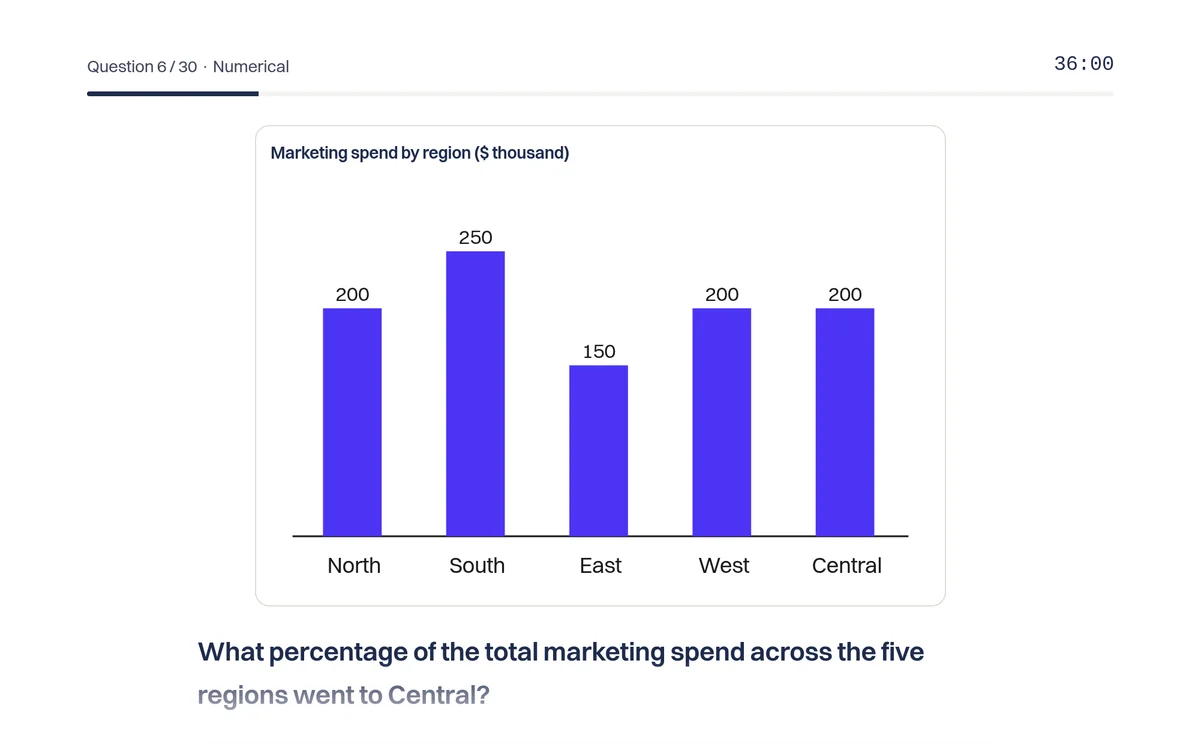
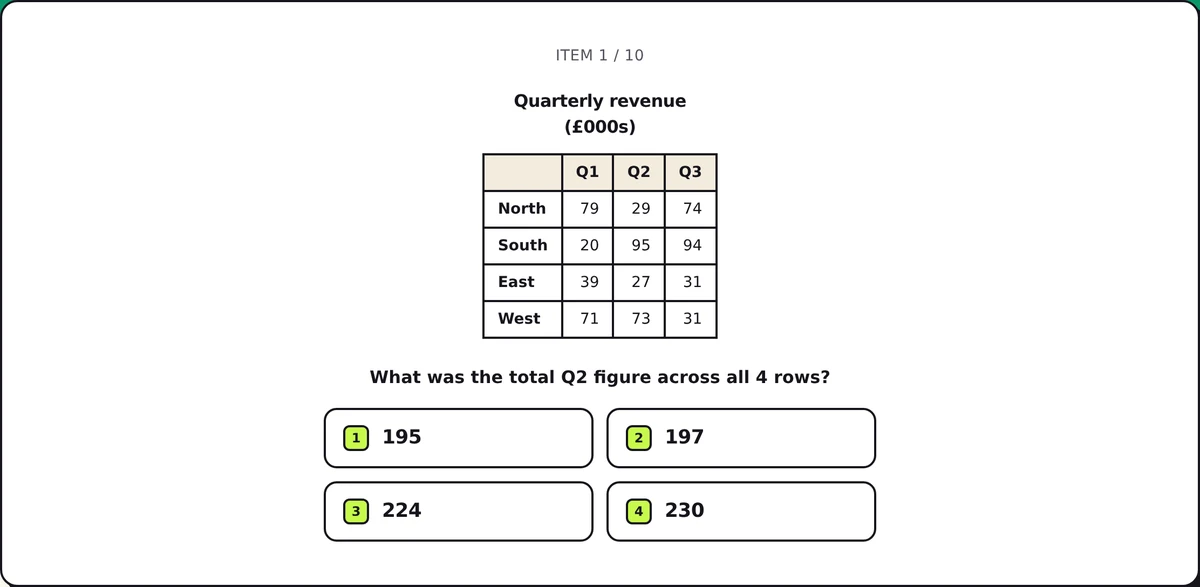
- Numerical: "solve problems involving numerical data" and "interpret data presented in charts, graphs, and tables". Expect percentages, ratios, reverse percentages and changes over time.
- Deductive: "draw logical conclusions based on information provided, identify strengths and weaknesses of arguments, and complete scenarios using incomplete information". Typically a few facts and the question "which of the following MUST be true?"
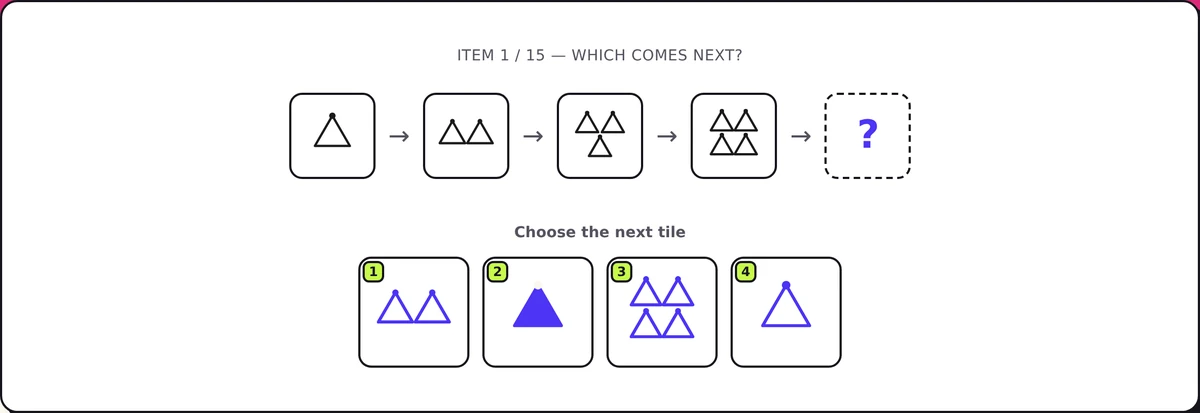
- Inductive: "completely non-verbal" questions with "only shapes and figures", where you infer the rule and apply it.
Three short examples, written by us in the same style (not SHL questions):
Numerical. After a 20% price rise a ticket costs £54. What did it cost before? £54 is 120% of the old price, so £54 ÷ 1.2 = £45. The trap answer is £54 × 0.8 = £43.20, which takes 20% off the new price instead of reversing the rise.
Deductive. All the reports Lena reviews are sent to finance. Some reports sent to finance are late. Lena reviewed the March report. Which must be true? The March report was sent to finance. "The March report was late" is only possible: the late reports are some of the reports sent to finance, not necessarily Lena's.
Inductive. A row of four squares shows a dot moving one corner clockwise in each square, while the number of stripes goes 1, 2, 3. The fifth square has the dot one more corner round and 4 stripes. Check each feature (position, count, shading, rotation) on its own.
For many more deductive formats with full solutions, see our SHL deductive reasoning test guide.
Rules you need to know before you start
- You cannot go back. SHL's candidate support explains that you cannot return to questions "because the difficulty level of each question is determined by the answers to previous questions" (SHL candidate support).
- Wrong answers do not cost extra. An SHL support article on the same pages says incorrect responses "do not affect your test score" and that you may not leave a question blank. A reasoned guess always beats running out of time.
- Calculators: check your instructions. SHL's support articles conflict. One allows a calculator for numerical tests "unless you have been instructed otherwise", one allows only an embedded on-screen calculator, and one says calculators are not allowed but pen and paper are. Have pen and paper ready and follow what your invitation says.
- One sitting, unsupervised. The fact sheet lists "Number of Sittings: One" and says the test is designed for an unsupervised setting. Some employers re-test shortlisted candidates later.
What the employer sees
SHL's sample Verify Interactive G+ report shows the shape of the result. There are four percentile bars: G+ (general ability) and one each for inductive, numerical and deductive reasoning. Each is "compared to" a named comparison group, and a percentile of 50 means the candidate did "better than 50% of the people in this group". The report also gives T-scores and sten scores for trained users, and it advises employers to weigh the result alongside interviews, work simulations and other evidence. SHL publishes the multiple-choice G+ fact sheet with the same structure: "Candidates will receive a score on each of the specific abilities as well as a general ability score."
Two things follow. First, an uneven profile is visible: a strong overall score with one weak area shows up as one short bar. Second, the score is relative. The same raw performance can be a high percentile against a general-population group and an ordinary one against a graduate group.
What is a good SHL General Ability score?
There is no universal pass mark, and employers do not publish theirs. Prep sites that quote a fixed "pass percentile" are describing, at best, one employer in one year.
The one public example we found is the European Commission. A candidate-prep site reports that the Commission's 2026 internal competitions (COM/AD/107, COM/AD/108, COM/AST/109) open with an adaptive interactive cognitive test and that candidates must reach the 60th percentile of a fixed reference population to continue (eu-now). The same page notes that the official notice names only an "external psychometric testing company", not SHL or G+. So treat it as an example of how a cut-off can work, not as an SHL norm.
A practical target for competitive graduate schemes: be comfortably above the middle of the comparison group, and even across all three abilities.
A 72-second pacing plan
36 minutes for 30 questions is 72 seconds each. The questions differ in length, so pace in blocks rather than per item:
- Checkpoints. Aim to be at question 10 by minute 12, question 20 by minute 24, and question 30 by minute 36. A quick glance at the timer every ten questions is enough.
- Two-minute ceiling. If a question has taken two minutes and you are not close, eliminate what you can and choose. You cannot come back to it, and a blank earns nothing.
- Estimate first on numerical items. Many options can be ruled out by rough size. Only calculate exactly when two options are close.
- Write the rules down for deductive items. A three-line sketch of who or what is linked to what usually settles "must be true" in under a minute.
- One feature at a time for inductive items. Position, number, shading, rotation. Test your rule on every frame, not just the last two.
- Settle in fast. The test is adaptive, so careful early answers matter. Do a warm-up question set before you start the real test.
How to prepare in a week
- Day 1: take SHL's free general ability practice on SHL Direct to see the real interface, then one full run of our SHL-style general ability test as a baseline. It gives you 30 fresh questions in 36 minutes, forward only, with a result for each area.
- Days 2–5: short daily drills of your weakest area: numerical reasoning, deductive reasoning or inductive reasoning.
- Day 6: a second full timed run on the device you will use, using the checkpoints above.
- Day 7: a light warm-up and rest.
FAQ
How many questions are in the SHL General Ability test? The multiple-choice Verify G+ has 30 questions, 10 each of numerical, deductive and inductive reasoning, in 36 minutes. The interactive version has up to 24 tasks in the same time.
Is SHL Verify G+ adaptive? Yes. SHL lists the question format as "Multiple choice, Adaptive", which is also why you cannot go back to change a submitted answer.
What does the employer see from an SHL General Ability test? A report with percentiles against a named comparison group: one for general ability and one each for numerical, deductive and inductive reasoning, as in SHL's sample report.
What is the pass mark for SHL Verify G+? There is no published pass mark. Each employer chooses its own cut-off and comparison group and does not publish them. Aim to sit clearly above the middle of the group in every area.
How long do I have per question in Verify G+? 36 minutes for 30 questions is 72 seconds each on average. In the interactive version it is about 90 seconds per task.
Is the GamePrep test the real SHL General Ability test? No. GamePrep is independent and not affiliated with SHL. Our test uses the same format with original questions written for GamePrep, and it is fixed-length rather than adaptive.
GamePrep is an independent practice platform and is not affiliated with SHL. The example questions on this page were written by GamePrep and are not SHL questions. Assessment formats evolve; treat your invitation and SHL's official practice materials as the source of truth. We provide practice only: no leaked questions or answers.