Cognify Proof It
How the Proofreading Game Works and How to Find Every Error
Proof It is the verbal game in Criteria Cognify, a timed proofreading task. You click the misspellings, wrong words, capitalisation and punctuation errors and double spaces in short documents. How it works, the three-strike rule, and free practice.
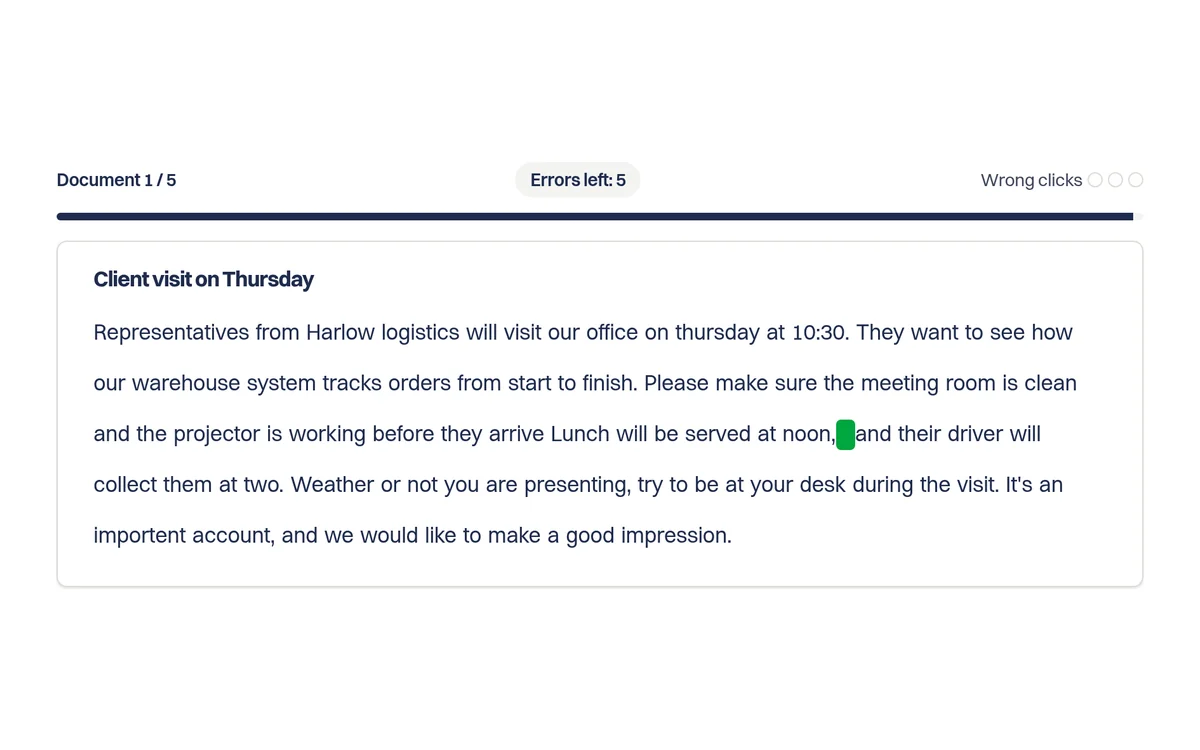
Proof It is the verbal game in Criteria's Cognify assessment, and it is a proofreading task: you get a short document and click every error in it before time runs out. Criteria says it "measures Verbal abilities such as identifying misspelled words and punctuation errors" (Criteria overview PDF, 2023). It is in every version of Cognify, alongside Grid Lock and Numbubbles. It is not reading comprehension: nothing asks what follows from the text. You can practise the same format free in our proofreading test.
How Proof It works
Criteria publishes no rules beyond the description above. Prep providers and candidates describe the rest (Game Assessment Prep), so treat these details as reported, not official:
- A short document on a word-processor-style page, such as a memo or an email.
- You click every error: "misspellings, punctuation slips, capitalisation, wrong words and even double spaces".
- A gauge shows how many errors are left, so you know when you have found them all.
- Three incorrect clicks end the document. Candidates also report being "kicked out for clicking twice on a double space", so clicking an error you have already found seems to count against you.
- Five documents in about five minutes. How many errors each document holds is not published.
On the employer's report, Proof It feeds the verbal knowledge percentile, one of three sub-scores next to the overall Cognify percentile (Criteria).
The kinds of error to look for
- Misspellings: recieve, seperate, occured. Usually easy, but they hide in long words you read by shape.
- Wrong words: a real word in the wrong place, such as their for there, then for than, affect for effect, or its for it's. A spell-checker would pass them, and so do quick readers.
- Capitalisation: a sentence that starts in lower case, or a name, day or month written in lower case (monday, london).
- Punctuation: a full stop missing at the end of a sentence, a dropped apostrophe (dont), a doubled comma.
- Double spaces: two spaces between words. They are easy to miss and you have to click the space itself, not the word next to it.
How to find more of them
- Read every word at an even pace. Scanning for typos finds misspellings and misses wrong words. Reading each sentence once, as a sentence, catches both.
- Check the edges of sentences. Capital letters at the start and the full stop at the end are where errors are easiest to plant and to miss.
- Use the gauge. If it still shows errors when you reach the end, go back over the sentences you read fastest.
- Only click when you are sure. With three strikes per document, a guess costs more than it earns.
Our proofreading test uses the same rules: five documents, 60 seconds each, a remaining-errors gauge and three wrong clicks per document. Your score is errors found minus wrong clicks, and every error you missed is listed with its correction afterwards. The documents and errors are written for GamePrep, not taken from Criteria.
For the other two games and the six-game version of Cognify, see our Criteria Cognify guide.
FAQ
What is Cognify Proof It? The verbal game in Criteria Cognify: a timed proofreading task in which you click the spelling, wrong-word, capitalisation and punctuation errors and double spaces in short documents.
Are there Proof It answers? No. Each document's errors are what you have to find, and the documents vary, so there is nothing to memorise. Practising the reading habit is what helps.
What happens if I click the wrong word? Candidates report that three wrong clicks end the document, and that clicking an error you already found counts as a wrong click.
How can I practise Proof It? Our free proofreading test follows the same format and shows every error you missed. Proofreading your own writing slowly, sentence by sentence, also helps.
GamePrep is an independent practice platform and is not affiliated with Criteria. Proof It is Criteria's name for its game; ours is an original practice version. Formats can change, so verify against your invitation. We provide related practice only: no leaked questions or answers.