Free Aptitude Tests
Practise Every Type Employers Use
Every kind of aptitude test employers send, in one place, with a free timed practice test for each: numerical, verbal, abstract, logical, mechanical, spatial, cognitive ability, situational judgement, game-based and personality.
An aptitude test is a timed test of how well you reason with numbers, words, shapes or rules, used by employers to compare candidates before an interview. Almost every test you can be sent belongs to one of four families: ability tests (numerical, verbal, abstract, logical, mechanical, spatial), game-based assessments, situational judgement tests and personality questionnaires. Below is each type, what it looks like, and a free practice test for it that is timed and scored as a percentile the moment you finish.
The four families of aptitude tests
| Family | What it measures | How it is scored | Can practice help? |
|---|---|---|---|
| Ability tests | Reasoning with numbers, words, shapes, rules, mechanics | Correct answers against a time limit, as a percentile | Yes: format, speed and strategy all improve |
| Game-based assessments | Memory, attention, speed, risk and learning style | Speed and accuracy in each game, compared with other candidates | Yes, mostly through familiarity with the formats |
| Situational judgement tests | Judgement in realistic work situations | Agreement with an expert key | Yes: knowing the format and the employer's values |
| Personality questionnaires | Typical behaviour at work | A profile, not a right or wrong score | Only the format; answer honestly |
Ability tests
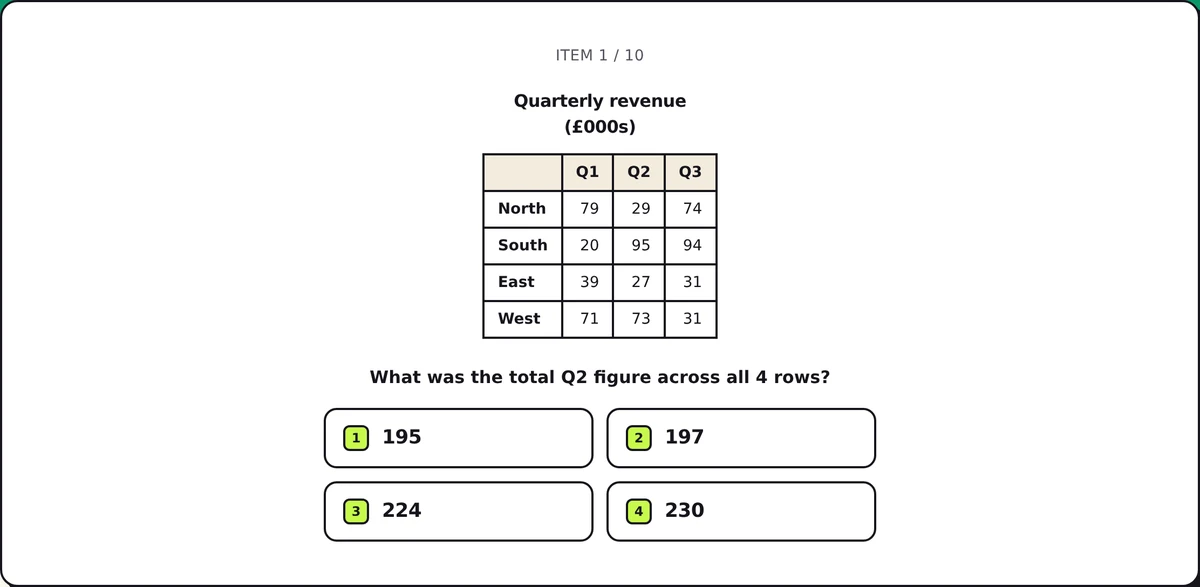
Numerical reasoning. Read tables and charts and answer data-interpretation questions under time: percentages, ratios, changes between years. Used by banks, consultancies and most graduate schemes (SHL, Cappfinity, Aon, Kenexa). Warm up the arithmetic with mental maths.
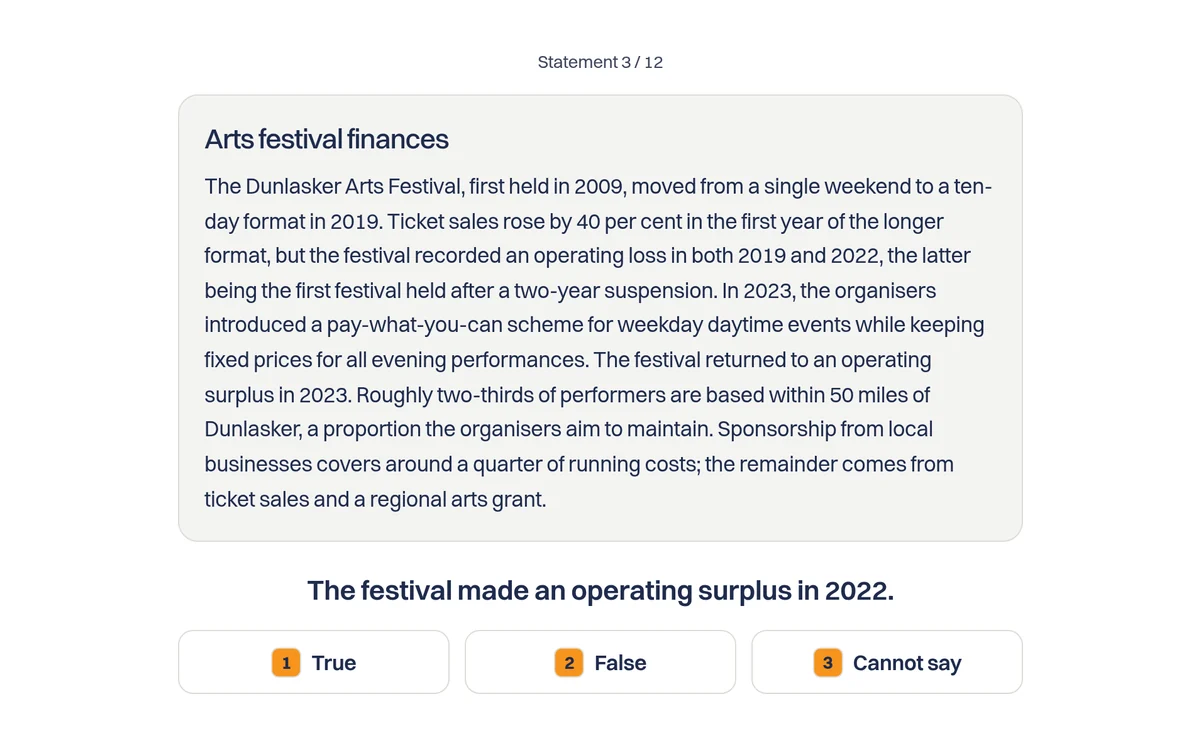
Verbal reasoning. Read a short passage and decide whether each statement is true, false or cannot say, using only the passage. The most common graduate test after numerical.
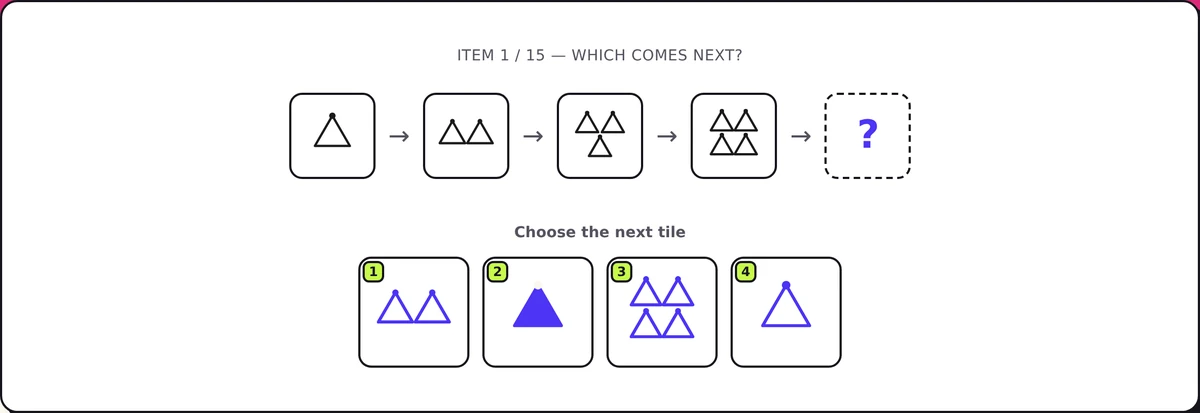
Abstract reasoning. Spot the rule in a row of shapes and pick what comes next. No knowledge needed; also called inductive, diagrammatic or non-verbal reasoning.
Logical reasoning. Read a few facts and decide which conclusion must be true. Some publishers call this deductive reasoning. The critical thinking test (Watson-Glaser style) is its law-firm cousin.
Cognitive ability tests. Short, fast mixed tests of verbal, numerical and logic questions: the Wonderlic (50 questions in 12 minutes) and the Criteria CCAT (50 in 15). Almost nobody finishes, which is the point. Practise both formats with the Wonderlic-style test and the CCAT practice test.
Mechanical aptitude. Gears, levers, pulleys, belts and springs drawn as diagrams: which way does the last gear turn, how much force lifts the load. Used for engineering, manufacturing, trades, utilities and apprenticeships.
Excel and data entry tests. Office and admin roles test the skill directly: formula results on a small spreadsheet (SUMIF, VLOOKUP, absolute references), or copying records into a form for speed (keystrokes per hour) and accuracy.
Spatial reasoning. Decide whether a rotated shape is the same as another or its mirror image. Common in engineering and technical roles, and inside game-based assessments.
Game-based assessments
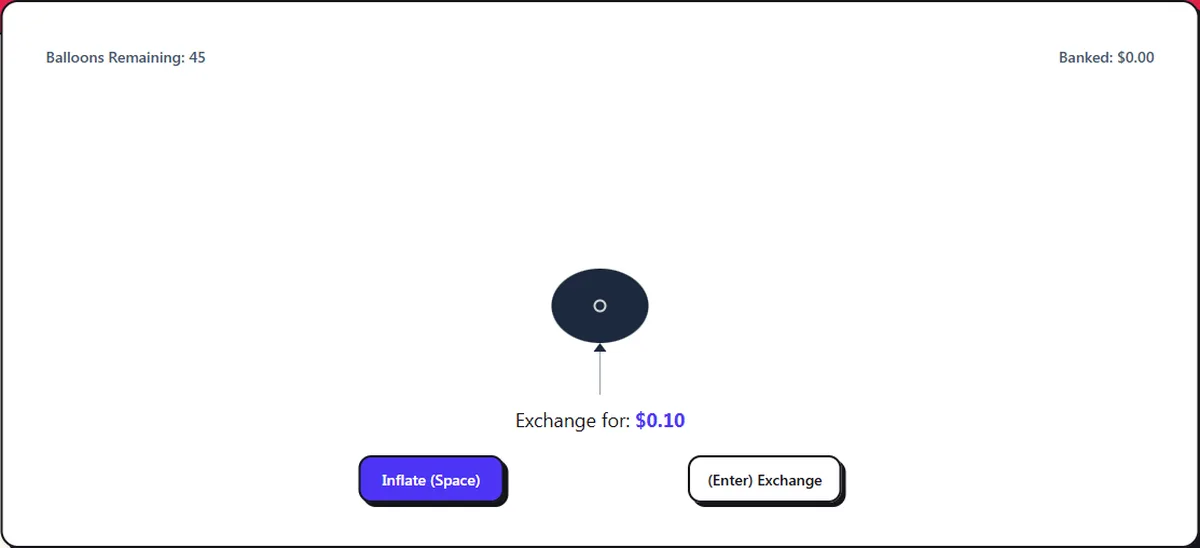
Pymetrics (Harver), Arctic Shores, HireVue, Cappfinity and Aon wrap the same skills in short games: memory, reaction time, attention under interference, impulse control, task switching and risk. There is no studying for them, but playing the formats beforehand removes the surprise that costs most people points. Every game we have is on the home page; the readiness check shows which ones a given employer uses.
Situational judgement tests
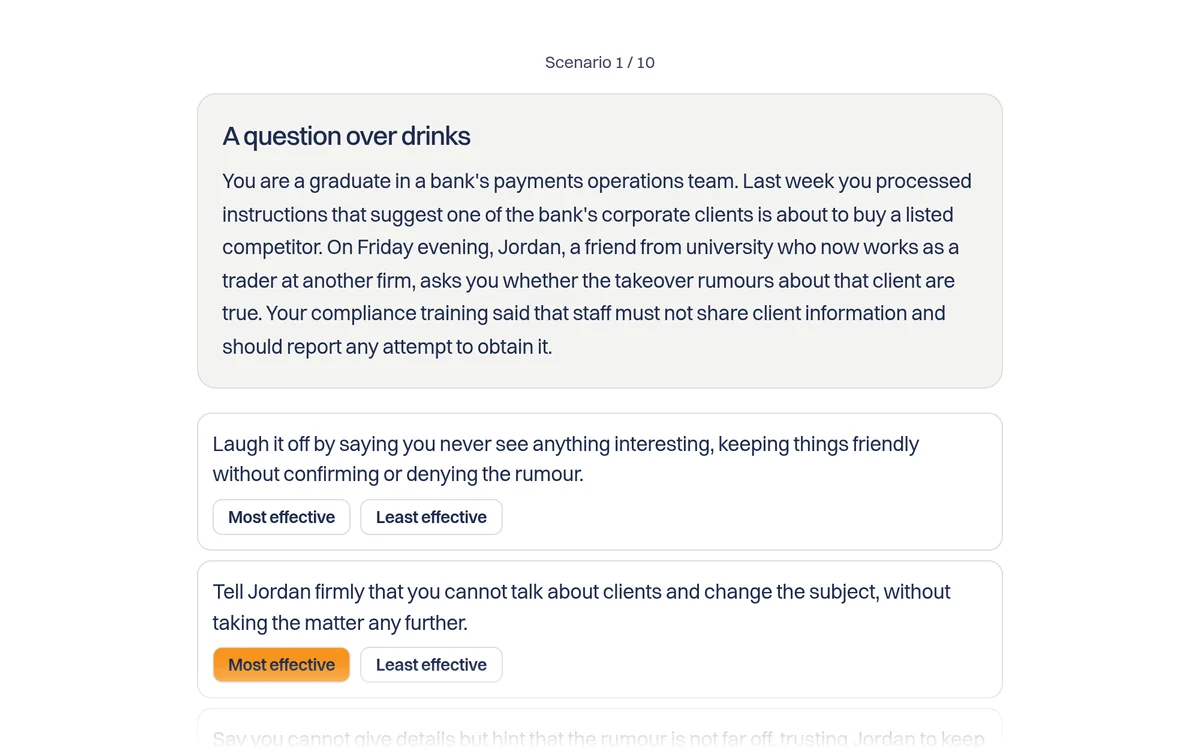
A situational judgement test describes a moment at work and asks which response is most and least effective. The key is written by people who know the job, so read the employer's values first and practise the format until the distinction between acting, escalating and overstepping feels natural.
Personality questionnaires
Hogan, SHL's OPQ and Saville's Wave ask how you usually behave at work, in true/false or agree/disagree statements. There is nothing to drill and faking an ideal profile tends to show up as inconsistency. What helps is knowing the format; our work personality questionnaire shows you what such a profile looks like, and the Hogan assessment guide explains how employers read it.
How to find out which test you will sit
- Read the invitation email. It usually names the provider (SHL, Aon, Cappfinity, Criteria, Wonderlic, Hogan, HireVue, Arctic Shores) and often the sections.
- Look at the login page. The platform's address and logo give the provider away even when the email does not.
- Check the employer. Our employer pages list what each employer is reported to use.
How to prepare in a week
- Day 1: take each test type you expect once, cold, and note the percentile. That is your baseline.
- Days 2 to 5: two or three short timed runs a day of your two weakest types. Short and often beats one long session.
- Day 6: a full-length run of each section in the real time limit.
- Day 7: one warm-up run, then rest. Sleep moves reaction and reasoning scores more than a last evening of practice.
FAQ
What is an aptitude test? A timed test of how well you reason with numbers, words, shapes, rules or mechanical problems, used by employers to compare candidates before an interview. Scores are reported as a percentile against other candidates.
Are these aptitude tests really free? Yes. Every practice test here is free to play, with no sign-up, and is scored as a percentile when you finish. A free account keeps your scores; a paid pass adds the full readiness report and plan.
What types of aptitude tests are there? Ability tests (numerical, verbal, abstract, logical, mechanical, spatial and short cognitive ability tests such as the Wonderlic and CCAT), game-based assessments, situational judgement tests and personality questionnaires.
Can you prepare for an aptitude test? Yes. You cannot memorise a well-built test, because questions vary between candidates, but familiarity with the format, a timing strategy and faster arithmetic and pattern-spotting all raise scores. Personality questionnaires are the exception: learn the format, then answer honestly.
What is a good aptitude test score? Results are percentiles against a comparison group, and employers rarely publish their cut-offs. For competitive roles, aim to be clearly above the middle of the group, with high accuracy on the questions you answer.
How long is an aptitude test? Most sections take 10 to 25 minutes. Short cognitive ability tests run 12 to 15 minutes for 50 questions; game-based assessments take 20 to 40 minutes in total.
GamePrep is an independent practice platform, not affiliated with SHL, Aon, Cappfinity, Criteria, Wonderlic, Hogan, Harver, HireVue, Arctic Shores or any other assessment vendor. We provide practice only: no leaked questions or answers.