Hogan Assessment
The Hogan Personality Inventory, HDS and MVPI Explained
The Hogan assessment is usually three questionnaires. The Hogan Personality Inventory has 206 true/false statements and takes 15 to 20 minutes. What each part measures, how employers read it, and how to prepare honestly.
TL;DR: "The Hogan assessment" usually means up to three personality questionnaires from Hogan Assessments, sent together or alone. The Hogan Personality Inventory (HPI) has 206 true / false statements, takes 15 to 20 minutes and reports seven primary scales plus a validity scale (Hogan HPI overview). The Hogan Development Survey (HDS) reports 11 scales of behaviour under strain, and the Motives, Values, Preferences Inventory (MVPI) reports 10 scales of what drives you; Hogan gives each a 15- to 20-minute completion time. There are no right answers and the questionnaires are built to notice an invented profile. The way to prepare is to know the format and answer consistently as your work self. You can try the format on our free work personality questionnaire practice. GamePrep is independent and not affiliated with Hogan Assessments; nothing here uses Hogan's items.
What is the Hogan assessment?
Hogan Assessments is a US test publisher whose questionnaires are used for hiring and for leadership development. Employers send them to candidates as an online link, usually after an application or a first interview, and often alongside an ability test or a situational judgement test. Hogan describes personality in three layers, and each layer has its own inventory:
- The "bright side": how you come across when things are going well. Hogan says it "describes how we relate to others when we are at our best" (Hogan, HPI). Measured by the HPI.
- The "dark side": tendencies that "emerge in times of increased strain" and can "disrupt relationships, damage reputations, and derail people's chances of success" (Hogan, HDS). Measured by the HDS.
- The "inside": "the core goals, values, drivers, and interests that determine what we desire and strive to attain" (Hogan, MVPI). Measured by the MVPI.
An invitation may include one, two or all three. Read it carefully: it usually names the inventories and gives a deadline.
The Hogan Personality Inventory (HPI)
The HPI is the part people search for most. Its format is simple: a statement about yourself and two buttons, true or false. According to Hogan's overview, it has 206 items, takes 15 to 20 minutes, has no psychiatric content and is written to a fourth-grade reading level (Hogan HPI overview). Hogan lists seven primary scales and 42 subscales (Hogan, HPI):
- Adjustment: composure under pressure and how you take criticism.
- Ambition: initiative, competitiveness and the wish to lead.
- Sociability: how much you seek out and enjoy social contact.
- Interpersonal Sensitivity: tact, warmth and attention to others.
- Prudence: self-discipline, conscientiousness and respect for rules.
- Inquisitive: curiosity, imagination and interest in ideas.
- Learning Approach: how much you value structured learning and staying up to date.
The descriptions above are our plain-language summaries, not Hogan's definitions. The point to take from them is that each scale has two ends, and both ends are useful somewhere. Low Sociability suits work that needs long, focused concentration; high Prudence suits compliance roles and can be a drag in a start-up that changes direction weekly. The HPI also carries a validity scale, which looks for answer patterns that make the rest of the report hard to trust.
The Hogan Development Survey (HDS)
The HDS asks about behaviour that shows up under stress, boredom or fatigue, when people stop managing the impression they make. Hogan reports 11 scales and 33 subscales and a 15- to 20-minute completion time (Hogan, HDS). Hogan's own pages do not give an item count. The scales describe strengths overused: confidence that turns into arrogance, care that turns into perfectionism, caution that turns into avoiding decisions. Everyone scores high on some of them. Employers mostly use the HDS to plan development and interview questions, not to look for a "clean" result.
The Motives, Values, Preferences Inventory (MVPI)
The MVPI asks what you want from work and what kind of environment you will thrive in. Hogan describes 10 primary scales, each with five subscales, and a 15- to 20-minute completion time (Hogan, MVPI). Values are about fit, not performance: someone driven by security may be unhappy in a role built on commission, however capable they are. The MVPI is the one Hogan inventory where faking hurts you most directly, because a false answer predicts a job you would not enjoy.
How employers read a Hogan report
Employers choose what the report is compared with: a profile of the role, often built from the scores of people who do it well, or a set of competencies. The same answers can fit one job well and another poorly. Reports usually flag strengths, risks and suggested interview questions, and many employers use them that way rather than as a strict cut-off. Whether you see your report is the employer's decision; ask them if you want feedback.
Can you fail or fake the Hogan assessment?
You cannot fail it in the sense of getting answers wrong, because there are none. You can be screened out if your profile is far from what the role needs, or if your answers are not credible.
True / false questionnaires look easy to fake: spot the flattering answer and give it every time. In practice that is the pattern questionnaires are designed to notice. A validity scale, statements that ask the same thing in different words, and statements that almost nobody can honestly agree with ("I have never been annoyed with anyone") all show when a person is describing an ideal instead of themselves. A profile that is high on everything is a warning in itself: real people pay for one strength somewhere else.
Faking also has a cost even when it works. You do not know which profile the employer compares you with, so you cannot know which ideal to imitate. And if the imitation succeeds, you have been selected for a job that suits somebody else.
How to prepare for a Hogan assessment
- Find out which inventories you will get. The invitation usually says. The HPI, HDS and MVPI ask different kinds of questions.
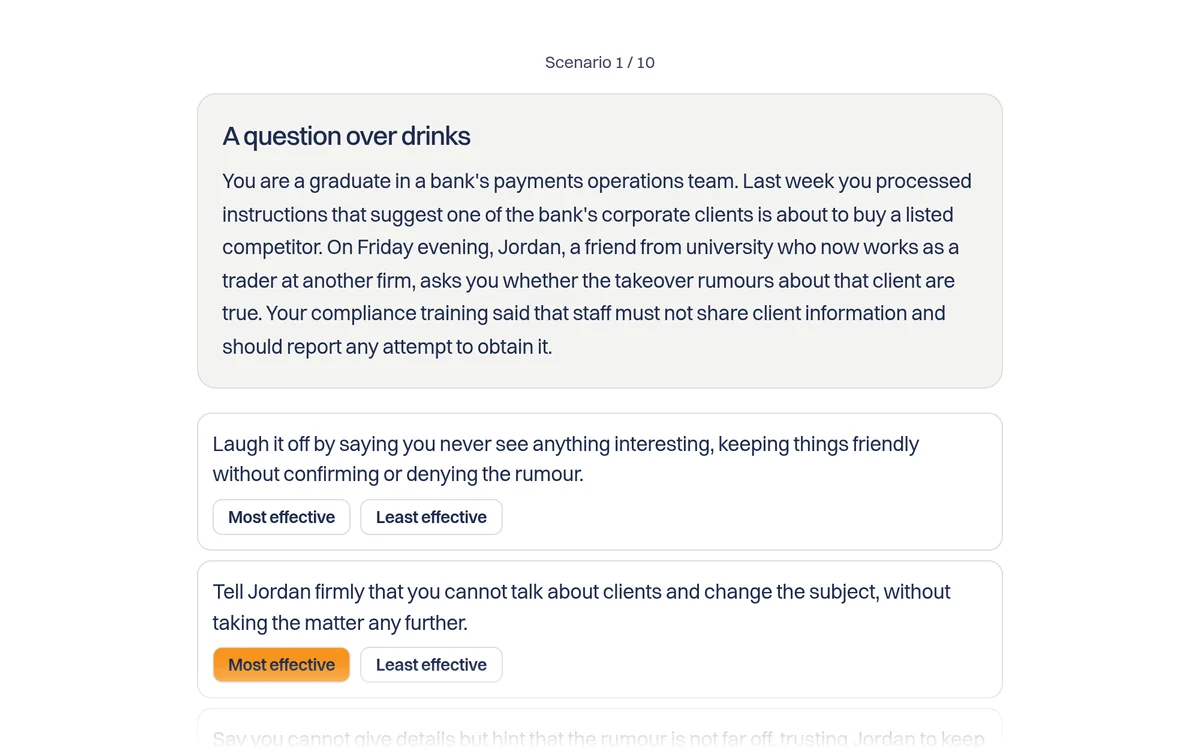
- Know the format before the day. The HPI is a long run of short true / false statements. Seeing a few dozen beforehand takes away the surprise, so you can concentrate on answering. Our practice questionnaire has a true / false section in the same style, an agree / disagree section and a short "most / least like me" block, with original statements.
- Answer as your work self. Think of an ordinary working week, not your best day and not your weekend.
- Go with your first honest answer. Overthinking statements is how contradictions creep in. The questionnaire is untimed, but 206 statements in 15 to 20 minutes is a few seconds each.
- Do not hedge every answer. On a true / false form there is no middle; pick the side that is more often true of you.
- Read the job description. Not to reshape your answers, but to prepare examples for the interview: if your report flags low Prudence, have a story ready about how you keep track of detail.
- Take it in one quiet sitting, on a device you trust, without anyone helping.
Practise the format
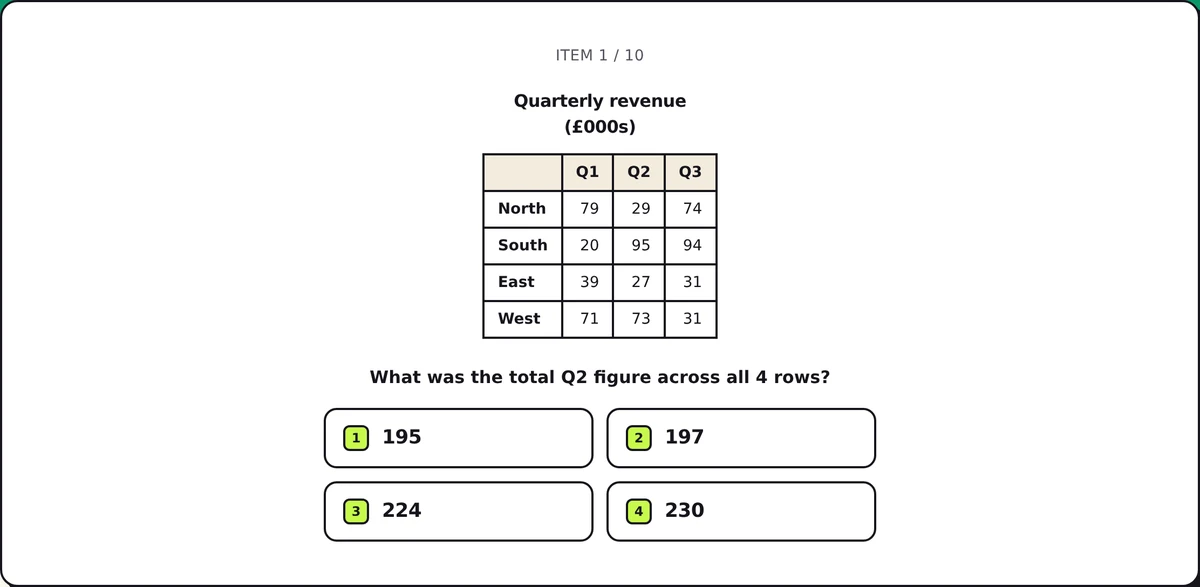
The free Work Personality Questionnaire Practice takes about eight minutes. It is not the Hogan and cannot predict your Hogan result: its seven dimensions and all of its statements were written for GamePrep. What it shows is the format, your profile on dimensions modelled on the same Five-Factor research employers draw on, and a consistency index from pairs of statements that ask the same thing twice, plus whether you endorsed the "too good to be true" statements. For the wider family of workplace questionnaires (SHL OPQ, Saville Wave and others), see personality tests for jobs. If your process also includes ability tests, psychometric test practice covers those.
FAQ
What is the Hogan assessment? It is a set of up to three personality questionnaires from Hogan Assessments: the Hogan Personality Inventory (everyday strengths), the Hogan Development Survey (behaviour under strain) and the Motives, Values, Preferences Inventory (what drives you). Employers use them in hiring and leadership development.
How many questions are on the Hogan Personality Inventory? Hogan's overview gives 206 true / false statements, taking 15 to 20 minutes. It reports seven primary scales, 42 subscales and a validity scale.
Can you fail the Hogan test? There are no right or wrong answers. You can be screened out if your profile is far from what the role needs or if your answers are not credible, for example when they contradict each other or describe an implausibly perfect person.
Can you practise for the Hogan assessment? You can practise the format and the habit of answering steadily and consistently, which is what our free practice questionnaire is for. You cannot and should not practise a different personality.
Is the GamePrep questionnaire the real Hogan? No. GamePrep is independent and not affiliated with Hogan Assessments. Our practice uses a similar true / false format with original statements and its own dimensions, so it cannot predict a Hogan result.
GamePrep is an independent practice site and is not affiliated with, endorsed by or connected to Hogan Assessments. Hogan, the Hogan Personality Inventory, the Hogan Development Survey and the Motives, Values, Preferences Inventory are names of Hogan Assessments' products, used here only to describe them.