Personality Tests for Jobs
Formats, What Employers Look For and How to Answer
Personality tests for jobs come in four formats: true/false, agree/disagree, most/least like me, and rate-then-rank. What employers look for, how faking is caught, and how to answer.
A personality test for a job is a questionnaire about how you usually behave at work: how you handle pressure, people, detail and change. It has no right answers, no time pressure in most cases, and it is built to notice a candidate who answers as an imagined ideal. Employers compare your profile with what the role needs and use the report to shape interview questions. To prepare, learn the formats, then answer quickly, honestly and consistently as your ordinary work self. You can try all three common formats in our free work personality questionnaire practice, about eight minutes. GamePrep is independent and not affiliated with Hogan Assessments, SHL or any other test vendor.
What are personality tests for jobs?
They are the fourth family of hiring tests, next to ability tests (numerical, verbal, logical), game-based assessments and situational judgement tests. Ability tests ask what you can do; a personality questionnaire asks what you tend to do. Most are built on the same research tradition, the Five-Factor model of personality (calm against reactive, outgoing against reserved, curious against conventional, warm against tough-minded, organised against flexible), split into narrower work-related scales. Some, like the Hogan Development Survey, add behaviour under stress; others add motives and values.
The four formats you will meet
True / false. One statement, two buttons. The Hogan Personality Inventory uses this format for its 206 statements. It feels fast and easy to steer, which is exactly why it includes a validity scale and repeated themes.
Agree / disagree (Likert). A statement and a scale, usually five points from "strongly disagree" to "strongly agree". It lets you say "mostly" instead of "always", but it is also where people drift into the safe middle and produce a flat, unhelpful profile.
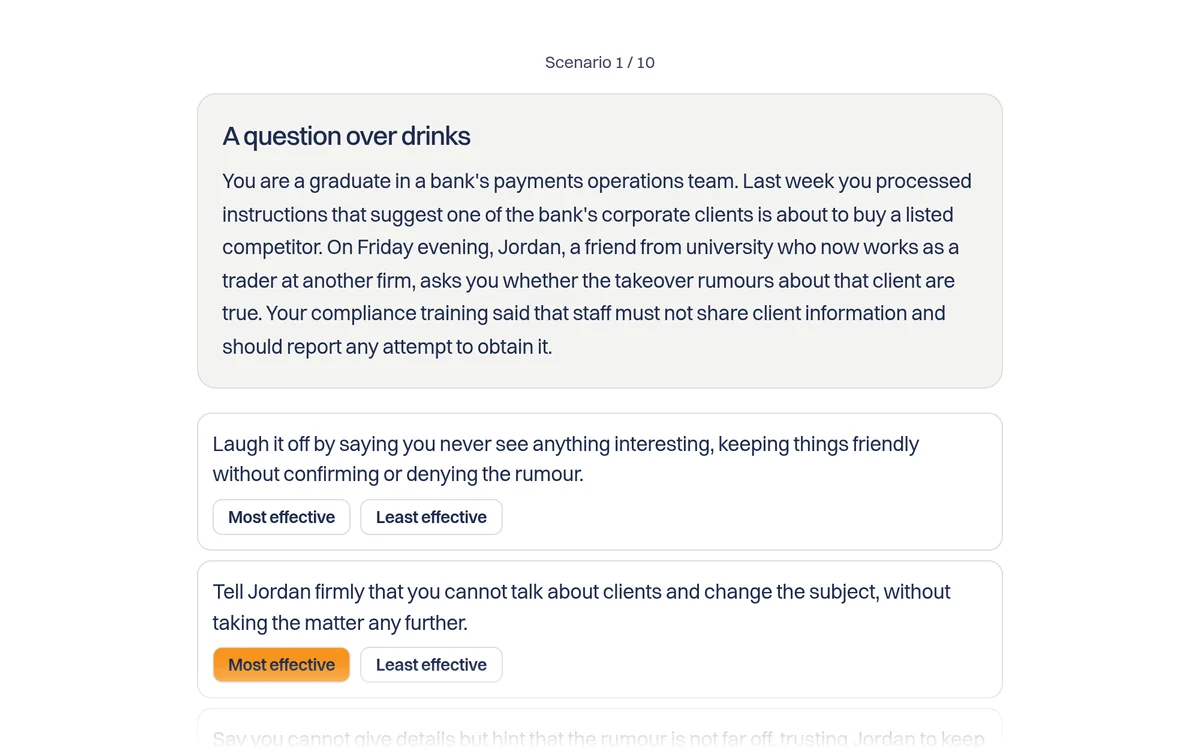
Most / least like me (forced choice). Three or four statements that all sound reasonable, and you pick the one most like you and the one least like you. SHL's OPQ32r works this way: candidates report 104 blocks of three statements, and SHL quotes about 20 minutes (SHL). Because every option is flattering, you cannot simply agree with everything.
Rate, then rank. Saville Assessment's Wave Professional Styles asks you to rate statements on a nine-point scale and then to rank any that you rated the same, so claiming to be strong at everything forces a choice; Saville gives it about 35 minutes (Saville). Korn Ferry's Talent Q Dimensions is another widely used questionnaire; candidates describe it as adaptive, adjusting what it asks to earlier answers.
What employers look for
There is no single good profile. A sales role may want social energy and drive, an audit role care and composure, a research role curiosity, a care role warmth. Employers usually build a target from the job itself, sometimes from the scores of people who already do it well, and look at how close you are. The report then becomes a set of strengths, risks and interview questions: "Tell me about a time you had to deliver an unwelcome message" for someone who scored very high on warmth, say. Some employers screen out profiles far from the target; many use the questionnaire mainly to guide the interview.
Two things matter in almost every report regardless of the role: whether your answers hang together, and whether they look like a real person.
How faking is detected
Questionnaires have used the same checks for decades:
- Repeated meaning. The same idea comes back later in different words, often reversed: "I stay calm when a deadline is brought forward" and, twenty questions on, "A sudden change of deadline leaves me flustered." Agreeing with both is a contradiction.
- Too good to be true. Statements almost nobody can honestly endorse: "I have kept every promise I have ever made." Agreeing with several suggests impression management.
- Forced choice. Formats that make you trade one virtue against another.
- Implausible profiles. Very high on every scale. Real strengths come with costs somewhere else, and assessors know it.
Our practice questionnaire includes the first three so you can see how your own answers look through those checks.
How to answer
- Answer as your work self, on an ordinary working week, not on your best day and not at home.
- Take the first honest answer. Long deliberation is where people start answering as they think they should, and where contradictions creep in.
- Be consistent, not strategic. You do not know which profile the employer wants. If you guess and succeed, you have been hired for a job that suits somebody else.
- Use the ends of the scale when you mean them. "Strongly agree" is a normal answer. A profile of nothing but middles tells the employer nothing.
- Read every statement fully. Many are reverse-worded; skimming flips your answer.
- Do it in one quiet sitting, without help, on a device you trust.
- Prepare examples for the interview. If you know you are more reserved or more spontaneous than average, have a real story about how you handle that at work.
Common myths
"There is a right answer for this company." There is a target profile for a role, but it varies by role, and it is not published. Guessing it is a lottery.
"Choose the middle to be safe." The middle is not neutral; it produces a flat profile and can lower your consistency on statements you actually hold strong views on.
"Personality tests cannot be failed." They have no wrong answers, but an inconsistent or implausible set of answers can count against you, and so can a profile far from the job.
Practise the formats
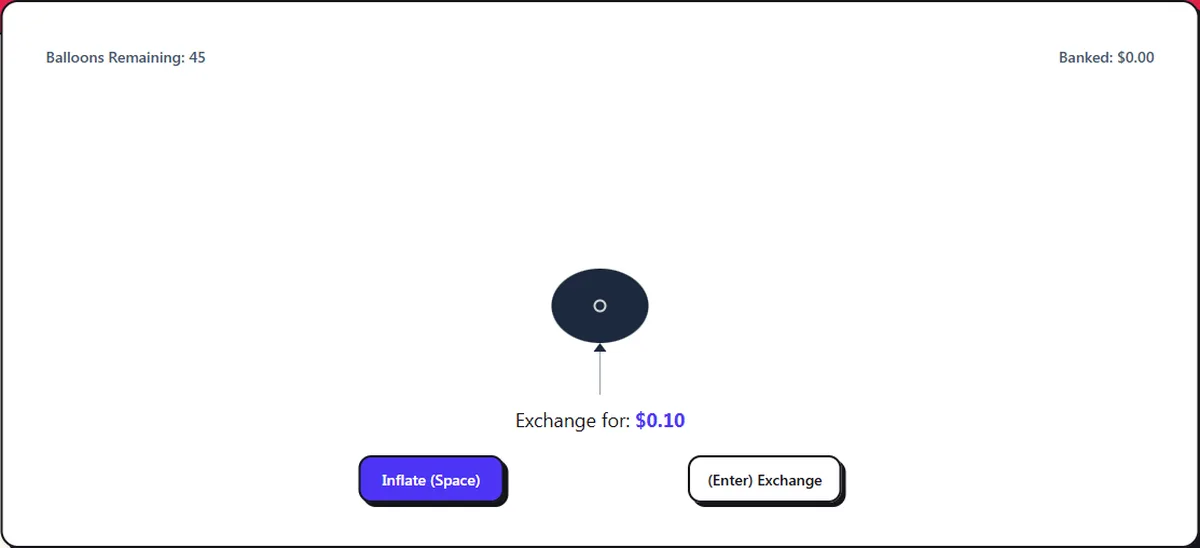
The free Work Personality Questionnaire Practice has a true / false section, an agree / disagree section and a "most / least like me" block, 72 answers in about eight minutes. At the end you see your profile on seven work-style dimensions with what a high or low score tends to mean at work, your consistency index from repeated-meaning pairs, and whether you endorsed the "too good to be true" statements. It is not any vendor's questionnaire and cannot predict a real result. If your process includes a judgement test too, try the situational judgement practice; if it includes behavioural games, the balloon game is the classic risk task.
FAQ
What is a personality test for a job? A questionnaire about how you usually behave at work, such as how you handle pressure, people, detail and change. Employers compare the profile with what the role needs and use the report to guide interview questions.
Can you fail a personality test for a job? There are no wrong answers, but you can be screened out if your profile is far from what the role needs or if your answers contradict each other or describe an implausibly perfect person.
How do I pass a personality test? Answer honestly and consistently as your ordinary work self, take your first answer rather than overthinking, use the ends of the scale when you mean them, and read each statement fully because many are reverse-worded.
How long does a personality test for a job take? Most take 15 to 40 minutes and are untimed. The Hogan Personality Inventory has 206 true / false statements and takes 15 to 20 minutes; SHL quotes about 20 minutes for the OPQ and Saville about 35 for Wave Professional Styles.
Is the GamePrep questionnaire the real Hogan or OPQ? No. GamePrep is independent and not affiliated with Hogan Assessments, SHL or any vendor. The practice uses similar formats with original statements and its own dimensions.
GamePrep is an independent practice site and is not affiliated with Hogan Assessments, SHL, Saville Assessment, Korn Ferry or any other test publisher. Product names are used only to describe those products.