The Wonderlic Test
Format, Scores and How to Prepare
The Wonderlic test is 50 questions in 12 minutes, and almost nobody finishes. What it measures, what counts as a good score, which jobs use it, and how to practise the pace with a free timed test.
TL;DR: The Wonderlic test is a short cognitive ability test: 50 multiple-choice questions in 12 minutes, mixing word meaning, arithmetic, number series, logic and simple spatial problems. The average score is commonly reported as about 20 out of 50, around 28 or more is generally considered strong, and very few people reach the last question. The fastest way to prepare is to rehearse the pace: take a free timed Wonderlic-style practice test, see where your points went, and drill the weakest part.
What the Wonderlic test is
The Wonderlic Personnel Test has been used in hiring for decades. It measures general cognitive ability, sometimes called general mental ability or "g": how quickly you take in new information, follow instructions and solve unfamiliar problems. Outside hiring it is best known from the NFL Scouting Combine, which gave it to draft prospects for decades before dropping it in 2022.
In hiring, it is a screen. You usually take it online, at home, soon after applying, and the employer compares your score with the level they set for the role. Wonderlic, Inc. has since added newer products, including a broader assessment with personality and motivation sections, but when people say "the Wonderlic" they almost always mean the classic 50-question, 12-minute cognitive test. Your invitation will say which one you are taking.
The format
| Feature | Wonderlic (classic format) |
|---|---|
| Questions | 50 |
| Time | 12 minutes |
| Time per question | About 14 seconds |
| Sections | None: question types are mixed together |
| Difficulty | Starts easy, gets harder |
| Score | Number correct out of 50 |
| Penalty for wrong answers | None commonly reported: a blank and a wrong answer score the same |
The question types are familiar from school; what is unusual is the speed:
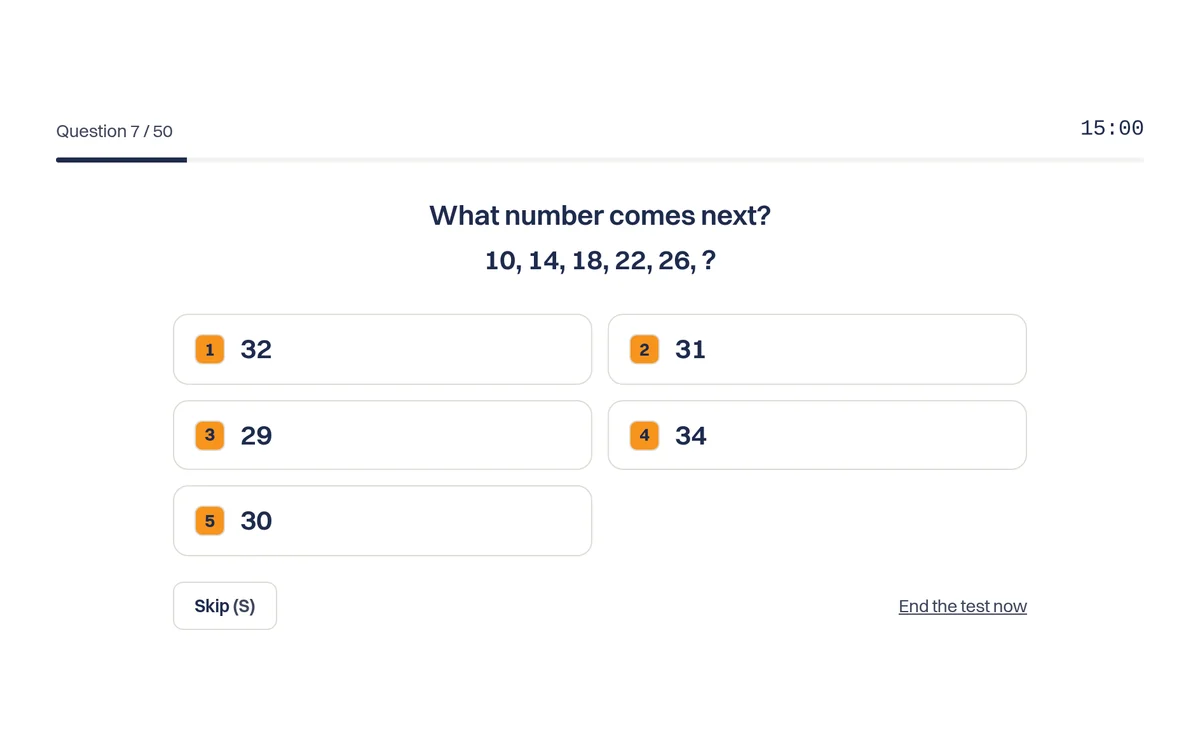
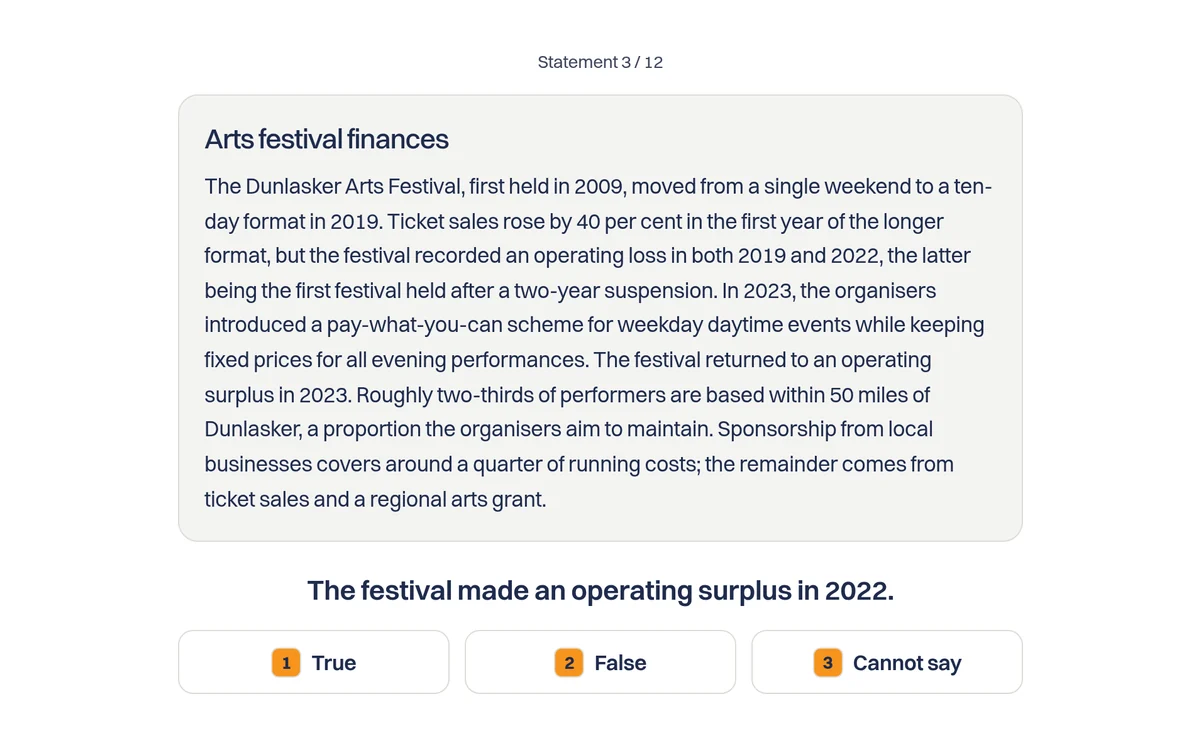
- Verbal: which word means the same or the opposite, analogies ("puppy is to dog as kitten is to…"), which word does not belong, sentences to unscramble or complete.
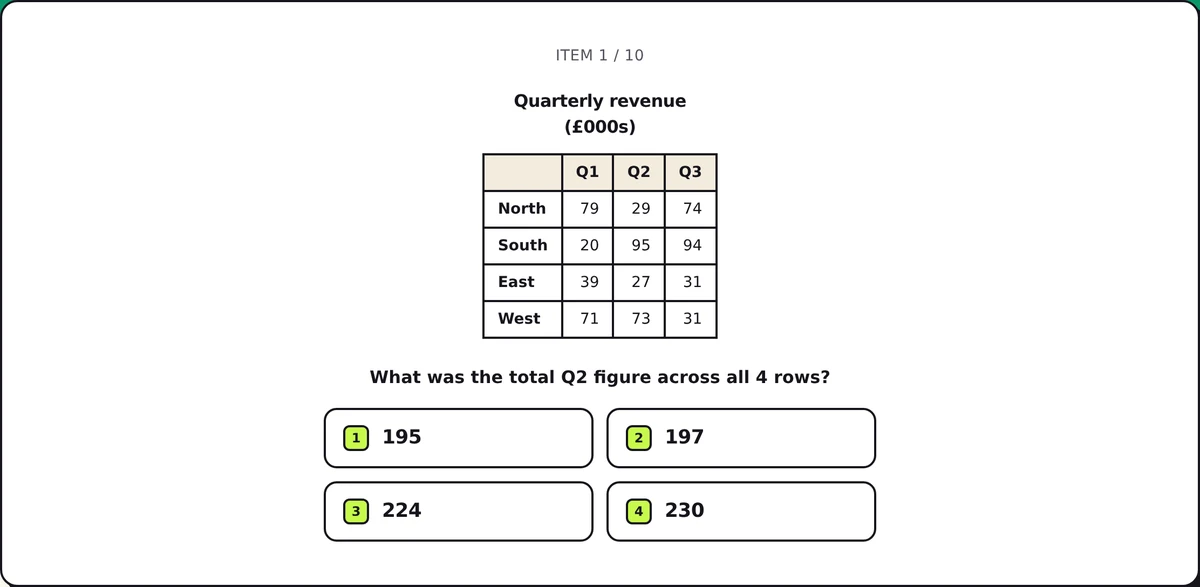
- Numerical: quick arithmetic, percentages and fractions, short word problems about prices, rates and time, and number series ("what comes next?").
- Logic: syllogisms ("all A are B…"), orderings ("Anna is taller than Ben…"), letter series and simple codes.
- Spatial: a few items about shapes, directions or figures.
Why almost nobody finishes
Twelve minutes for fifty questions is about fourteen seconds each, and that has to include reading the question. Easy items take a few seconds; the harder ones near the end can take a minute. The test is designed so the clock runs out first, which means the score is partly a measure of speed, and how you handle the clock matters as much as how hard you think.
The most common way to lose points is not getting questions wrong. It is spending ninety seconds on one stubborn word problem while three easy questions you never reached would have taken ten seconds each. Every question is worth one point, whatever its difficulty.
What is a good Wonderlic score?
There is no universal pass mark. The figures most often reported are:
| Score (out of 50) | Roughly |
|---|---|
| 10 | Well below average; often cited as a floor for basic roles |
| 20 | Average |
| 25 | Above average, about the top quarter |
| 28 | Strong, about the top 15% |
| 32+ | Rare, about the top 5% or better |
Employers choose their own minimum for each job. Analytical, technical, finance and management roles usually ask for more than entry-level or manual roles, and the score is normally weighed next to interviews and experience rather than deciding on its own. Treat any number you read online, including these, as a guide rather than the bar your employer uses.
Which jobs and employers use it
Wonderlic-style tests show up wherever an employer wants a fast, cheap read on problem-solving ability before interviews: sales and account management, customer service and call centres, administrative and office roles, banking and finance, retail and restaurant management, manufacturing and logistics, and some public-sector and security hiring. Many employers do not name the brand in the job advert, so the first sign is often the invitation email itself.
If your invitation names Criteria's CCAT instead, the test is very similar: 50 mixed questions, but with 15 minutes and a bigger share of spatial and pattern items. Our CCAT practice test follows that format, and the CCAT guide covers the differences.
How to prepare
You cannot learn the questions in advance; real tests draw from large banks and our practice questions are generated fresh every time. What you can train is everything around the questions.
- Take one timed run cold. Use the Wonderlic-style practice test with the full 12 minutes. Do not pause it. Your result shows how many you answered, how many you got right and which question types (verbal, numerical, logic, spatial) cost you points.
- Drill the weakest area in short sessions. If numbers were the problem, ten minutes a day of mental math and numerical reasoning makes arithmetic automatic fast. If words were, practise synonyms and analogies and try the verbal reasoning test. If logic was, work through orderings and syllogisms with the deductive reasoning test.
- Practise skipping. It feels wrong, which is why it needs practice. Set yourself a rule, such as "if I don't see the way in after 20 seconds, I guess and move on", and keep it during practice runs.
- Answer every question you reach. With no penalty for wrong answers, a guess can only help. Never leave a question you have read blank.
- Use rough arithmetic. Options are usually far enough apart that an estimate is enough: 24% of 310 is "a bit under 75", so the answer is not 62 or 93.
- Take a second full run a few days later and compare. Gains usually come from answering more questions at the same accuracy, not from solving harder ones.
On the day
- Use a laptop or desktop, a quiet room and a stable connection; twelve minutes leaves no room for a bad start.
- Have scrap paper and a pencil ready if your invitation allows them, and check what it says about calculators. Many cognitive tests do not allow one, so practise without.
- Read each question once, carefully. Many misses are a missed "not" or "opposite", not a hard sum.
- Do not plan on coming back. Even where a test lets you return to a question, there is rarely time left to do it, so treat a skip as final and spend the time on the next one.
How our practice test differs from the real Wonderlic
Our test copies the format, not the content. The questions come from our own templates, so every run is different and none is a real Wonderlic question. Some real question types (proverbs, picture-based spatial items) are hard to generate well and appear less or not at all; our spatial items are text-based instead. Difficulty rises in five fixed steps rather than following Wonderlic's calibration on real candidates, and the percentile comes from a fixed table built on the commonly reported average of about 20. Use it for what transfers: the pace, the mix, and the habit of moving on.
Check how ready you are
After a few practice runs, the Wonderlic readiness check puts your results for every section of the test in one report: your typical score (the one that matters with a single attempt on the day), the section to fix first, and a day-by-day plan up to your test date.
FAQ
How long is the Wonderlic test? The classic Wonderlic is 12 minutes for 50 questions, about 14 seconds per question including reading time.
What is the average Wonderlic score? About 20 out of 50 is the figure most commonly reported. Around 28 or more is generally considered strong.
Is there a penalty for guessing on the Wonderlic? The score is commonly described as the number of correct answers, with nothing deducted for wrong ones, so answering every question you reach is worthwhile.
Can you study for the Wonderlic? You cannot learn the questions, but you can train the pace, the question types and the habit of skipping. Timed practice runs and short daily arithmetic drills move scores most.
Is the Wonderlic the same as the CCAT? No, but they are close: both are 50 mixed questions with a clock that runs out first. The CCAT gives 15 minutes instead of 12 and has more spatial items.
Are GamePrep's questions real Wonderlic questions? No. They are generated from our own templates for practice, so each run is different. GamePrep is not affiliated with Wonderlic, Inc.
GamePrep is an independent practice platform and is not affiliated with, endorsed by or connected to Wonderlic, Inc. or Criteria Corp. "Wonderlic" and "CCAT" are used only to describe the test formats our practice follows. We provide practice only, with no real or leaked questions, and no practice can guarantee a score. Formats change between employers and over time; where this page and your invitation disagree, the invitation is right.