Criteria CCAT: 50 Questions in 15 Minutes, and How to Prepare
The CCAT is Criteria's classic cognitive aptitude test — 50 mixed verbal, numerical and spatial questions in 15 minutes. What the format rewards, what practice actually moves, and where our games stop being the right tool.
TL;DR: The Criteria Cognitive Aptitude Test (CCAT) is a 50-question, 15-minute test of general cognitive ability, mixing verbal reasoning, maths and logic, and spatial reasoning in one unbroken run. It is not a game-based assessment — there are no animations and no tutorials, just questions and a clock. Almost nobody finishes all fifty, and that is by design.
What the CCAT actually is
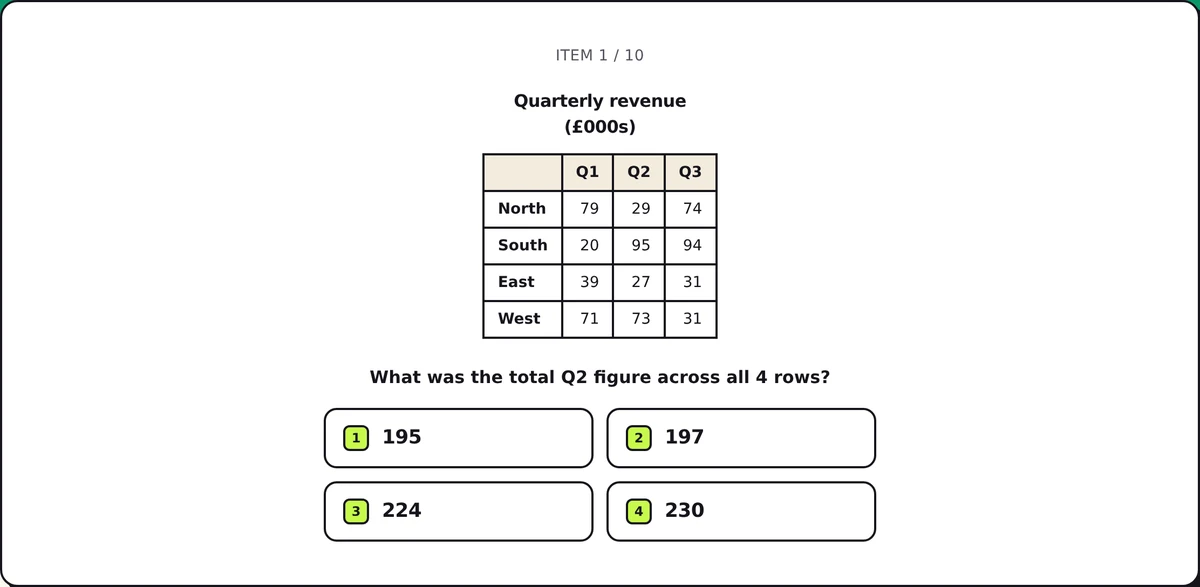
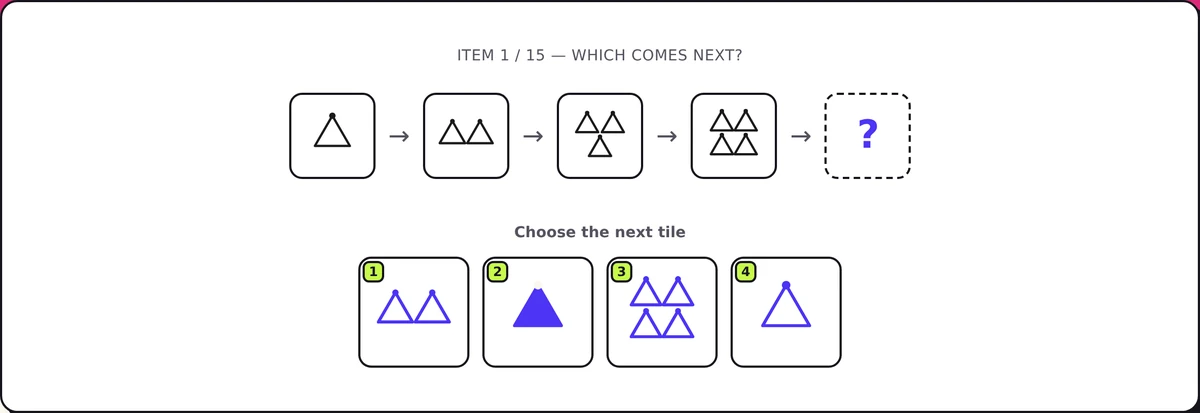
Criteria sells several assessments, and they prepare differently. Cognify is the game-based cognitive one. The CCAT is the traditional one: multiple choice, one timer, fifty items drawn from three families — word relationships and verbal logic, arithmetic and numerical word problems, and shape or pattern series.
Three design choices matter more than the content:
- The clock is the test. Fifteen minutes across fifty items is about eighteen seconds per question, including reading it. The format deliberately outruns you.
- There are no sections. Question types are interleaved, so you switch between words, numbers and shapes constantly rather than settling into one mode.
- Your raw score is a count of correct answers, then expressed as a percentile against a comparison group. Employers set their own bar for a role.
Criteria publishes the format on its own site, and your invitation overrides anything written here — including this page. Formats and configurations change between hiring cycles.
Why almost nobody finishes, and what to do about it
Unfinished is the normal outcome. Treating the test as something to complete is the single most expensive mistake, because the way people chase the last items is by rushing the ones in front of them.
Two consequences follow, and they point in opposite directions from the usual advice:
Answer every question you attempt. Where a test does not deduct for wrong answers — and the CCAT is generally described as one that does not — a blank and a wrong answer are worth the same, so a guess on an item you have already read is free expected value. Confirm this against your own invitation rather than assuming it.
Leave the expensive ones. A long numerical word problem and a three-word analogy are worth exactly the same point. Spending ninety seconds on one hard item costs you four or five easy ones elsewhere. The skill being rewarded is triage, and it is trainable in a way that raw reasoning is not.
What practice actually moves
Be clear about the parts: some of this responds to preparation and some does not.
Moves within days. Arithmetic fluency — making the sums automatic so your attention goes to the question rather than the calculation (mental math, numerosity). Reading quantities and tables at speed (numerical reasoning). Inferring the rule behind a sequence of shapes, which is the same habit the shape-series items test (inductive reasoning). And simply performing under an unforgiving clock without panicking, which every timed game here trains — the flanker task in particular, because it punishes exactly the kind of attention slip that a rushed test produces.
We do not cover the verbal third. Analogies, antonyms and sentence logic are a real part of the CCAT and we have no clone of them yet. We would rather say so than stretch the claim: pair this with a verbal question bank if your invitation names the CCAT. Every run here is scored server-side against fixed norms, so one cold pass tells you which of the parts we do cover is weakest — see how we score.
How the CCAT differs from the game batteries
Preparation advice does not transfer between these, and mixing them up wastes the days you have:
- CCAT — ability, with right answers. Practice improves your result. Content knowledge barely matters; speed and triage matter enormously.
- Cognify — ability, in game form. Also trainable, but the mechanics are unfamiliar and the tutorials are part of the test.
- Trait and risk games — pymetrics' balloons, Arctic Shores' behavioural tasks — measure who you are. There is no score to chase, and manufacturing a profile tends to backfire.
If your process includes a CCAT and a game round, train the triage habit for the first and the mechanics for the second. For the wider landscape, see psychometric test practice.
Preparing in the days you have
- Take one cold run at the games above and write down the percentiles, so you drill the weakest rather than the most comfortable.
- Rehearse the clock, not just the content. Set a timer, accept that you will not finish, and practise abandoning an item mid-way — it feels wrong and it is the correct move.
- Do the arithmetic daily in short bursts. Of everything on the test, numerical fluency moves fastest.
- Sit it on a laptop, in one uninterrupted block, at a time of day when you are sharp. Fifteen minutes has no room for a bad start.
FAQ
What is the Criteria CCAT? A 50-question, 15-minute cognitive aptitude test from Criteria, combining verbal reasoning, numerical and logical problems, and spatial or pattern items in one timed run.
How long is the CCAT? Fifteen minutes for fifty questions — roughly eighteen seconds each, including reading time.
Is the CCAT a game-based assessment? No. It is a traditional multiple-choice test. Criteria's game-based cognitive assessment is Cognify, which is a different product and prepares differently.
What is a good CCAT score? No public pass mark exists. Your count of correct answers is compared against a norm group, and the employer decides the bar for the role — which varies by seniority and function.
Do wrong answers count against you? The CCAT is generally described as having no penalty for incorrect answers, which makes guessing on an item you have already read worthwhile. Verify it against your invitation before relying on it.
Can you practise for the CCAT? Yes, and the fastest gains are in arithmetic fluency, pattern inference and triage under time pressure. The verbal items need a question bank we do not provide.
Is a calculator allowed? That is set by the employer and stated in your invitation. Train without one, so you are not dependent on something you may not get.
GamePrep is an independent practice platform and is not affiliated with Criteria. Assessment names, formats and configurations vary by employer and change between cycles — verify everything against your invitation. We provide related practice only — no leaked questions or answers. Format details above follow Criteria's own published description of the test; where this page and your invitation disagree, the invitation is right.