Aon digitChallenge
How It Works, Who Uses It and How to Fill the Equations Fast
Aon's digitChallenge shows an equation with only the result filled in; you complete it with digits 1 to 9, each used once. Six minutes, adaptive, + − ×. How it works, who uses it and how to solve fast.
Aon's digitChallenge is a six-minute numeracy game: you see an equation with only its result filled in, and you complete it with the digits 1 to 9, each used once, using addition, subtraction and multiplication. Aon says it "measures your ability to solve basic arithmetic functions using mental calculation", and that you should "finish as many tasks as you can" (Aon). It adapts as you go: "the more questions you get correct, the harder the assessment will become but if you answer a question incorrectly, the assessment will become easier" (Aon digitChallenge practice tasks, PDF). P&G's online Interactive Assessment includes a task that matches it exactly. The arithmetic is simple; the skill is searching for a valid combination quickly. You can practise it free on our digitChallenge practice.
What is the Aon digitChallenge?
digitChallenge is one of Aon's short gamified tests (Aon's assessment business was formerly cut-e, and some invitations still carry that name). Aon's candidate page lists it as Numeracy (digitChallenge), "6 minutes to complete", next to its siblings gridChallenge (working memory), switchChallenge (deductive reasoning) and motionChallenge (complex planning). Prep sites often group the four as "smartPredict". Aon's practice PDF files it under "Deductive Numeracy" and describes it as a test of "numerical comprehension".
Do not confuse it with scales eql, which Aon's page lists separately as a 5-minute "Basic Numerical Comprehension" test with the same one-line description. If your invitation says digitChallenge, this guide is the right one.
How does digitChallenge work?
Aon's practice PDF and P&G's own description of its version agree on the mechanics:
- Only the result is given. You see something like
_ + (_ × _) = 46and must fill the gaps. - Digits 1 to 9, each used once per equation. No zero, no repeats.
- Addition, subtraction and multiplication, with brackets around products in harder items. P&G reminds candidates of the order of operations: "multiplication should be calculated first, then addition and subtraction" (P&G).
- More than one answer can be right. Aon: "There can be multiple correct answers to each question." Any valid filling counts; there is no best answer to hunt for.
- You must fill every gap to move on. P&G: "you must fill all empty gaps before you can unlock the next level", and you then tap the lock icon. There is no skip button.
- The number of gaps changes. P&G: "Over time, the number of gaps to fill may increase or decrease", which is the adaptive staircase at work. Aon's own practice items run from two gaps (
_ − _ = 7) to four, with a product in brackets. - No going back. P&G warns that once you answer "you will not be able to go back to change your responses".
- A practice round first. Aon says you get "some practice tasks that you can take as many times as you like before you start the actual assessment". Use them until the controls feel natural.
How is digitChallenge scored?
Aon does not publish its scoring. What it does say: the test is timed, "you are not expected to answer all the questions", and "it is normal for candidates to be unable to answer all the questions in the allotted time". Because the test is adaptive, getting items right moves you to harder equations, so the level you reach and hold matters, not just the count. Results are compared with other candidates and the employer sets its own bar; candidates who ask what score P&G needs get no official answer (Reddit).
The practical conclusion: accuracy first, then speed. A wrong answer drops you to easier items, and P&G's version will not let you go back to fix it.
How to fill the equations fast
These techniques turn a guessing game into a short search.
1. Read the shape before the numbers. Count the gaps and find the operators. A product in brackets is where most of the value comes from, so it decides everything else.
2. Bound the target. With two gaps and a plus, the most you can make is 9 + 8 = 17. With a product, 9 × 8 = 72. If the target sits near the top of what the shape can make, you need your biggest digits; near the bottom, your smallest.
3. Spend your small digits on subtraction. When a term is subtracted, use 1 and 2 first. It gives the positive terms the most room, and it is how Aon's own worked solutions start.
4. Work backwards from the target. For (_ × _) + _ = 50, list products just under 50: 48 (6 × 8) leaves 2, and 42 (6 × 7) leaves 8. Both work. 45 (5 × 9) leaves 5, which is already used, so drop it.
5. Know your times table near the target. Products of two different digits from 1 to 9 are a short list. Being able to say "the products between 40 and 56 are 40, 42, 45, 48, 54 and 56" instantly saves seconds on every multiplication item.
6. Check the gap you have left. In (_ × _) − _ − _ = 30, 8 × 4 = 32 needs two different digits that add to 2, which is impossible. Change the product: 5 × 7 = 35 needs two digits adding to 5 (2 and 3), and (5 × 7) − 2 − 3 = 30 works.
7. Pair up long chains. For _ − _ + _ − _ = 3, split it into two differences that add to 3, such as 1 and 2: 9 − 8 + 7 − 5 = 3.
8. Run the duplicate check before you lock. The most common avoidable error is reusing a digit. Glance across the equation once before you tap the lock.
9. Do not freeze. There is no skip, so a 40-second stall on one item costs the clock more than anything else. If your first approach fails, change the product or the subtracted pair and try the next candidate.
10. Plan on mental arithmetic. Aon's general FAQ says pen and paper or a calculator help in some tests, and that "if any kind of aid is required or could be helpful, you will be informed during the test's introduction". digitChallenge measures mental calculation, and writing out candidates is slower than the search methods above anyway.
Which employers use digitChallenge?
Aon does not publish its client list per test. The best-documented user is Procter & Gamble. P&G's Interactive Assessment page does not use Aon's name, but its "Assessment #1" (about 6 minutes, fill the gaps with the numbers 1 to 9, each used once, so the result is correct) matches digitChallenge exactly, and its other two tasks match switchChallenge and gridChallenge (P&G). Candidates name the "digit challenge" in P&G's process directly (Reddit). P&G says the Interactive Assessment takes "approximately 30 minutes" in total (P&G); the P&G PEAK and Interactive Assessment guide covers the whole stage.
Other Aon clients can switch digitChallenge on for any role, so if your invitation comes from an Aon or cut-e address, check it for the test names. The cut-e / Aon assessment guide covers the rest of Aon's tests.
How to practise digitChallenge
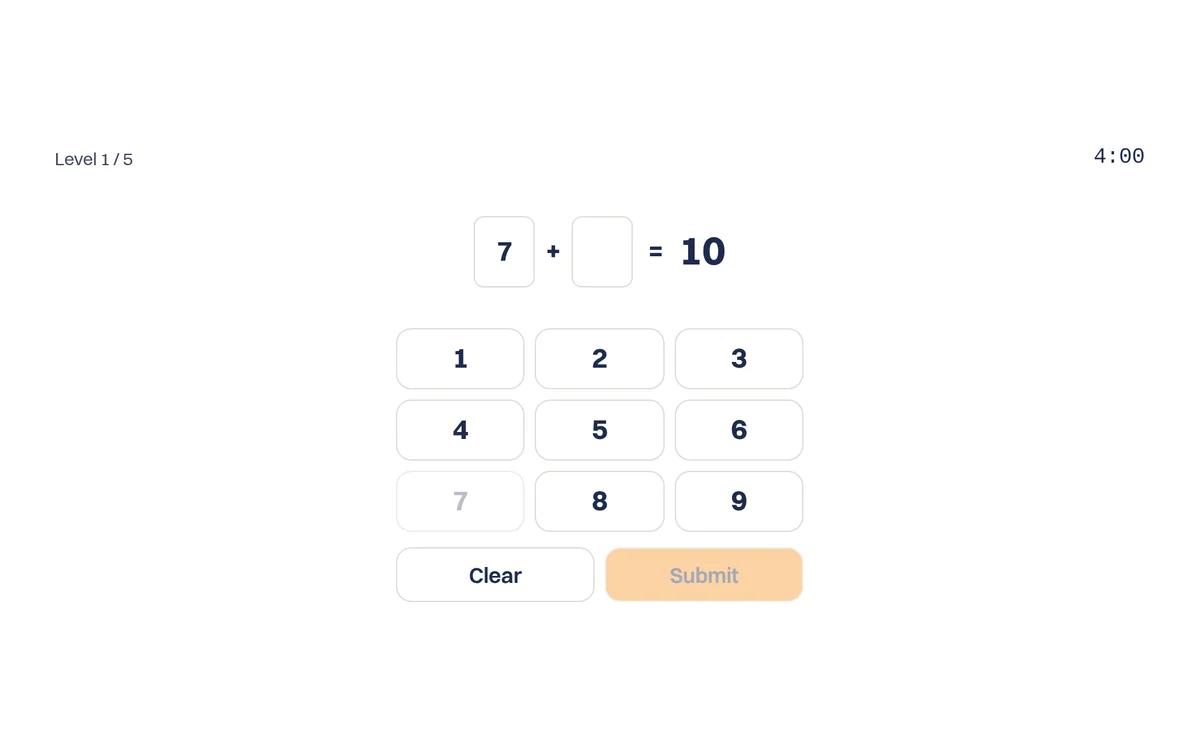
Our digitChallenge practice follows Aon's rules: only the result is shown, you fill the blanks with digits 1 to 9 each used once, the operations are +, − and × with brackets around a product, and any filling that makes the equation true counts. It adapts across five levels, built from the shapes in Aon's practice tasks, moving you up after a right answer and down after a wrong one. Two differences: our run is 4 minutes rather than Aon's 6, and the equations are generated fresh for each page and checked on our server, so you cannot memorise them.
A plan for the week before:
- Day 1: one cold run. Note which shapes slow you down, usually the ones with a product and two subtractions.
- Days 2 to 5: two or three runs a day, using the bound-then-work-backwards method on every item. Add five minutes of mental math to make the times table automatic, and a few rounds of Numerosity, another "find the combination that hits the target" game.
- The day before: one relaxed run, then stop.
- On the day: use Aon's practice tasks until the controls feel natural, then start the real test in a quiet room. Aon says a test cannot be paused once started.
FAQ
What is the Aon digitChallenge? A six-minute adaptive numeracy test. Each item shows an equation with only the result; you fill the gaps with digits 1 to 9, each used once, using addition, subtraction and multiplication.
How long is the Aon digitChallenge? Aon's candidate page says 6 minutes, and P&G describes its version as about 6 minutes. Some prep sites say five; trust your invitation.
Can a digitChallenge item have more than one answer? Yes. Aon says there can be multiple correct answers. Any filling that makes the equation true counts.
Do I need to finish every question? No. Aon says it is normal not to finish. Work quickly and accurately; the test adapts to you.
Does digitChallenge use division? Aon's practice material lists addition, subtraction and multiplication only.
Can I use a calculator for digitChallenge? Plan on mental arithmetic. Aon says you will be told in the introduction if any aid is useful, and the test is a measure of mental calculation.
Is digitChallenge the same as P&G's digit challenge? P&G does not name the vendor, but its Assessment #1 follows the same rules as Aon's digitChallenge, and candidates call it the digit challenge.
How do I get faster at digitChallenge? Learn the products of two different digits, use your smallest digits on subtracted terms, and work backwards from the target. A few days of timed practice makes the search automatic.
GamePrep is an independent practice platform and is not affiliated with Aon, cut-e or Procter & Gamble. Task names and formats vary by employer and change between cycles; verify everything against your invitation and Aon's official practice tasks. We provide practice only, with no leaked questions or answers.