Caliper Test (Talogy Caliper)
What the Assessment Measures and How to Prepare
The Caliper assessment, now Talogy Caliper, is an untimed personality profile with an abstract reasoning section. Format, scores and what you can prepare for.
TL;DR: The Caliper Profile, now sold as Talogy Caliper™, is a hiring and development assessment that measures 21 personality traits plus abstract reasoning (Caliper FAQ). It is untimed and takes about an hour. Talogy says it has 98 questions (Talogy). The first section asks you to pick the statement most and least like you (Caliper FAQ). Your scores are compared with job models, and the employer, not Caliper, decides whether you see them. You can warm up for the abstract reasoning part. For the personality part you can learn the format and see how a profile reads, but not fake it: it has no right answers, was built to resist faking, and should be answered honestly.
Who makes the Caliper test now
Caliper was founded in 1961 by Herbert M. Greenberg and David G. Mayer. It started as a way to select insurance sales agents and to fix a problem with existing tests "known as 'acute fakability'" (Caliper, about). In 2019 it was bought by the group that became Talogy. Talogy's timeline says "We acquire Cubiks and Caliper" in 2019, and in 2022 the company rebranded as Talogy, "officially uniting" its acquired businesses, Caliper among them (Talogy, about). It is not part of PDRI. The product is now called "Talogy Caliper™, previously Caliper Profile" (Talogy). Candidates still use the old name, and calipercorp.com is still live.
What the assessment measures
Caliper's FAQ says the profile "measures 21 behavioral traits and abstract reasoning that relate to job performance" (Caliper FAQ). The product page counts the same thing as "22 robust traits" (Caliper Profile). Talogy's scoring guide puts it clearly: "21 unique personality traits and 1 type of cognitive ability (Abstract Reasoning)", and "with the exception of Abstract Reasoning, traits should be thought of as motivations or natural tendencies rather than abilities" (Talogy support, scoring guide).
So the assessment has two very different parts:
- Personality (most of it). Questions about how you tend to behave and what motivates you. There is no correct answer. A high score on one trait is not better than a low one: each "can be a disadvantage or a strength, depending on the responsibilities at hand" (scoring guide).
- Abstract reasoning (one cognitive section). This one does have right and wrong answers. Caliper offers a 25-minute short form without it, which it recommends "only for assessing entry-level positions" (Caliper FAQ). If your invitation is for the short form, you may not get reasoning questions at all.
Format and timing
- Length: about 60 minutes and "not timed" (Caliper FAQ). Talogy says it "has no set time limit, but it typically takes about one hour" (Talogy). Talogy's guidance to employers gives the "average seat time" as 60 to 75 minutes (Talogy support, best practices).
- Number of questions: 98, according to Talogy (Talogy). Caliper does not publish how they split between sections.
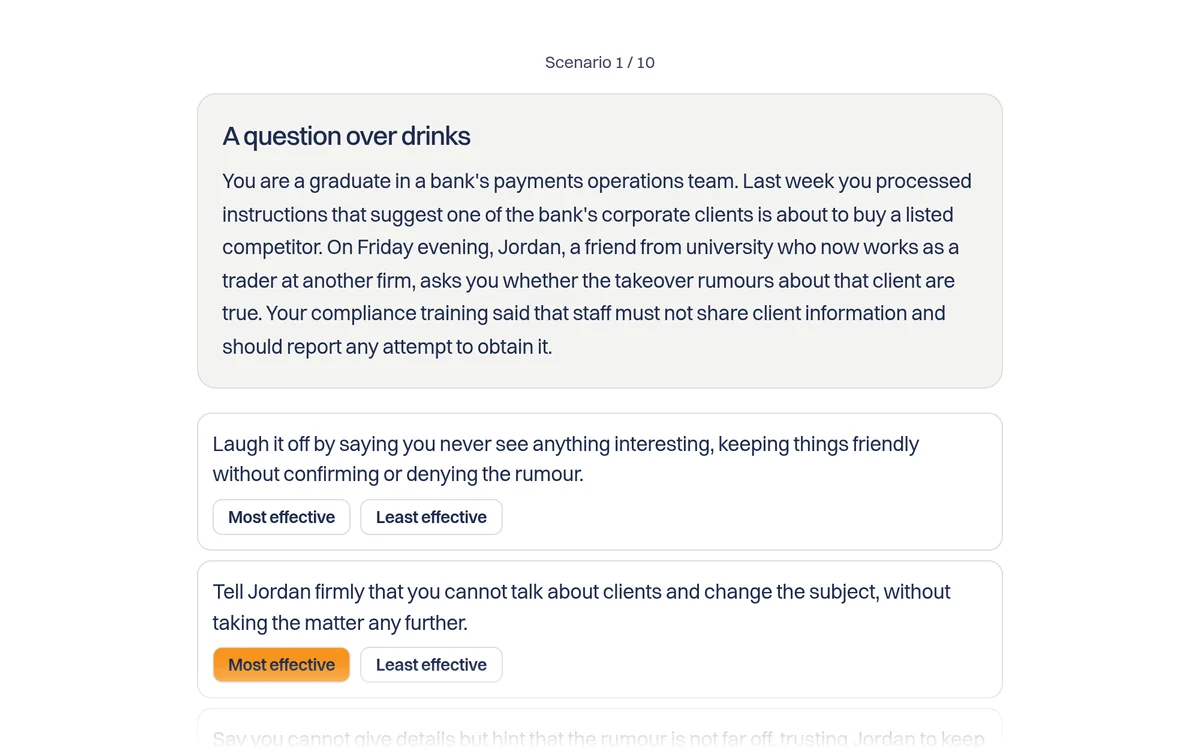
- Most and least like me: in the first section "you should have two answers per question": one for "most" and one for "least". The test will not let you continue with only one (Caliper FAQ).
- Other item types: Caliper and Talogy do not publish the other question formats or what the abstract reasoning items look like. Prep sites describe agree and disagree statements and pattern or series puzzles, but we could not confirm these on the vendor's own pages.
- Pausing: because it is untimed, you can stop and come back through the emailed link, and it resumes after the last completed section. Caliper still recommends doing it in one sitting (Caliper FAQ).
- Device and setting: it is "mobile friendly" (Caliper Profile), but Caliper recommends "a desktop/laptop computer running the latest version of the Chrome or Firefox web browsers" (Caliper FAQ). Talogy asks candidates to take it "in a place with as little distraction as possible" and to "answer all items without input from others" (best practices).
- Languages: 27 language versions, including UK and US English, Arabic, Japanese, Polish and European and Mexican Spanish (Caliper FAQ).
- Adjustments: ask the employer, or call Caliper Customer Relations, if you need readers or other support (Caliper FAQ).
How employers use the report
Each trait is scored "as a percentile representing a person's degree of motivation relative to others in their country of employment" (scoring guide). Caliper uses country norm groups for this (Caliper FAQ). Traits are then combined into:
- Behaviour scores, such as openness to learning (built from Flexibility, Openness and Abstract Reasoning).
- Competency scores, which predict performance in areas that matter for a role.
- Job models: sets of 5 to 9 key competencies for a type of job, such as sales or management.
- A job-fit score from 1 to 99 against the chosen job model. Talogy describes 1 to 39 as "limited alignment", 40 to 59 as "moderate", 60 to 79 as "good" and 80 to 99 as "strong alignment" (scoring guide).
The employer chooses the job model, so the same answers can fit one role well and another poorly. Talogy tells employers to use the profile "as one of multiple decision-making factors", alongside experience, interviews and references (best practices). Caliper reports an average validity coefficient with job performance of .29 to .39, "at or above industry standards", and says the profile has been validated for job models such as senior leaders, managers, new business development, customer service and analysts (Caliper FAQ, checked 4 November 2026). Employers buy it on a "Caliper Essentials Subscription" that lets them run reports for selection, coaching and development, so the same profile can follow you after you're hired.
Will you see your results? Probably not. "Caliper does not send assessment results to individuals". The client company decides, and only it can share them (Caliper FAQ). Talogy also "strongly recommends against sharing Selection reports or discussing scores directly with internal or external job applicants" (best practices).
Retakes. Caliper recommends re-assessing "no sooner than 5 years from the most recent administration". Where two results close in time differ a lot, it recommends using the first one (Talogy support, re-testing). In practice, the first attempt is the one that counts.
Can you prepare for the Caliper test?
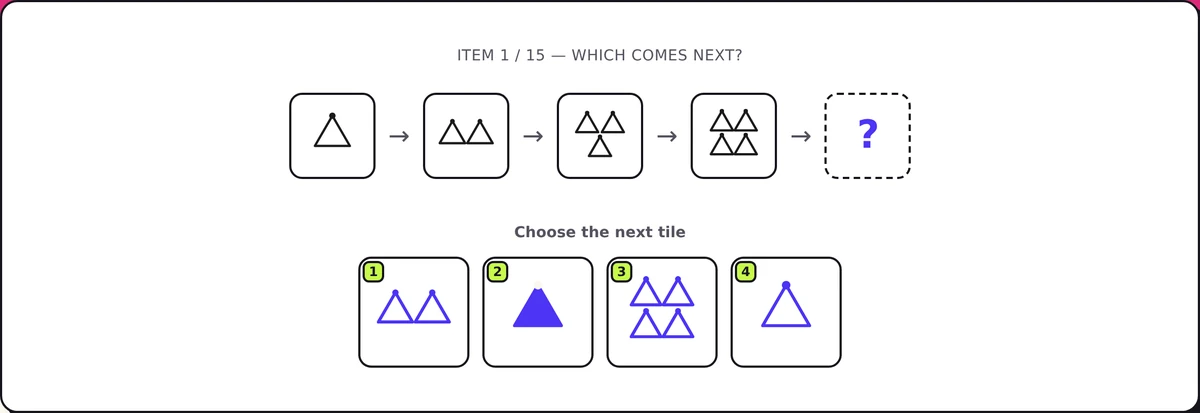
Abstract reasoning: yes, a little. This is the only part with right answers. Pattern and rule-finding puzzles reward familiarity with common rule types and a calm pace. Our free inductive reasoning practice (shapes that follow a hidden rule) is a reasonable warm-up. It is a similar kind of task, not Caliper's own items, which Caliper does not publish.
Personality: you can learn the format, not fake it. Earlier versions of this page said you can't prepare this part at all. That was too blunt. You can't rehearse a winning profile, but you can do three useful things beforehand:
- See the format. The first section makes you choose the statement most like you and the one least like you from each set (Caliper FAQ). Reading a few sets of statements in advance means you spend the real hour deciding, not decoding.
- See how a profile reads. Our free personality test for jobs is an eight-minute work-personality questionnaire with true/false statements, an agree/disagree scale and a short "most like me / least like me" block, the same kind of forced choice as Caliper's first section. At the end it shows your profile across seven dimensions, how consistent your answers were across repeated-meaning pairs, and whether you agreed with "too good to be true" statements. It isn't Caliper's questionnaire, traits or norms, but it shows how one set of honest answers becomes a picture of how you tend to work, and why answering for an imagined ideal shows up as inconsistency.
- Think about real examples. Before you start, recall how you actually behave at work or in study: under pressure, with deadlines, with people who disagree. Answering from real situations is faster and more consistent than answering from how you'd like to be.
What you shouldn't do is try to answer as the "ideal" candidate. There are no right answers. Talogy says a typical person "will have a variety of high and low trait scores" (scoring guide). Caliper was designed from the start against "acute fakability" (Caliper, about) and advertises "low fake-ability" (Caliper Profile). The most/least format makes you choose between statements that all sound reasonable, so you cannot simply agree with every flattering one. Trying to guess the "ideal" profile has two costs:
- You do not know which job model the employer picked, so you cannot know which profile it rewards.
- If the answers work, you are matched to a job that fits a person you are not.
On the day: read each set fully, think about how you behave at work rather than how you would like to, and answer quickly with your first honest choice.
Judgement tests are separate. Caliper is not a situational judgement test. Employers often add one at another stage, though, and our situational judgement practice uses a similar most and least choice about work scenarios. It is useful only if your process includes such a test. It will not change your Caliper personality scores.
For other formats you may meet in the same hiring process, see psychometric test practice.
FAQ
What is the Caliper test? The Caliper test is the Caliper Profile, now called Talogy Caliper. It is a hiring and development assessment that measures 21 personality traits and one cognitive ability, abstract reasoning. Employers compare the results with job models to see how well a candidate fits a role.
How long does the Caliper assessment take? It is untimed and usually takes about an hour. Talogy gives the average as 60 to 75 minutes. A 25-minute short form without the abstract reasoning section is used for some entry-level roles.
What kind of questions are on the Caliper test? Talogy says there are 98 questions. In the first section you choose the statement most like you and the one least like you from each set. There is also an abstract reasoning section. The vendor does not publish what those items look like.
Can you practise for the Caliper test? You can warm up the abstract reasoning part with pattern and rule-finding puzzles. For the personality section you can learn the most/least format and see how a work profile reads with a practice questionnaire, but you can't practise a "right" profile: it has no right answers and was built to resist faking. Answer it honestly about how you behave at work.
Does Caliper work on a phone? Caliper calls the profile mobile friendly, but its FAQ recommends a desktop or laptop with the latest Chrome or Firefox. If the link won't open, ask the company that sent it to resend it.
Can I see my Caliper results? Usually not. Caliper does not send results to candidates, and Talogy advises employers not to share selection scores with applicants. Ask the employer if you want feedback.
GamePrep is an independent practice platform and is not affiliated with Caliper or Talogy. Our games practise similar skills and are not Caliper's own questions. Formats change, so treat your invitation as the source of truth. We provide practice only: no leaked questions or answers.