Matrigma Test
Assessio's 12-Minute Matrix Test, Scores and How to Prepare
Matrigma is Assessio's non-verbal matrix test of problem-solving ability. The usual adaptive version takes 12 minutes. Format, scoring and how to prepare.
TL;DR: Matrigma is a non-verbal aptitude test from the Swedish publisher Assessio. You look at a pattern of figures with a piece missing and choose the piece that completes it. The version most candidates get, Adaptive Matrigma, lasts 12 minutes: a right answer brings a harder question, a wrong one an easier one, so it is meant to feel hard (Assessio, candidates page). Results are compared with a working-age norm group and reported on a 0 to 10 scale. Assessio says the underlying ability "does not improve with education or training", but that knowing the format helps you get closer to your own best (Assessio, Matrigma page). So practise until the format feels familiar, then rest.
What Matrigma is
Assessio describes Matrigma as a test that "measures problem-solving skills and general aptitude" in "only 12 minutes" (Assessio). Its FAQ puts it more precisely: Matrigma "measures an individual's general problem-solving ability", and Assessio adds that it "is not an intelligence test, it only measures one part" (Assessio). In psychology terms it is a test of fluid reasoning: working out rules from unfamiliar material rather than recalling what you know.
Assessio says the test is figural on purpose. The tasks involve "seeing relationships between different objects and filling in gaps where information is missing", and figures are used because they give "everyone the same chance, regardless of educational level, language, math skills, dyslexia" (Assessio). The test draws on both inductive and deductive reasoning, in Assessio's words.
Matrigma was first published in 2008, according to Assessio's technical manual for Adaptive Matrigma (Adaptive Matrigma technical manual, 2017 edition, p. 2). Assessio is a long-established Nordic test publisher. It says it has "been working on psychometric testing for selection and development since 1954" (Assessio).
What the questions look like
Each item is "a matrix with six response alternatives" (technical manual, p. 3). You study a grid of figures that change according to hidden rules, then pick which of six options fills the empty cell. Prep sites usually show these as 3×3 grids. Assessio's own pages that we read describe matrices but do not state the grid size, so treat 3×3 as typical rather than guaranteed.
Before the scored part starts, you go through practice tasks. The manual says these are separate from the first scored items, which form a "warm-up phase" of easier questions (technical manual, p. 8). Those early easy items count, so do not treat them casually.
Timing and number of items
There are two versions, and your instructions tell you which one you have:
- Adaptive Matrigma (the usual one): 12 minutes. Assessio calls it "the most common version of Matrigma" (Assessio). The technical manual adds the mechanics: each item has a one-minute limit, and "a respondent will never be administered more than 40 tasks within the 12 minute testing time" (technical manual, p. 10). There is no fixed number of questions. How many you see depends on your pace and your answers, up to that cap of 40.
- The 40-minute version. Assessio says there is "also a 40-minute version with progressively more difficult tasks that is not used as often", and "if you get that version, it is clearly stated in the instructions" (Assessio). Assessio does not publish the number of items in this version on the pages we read.
Because the adaptive test hunts for your ceiling, Assessio warns that it "will feel tough in order to find your natural maximum level" (Assessio). Getting questions you cannot solve is normal. It does not mean you are failing.
Device. The technical manual recommends "a personal computer with a full-sized computer screen". An employer can allow phones and tablets, but "responding to Adaptive Matrigma on such a device may however affect the result" (technical manual, p. 12). If you have the choice, use a laptop or desktop.
Languages. The test itself has no words, but the instructions come in 29 language versions, from Arabic to Vietnamese, including Swedish, Norwegian, Danish, Finnish, English (USA), German, Polish and two Dutch versions (Belgium and the Netherlands) (Assessio).
How Matrigma is scored
Norm group. Assessio compares results "to a norm group consisting of the working age population, not the whole population", which has a higher share of people with post-secondary education than the population as a whole (Assessio; candidates page). The technical manual describes the classic Matrigma norm group as 4,606 people, and says Adaptive Matrigma scores were linked to that scale (technical manual, pp. 7 to 8).
The scale. Results are reported on the C-scale, which "ranges from 0 to 10, has a mean of 5, and a standard deviation of 2". It is not a stanine (1 to 9) and not a raw percentage. Assessio groups it into three levels (technical manual, p. 13):
| C-score | Level | Roughly |
|---|---|---|
| 0 to 2 | Low (below average) | the lowest 16% of the norm group |
| 3 to 6 | Average | within one standard deviation of the mean |
| 7 to 10 | High (above average) | the highest 16% of the norm group |
Reports. The employer gets an "Interpretive Report" with your C-score and level. You may see a "Your Result" screen showing Below average, Average or Above average, but only "if this is enabled by the test administrator" (technical manual, p. 14). Employers can also rank candidates by C-score.
Pass marks. Assessio publishes none. Its product page suggests employers "adjust your requirements according to the level of complexity of the role" (Assessio). Assessio presents it together with its MAP personality test, saying the two give "a very good overall picture" of a candidate (Assessio).
The technical manual we cite is the 2017 edition. Assessio may have changed details since then, so your invitation is the final word.
What a low score does and doesn't mean. Assessio answers this directly. Asked whether a low Matrigma score means a person is "unsmart", it says "Absolutely not. Matrigma is not an intelligence test, it only measures one part – problem-solving ability." It adds that people with lower scores can compensate "by having a sense of purpose or structure", and that "problem-solving skills alone do not paint the whole picture" (Assessio, checked 4 November 2026).
ADHD. Assessio's FAQ says "Many people with ADHD perform well on matric tests". It explains that in Adaptive Matrigma "the individual does not have to allocate their time between tasks and plan their work, as they are presented with each sub-problem separately", and that the 12-minute length "places limited demands on your stamina" (Assessio). If you need an adjustment, ask the employer before you start: Assessio's pages don't describe a candidate-side request process.
Who uses Matrigma
Assessio calls Matrigma "a popular and well-known aptitude test not only in the Nordic countries but also globally" (Assessio). We have not listed individual employers. We only name an employer when its own careers pages say which test it uses, and we did not find one that names Matrigma.
Is there an official practice test?
We did not find a free, public Matrigma practice test on Assessio's website (checked 27 October and again 4 November 2026). The official practice comes inside the test: the practice tasks you complete before the scored items begin (technical manual, p. 8). Matrigma "practice tests" elsewhere are made by independent prep companies, not Assessio.
How to prepare
Assessio's own answer to "Is it okay to practice Matrigma?" is worth reading in full. It says general problem-solving ability "is something you are largely born with and is stable over time in adults. It does not improve with education or training." It goes on: "an individual can definitely become more confident with tests as a format and thus get closer to their own maximum level if they have practiced and understand how the test is structured", and "much more crucial to the result than training is to ensure that you are well rested, focus only on the test and sit in an undisturbed environment" (Assessio).
So the realistic aim is to remove surprises:
- Learn the rule types. Matrix puzzles reuse a small set of changes: shapes that rotate, move, add or drop elements, shade in, or combine across a row. Check one property at a time (shape, position, number, colour) rather than staring at the whole grid.
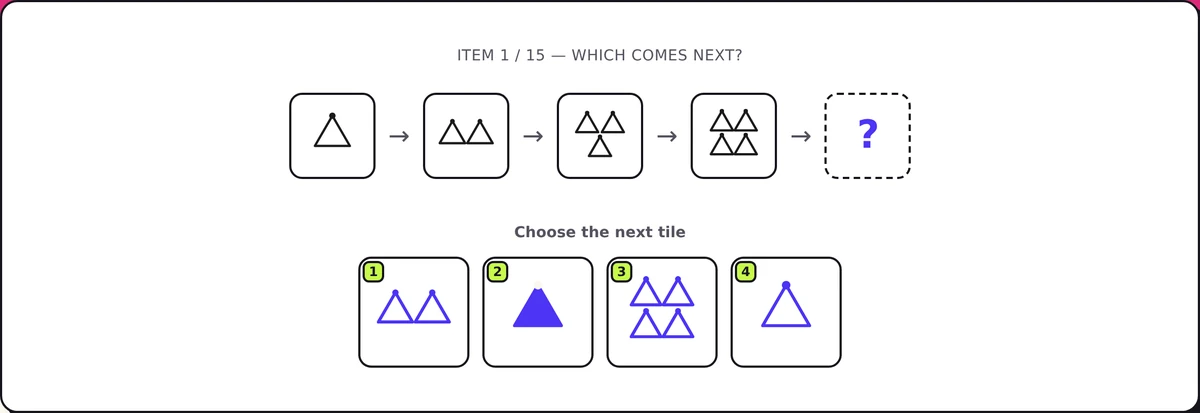
- Practise the same rules on a clock. Our free inductive reasoning practice uses the same kinds of rules: shape, rotation, count and shading. It shows them as a row (pick what comes next) rather than a 3×3 grid, so it is a similar format, not Matrigma. In a matrix, apply the rule across each row and then check it down each column.
- Warm up the logic. Assessio says Matrigma involves deductive as well as inductive reasoning. Our deductive reasoning practice trains working strictly from what is given, which is also useful when you check an answer option against the rule.
- Respect the one-minute limit per item. If a puzzle will not resolve, pick the option that fits the most rules you have found and move on. A blank costs you more than a reasoned guess.
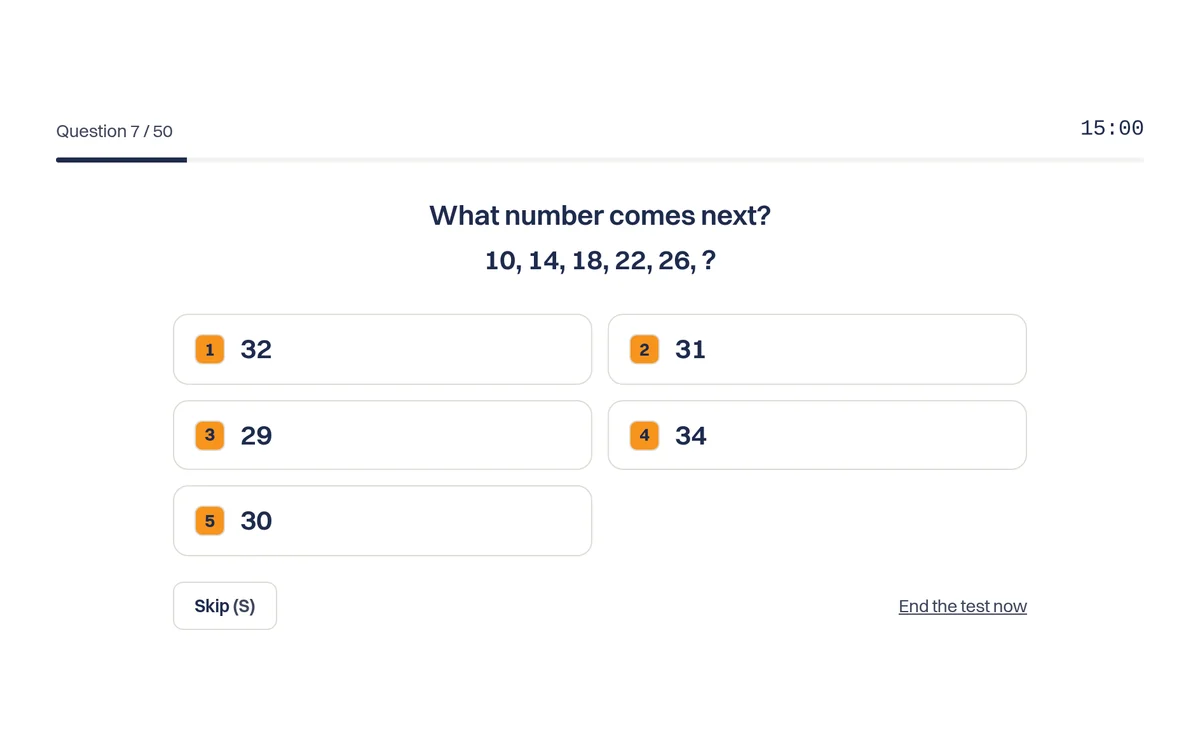
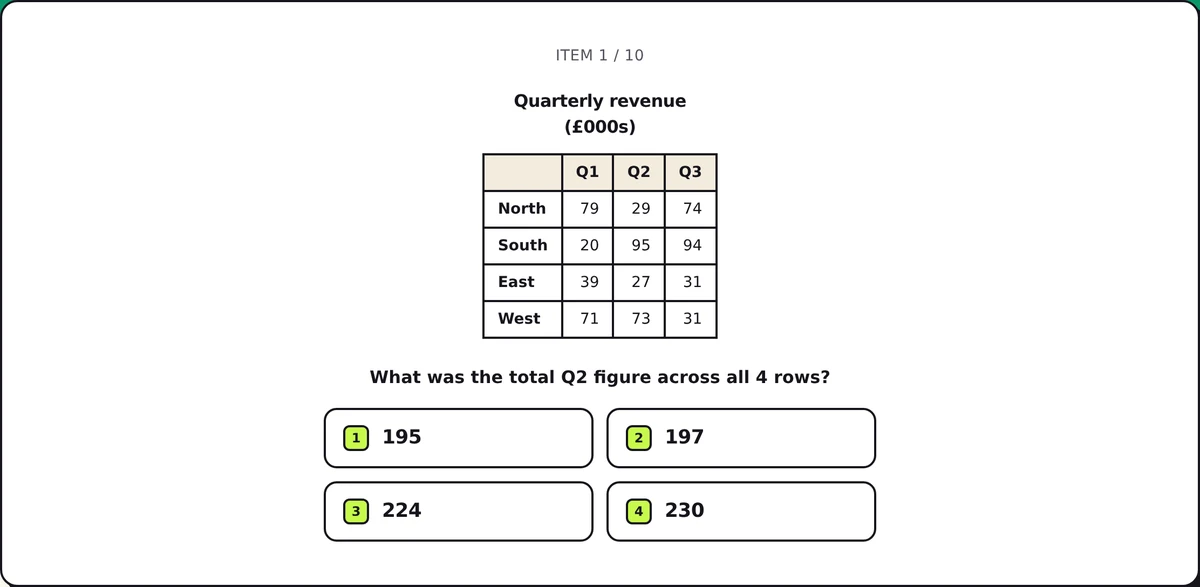
- Practise on a short clock. Matrigma is a speeded cognitive screener, like the Wonderlic and the CCAT. Our Wonderlic-style test (50 questions in 12 minutes) and CCAT-style test (50 in 15) are not matrix tests, and most of their items use words and numbers, but the CCAT-style test includes shape series and odd-one-out items, and both train the same habit: decide fast, guess sensibly, move on. If your employer pairs Matrigma with other tests, they are also the closest general warm-up. See the Wonderlic guide and the CCAT guide.
- On the day, use a computer, sit somewhere undisturbed with a stable connection (Assessio), and expect it to feel hard.
What first attempts look like. On our score benchmarks, as of November 2026, the median first attempt on GamePrep's inductive reasoning test was 66 out of 100 (209 players), with the middle half between 53 and 76. That is our own scale and our own players, not Assessio's C-scale or norm group, so it tells you where your first go sits among people practising, nothing more.
For a wider view of ability tests, see psychometric test practice.
FAQ
What is the Matrigma test? Matrigma is a non-verbal aptitude test from the Swedish publisher Assessio. It measures general problem-solving ability: you complete patterns of figures by choosing the missing piece from six options. Employers use it in recruitment, and Assessio suggests combining it with its MAP personality test.
How long is the Matrigma test? The usual version, Adaptive Matrigma, takes 12 minutes. Each item has a one-minute limit and you see no more than 40 items. A less common 40-minute version exists, and your instructions say clearly if you have it.
How many questions are on the Matrigma test? The adaptive version has no fixed number. It depends on your speed and answers, up to a cap of 40 items in 12 minutes. Assessio does not publish an item count for the 40-minute version.
How is Matrigma scored? On Assessio's C-scale from 0 to 10, where 5 is the average of a working-age norm group. Scores of 0 to 2 count as below average, 3 to 6 as average and 7 to 10 as above average. Each employer chooses its own cut-off.
Is Matrigma like the Wonderlic or CCAT? All three are short, timed cognitive screeners, but Matrigma uses only figure matrices, while the Wonderlic and CCAT mix verbal, numerical, logic and spatial questions. Practising those still trains fast decisions under a clock.
Does ADHD affect Matrigma results? Assessio says many people with ADHD perform well on matrix tests, and that the adaptive version presents one problem at a time and lasts only 12 minutes, which limits the planning and stamina it demands. Ask the employer about adjustments before you start.
Can you practise for the Matrigma test? You can get used to the format, and Assessio agrees that this helps you reach your own maximum. Assessio also says the underlying ability does not improve with training, and that being well rested matters more. A few short timed sessions on matrix-style rules are enough.
GamePrep is an independent practice platform and is not affiliated with Assessio. Our reasoning tests are a similar format, not Matrigma itself. Formats change, so treat your invitation as the source of truth. We provide practice only: no leaked questions or answers.