HireVue Flashback Game
How the N-Back Works, How It Is Scored and Free Practice
HireVue's Flashback game is a gamified n-back test. Shapes appear one at a time and you decide whether each one matches the shape 1, 2 or 3 steps back. How it works, how it is scored and how to practise free.
HireVue's Flashback game is a gamified n-back test: shapes appear one at a time, and for each one you decide whether it matches the shape shown 1, 2 or 3 steps earlier. HireVue's own research poster describes it as a "gamified version of the n-back task, measuring working memory and attention", in which "the shapes become increasingly complex and the cognitive load of the task increases", and times it at 2.5 minutes (HireVue validation study). It is one of the hardest-feeling games in a HireVue battery, but the skill underneath it, keeping a short rolling list in your head, responds well to practice. You can train it on our free n-back test.
What is the HireVue Flashback game?
Flashback is one of the cognitive games HireVue took over when it bought the London games studio MindX in 2018 (HireVue); the study participants above played it in the MindX mobile app. An independent audit of HireVue's assessments lists it among ten cognitive games (Digitspan, Disconumbers, Puzzlepicture, Pathfinder, Symbolspan, Flashback, Colortracks, Numerosity, Singularity and Shapedance), and says employers get them in packages: "Short (2-game), Standard (3-game), and Comprehensive (4-game)" (HireVue IO psychology audit, 2020). So you may meet Flashback, or you may not. Your invitation decides.
The task itself is a classic of memory research. The n-back was introduced by Kirchner in 1958, and HireVue's version keeps the same rule: compare what you see now with what you saw n items ago.
How does Flashback work?
From HireVue's description and the way prep providers rebuild it, the game runs like this:
- One shape at a time. A shape appears in the middle of the screen, then the next one replaces it.
- One question per shape. Does this shape match the one shown n steps back? Prep simulators use two buttons, Match and No match (HireVueGames).
- The n changes. HireVue says players compare with the shape "displayed 1, 2 or 3 steps back". Early levels are 1-back (the shape just before); later levels move to 2-back and 3-back.
- The shapes get harder. HireVue says the shapes become "increasingly complex". Prep sites report a later rule where both shape and colour must match, so a blue star after a red star is not a match (HireVueGames). Treat that detail as a prep-site reconstruction, not an official rule.
- It adapts. HireVue says of its games that "candidates advance or go back in levels depending on their performance" (HireVue). Accurate play moves you to harder levels; mistakes send you back.
- It is short. 2.5 minutes in HireVue's study. HireVue's candidate blog says each game "takes approximately 3 minutes to complete and comes with its own instructions", and starts "with some easy levels so you can get used to the game format" (HireVue blog).
Read the instructions screen carefully every time it appears. The level number tells you which n you are on, and mixing up 2-back and 3-back is the most expensive mistake in the game.
What does Flashback measure?
Working memory updating: holding the last few items, comparing the newest one against the right position, then dropping the oldest and adding the newest. HireVue's study pairs it with attention, because a single lapse breaks the chain. Unlike a digit span test, nothing is ever recalled at the end. The demand is continuous: every new shape changes what you have to hold.
That is why the game feels harder than its rules. At 1-back you only hold one item. At 3-back you hold three in order, and you must update all three positions every time a shape appears.
How is Flashback scored?
HireVue does not publish a pass mark or a scoring formula for live assessments. Its validation study shows the kind of measures it used across the six games it tested, each scaled from 0 to 1:
- maxCompletion: the highest level you reached, relative to the top level in the game.
- winRatio: how many levels you completed correctly. "If the player made no mistakes at any level, winRatio = 1."
- scoreRatio: maxCompletion times winRatio, "a normalised measure of how far and how well a player has done in the task."
The study notes that a player can be perfectly accurate "but have not performed the task quickly enough to play many levels in the allocated time", which is why the combined measure exists. The practical reading: accuracy keeps you climbing, and climbing is what scores. Guessing fast and wrong drops you back a level, which costs more time than a careful answer.
Your result is then compared with other candidates, and each employer sets its own bar. See what is a good HireVue game score for how that works across the battery.
Strategy: how to keep up when n goes up
- Name each shape with one short word. "Star", "moon", "cross". A label is easier to hold than a picture. If colour matters, bind it into the label: "blue star".
- Rehearse the list as a rhythm. At 2-back, keep a two-word loop going ("star, moon... moon, cross"). At 3-back, three words. Each new shape pushes the oldest word out.
- Compare first, then update. When a shape lands, check it against the oldest word in your loop, answer, and only then shift the loop. Updating first is how people end up comparing with the wrong position.
- Watch for the 1-back trap. After a 1-back level, your instinct keeps matching against the previous shape. At 2-back, a shape that repeats the one just before is a lure, not a match.
- Answer every shape. Prep simulators count a missed window as a miss (Game Assessment Prep); assume the real game does too.
- When you lose the thread, rebuild instead of guessing. In most n-back designs matches are the minority, so "No match" is the safer answer for the one or two shapes it takes to refill your loop.
- Do not chase speed. In HireVue's study, accuracy (winRatio) was one of the strongest predictors across games. Steady and correct beats fast and patchy.
How to practise for Flashback
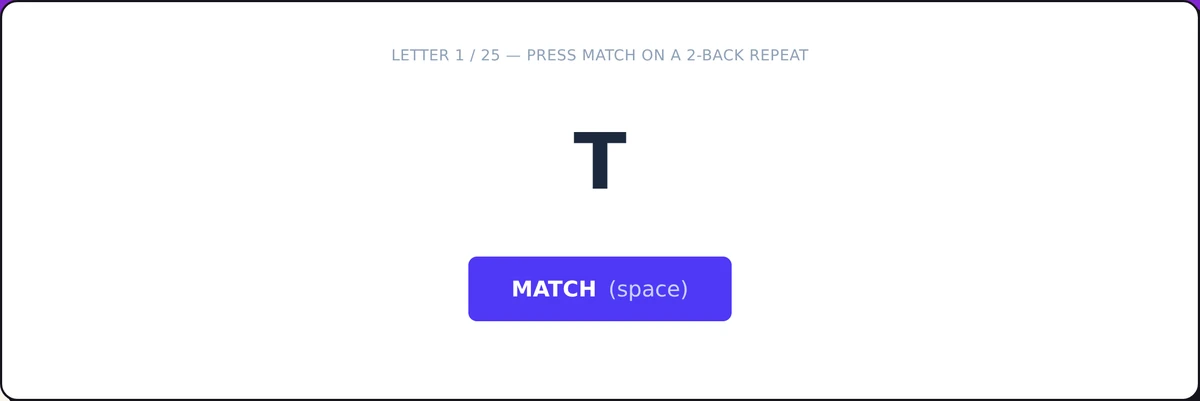
Our n-back test is a 2-back with letters, not HireVue's shapes: 25 letters, each shown for 1.6 seconds, and you press Match when the letter equals the one two before. It does not step through 1-back and 3-back levels, so treat it as training for the core skill, which is the 2-back loop, rather than a copy of the game. The score is built to punish trigger-happy pressing: it is 100 times your hits minus your false alarms, divided by the number of real matches, with a floor of zero.
What first attempts look like: among 207 players' first attempts on GamePrep (July to November 2026), the median score was 13 out of 100. At least a quarter scored 0, meaning no more hits than false alarms. The upper quartile was 50 and the 90th percentile 88. So a first run that feels like a disaster is normal. Among the 27 players who came back for a third run, the median change from first to third attempt was +13 points. Those are players who chose to return, so read it as a sign the task responds to practice, not as a promise. More score distributions are on our score benchmarks page and in the cognitive test statistics study.
A simple plan for the week before:
- Day 1: one cold run of the n-back test to get a baseline. Read the n-back test explained for the false-alarm trap in detail.
- Days 2 to 5: three or four runs a day, using the labelling and rhythm method on every run. Stop when you notice fatigue: a tired run teaches bad habits.
- Alongside: a few rounds of digit span or the Corsi block test. Both build the short-term store the n-back leans on, and Digitspan often sits in the same HireVue battery (see the HireVue Digitspan guide).
- Test day: two warm-up runs, then a quiet room and a stable connection.
Which employers use Flashback?
HireVue does not publish which clients use which games, and the audit describes a model in which HireVue's psychologists pick the game package for each client. Candidates report HireVue games, usually two to four of them, alongside or after a HireVue video interview. One candidate described "4 questions that were recorded and then 3 games to play... remembering sequences backwards and patterns" (Reddit). The invitation is the only reliable guide to which games you will get. For the full set of HireVue games and how employers combine them, see HireVue games explained and the complete guide to HireVue game-based assessments.
FAQ
What is the HireVue Flashback game? A gamified n-back test. Shapes appear one at a time and you decide whether each matches the shape shown 1, 2 or 3 steps earlier. HireVue's research says it measures working memory and attention.
How long is the Flashback game? HireVue's validation study timed it at 2.5 minutes, and HireVue's candidate blog says each game takes about 3 minutes. Check your own instructions screen.
Is Flashback 2-back or 3-back? Both, and 1-back too. The level decides. Early levels compare with the previous shape; later levels move to 2-back and 3-back as you play accurately.
Does colour matter in Flashback? HireVue only says the shapes get more complex. Prep sites report later levels where shape and colour must both match. Read each level's instructions rather than assuming.
What is a good Flashback score? HireVue publishes no pass mark. Results are compared with other candidates and each employer sets its own bar. Reaching higher levels with few mistakes is what lifts the score.
Can you practise for the Flashback game? Yes. The 2-back loop is a trainable habit. Practise on a free n-back test for a few days so the rhythm is automatic before the real thing.
Should I guess if I lose track? Guessing "Match" at random adds false alarms. Rebuild your loop over the next one or two shapes, answering "No match" until you are sure, because matches are usually the minority.
GamePrep is an independent practice platform and is not affiliated with HireVue or MindX. HireVue does not publish its game rules in full; the mechanics above come from HireVue's published research and candidate and prep-provider descriptions, and assessments change. Verify everything against your invitation. We provide practice only, with no leaked questions or answers.