Spatial Reasoning Test Practice
A spatial reasoning test asks you to picture shapes in your head and work out what happens when they are turned, flipped, folded or put together.
Free, no sign-up, unlimited plays, about 12 min, scored on our server as a percentile the moment you finish. Spatial reasoning test guide.
Loading game…
What is a spatial reasoning test?
A spatial reasoning test asks you to picture shapes in your head and work out what happens when they are turned, flipped, folded or put together. There is no reading and no arithmetic: every question is a drawing and a handful of options, and you pick the one that fits. Employers use these tests for jobs where people read drawings or picture objects they cannot see, such as engineering, design, architecture, manufacturing, air traffic and pilot training, and some graduate and apprentice schemes add one next to numerical and verbal reasoning.
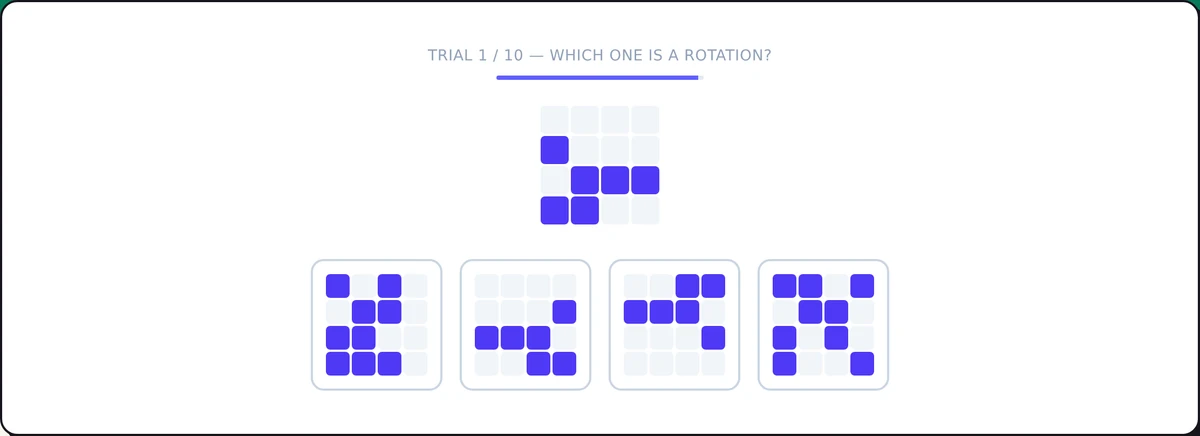
This practice test gives you 20 questions in 12 minutes in the four formats that come up most often, taking turns, each round a step harder:
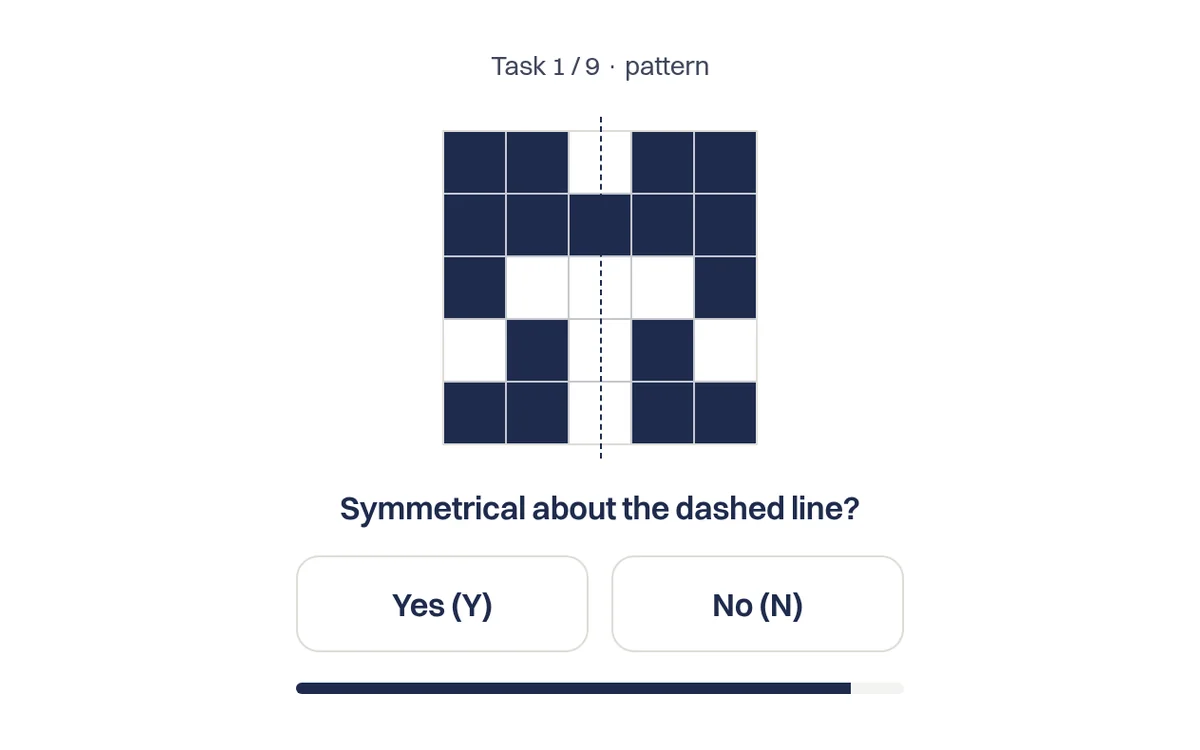
- Mirror images. A shape and a dashed mirror line: which option is its reflection? In a vertical line left and right swap and top and bottom stay put; in a horizontal line it is the other way round. The decoys are the shape turned instead of flipped, or reflected in the wrong line. From the third round a marked cell has to land in the right place too.
- Shape assembly. A shape, and four sets of pieces: which set fits together to make it exactly? Pieces may be turned but not flipped. The wrong sets look close: one piece is a mirror image, or one cell has moved.
- Cube nets. A flat net of six faces: which of four cubes can be folded from it? Faces two apart in a straight row end up opposite each other and can never be seen together. The hard decoys show three faces that do meet at a corner, but in the wrong order around it.
- 3D rotation. A figure built from cubes: which option is the same object, only turned? The others are its mirror image, turned, or a figure with one cube moved. This is the format psychologists call mental rotation, after Shepard and Metzler's 1971 experiment with block figures.
Every question is generated from a seed and marked on our server, so you can retake the test and get new questions each time. At the end you get your score, a percentile on our own practice scale, your result for each format and every question you missed drawn again, with your choice, the right answer and the rule behind it.
How to get faster at spatial questions
Rule options out rather than proving one right. On cube nets, find two faces that must be opposite and strike every cube that shows both. On 3D figures, pick the most distinctive arm and follow which way each bend goes; a mirror image always bends one of them the other way. On assembly, count cells first, then place the most awkward piece in the only corner it fits. Practice helps: people get quicker at mental rotation with practice, though the gain is largest on shapes they have seen before, so mix the formats.
This is an independent practice test. The questions are generated by GamePrep and are not taken from any publisher's test, and we are not affiliated with SHL, Aon, Kenexa, Saville, Thomas International or any other test provider.
- 1
Play
Hit start and the game runs the way the real assessment does, timers and all.
- 2
Get scored
Your result is graded on the server against fixed norms and turned into a percentile.
- 3
Improve
Save your run to a free account and watch your score climb across sessions.
Frequently asked questions
What is a spatial reasoning test?
A test of how well you can picture shapes and objects in your head and work out how they look when turned, reflected, folded or combined. Questions are drawings with multiple-choice options, usually under a tight time limit.
What kinds of questions are in a spatial reasoning test?
The common formats are mirror images, rotation of flat shapes, cube nets (which cube a net folds into), 3D rotation of block figures, shape assembly (which pieces make a shape), block counting and map or direction questions. This practice test covers mirror images, shape assembly, cube nets and 3D rotation.
Which jobs use spatial reasoning tests?
Mostly jobs where people work with drawings, layouts or physical objects: engineering, design, architecture, manufacturing and technical apprenticeships, pilot and air traffic control selection, and some graduate schemes that add a spatial test to numerical and verbal reasoning.
How is this spatial reasoning test scored?
One point per right answer, out of 20, with no penalty for a wrong guess, marked on our server. The percentile compares your score with our own practice scale, not with a publisher's norm group, because publishers do not release their norms.
Can you improve at spatial reasoning with practice?
Yes. Studies of mental rotation find people get faster and more accurate with practice, most of all on the kinds of shape they practised. Learning the rules for each format (opposite faces on a net, bends on a block figure) also saves time on the day.
Are these the real test questions?
No. Every question is generated by GamePrep from a seed, so there is nothing to memorise and you get a new set on every run. The formats follow how employer spatial tests are publicly described.
More spatial games to try



The free prep checklist
Assessment coming up? One email with the 1-page checklist candidates use before a game-based assessment: which games to drill, and what to do the night before. Unsubscribe anytime.
No spam. We never share your email.
Keep your scores
Guest scores live only in this browser. Create a free account to keep them on any device and track your percentile across all 55 games.