Spatial Reasoning Tests
Question Types, Examples and How to Improve
A spatial reasoning test asks you to picture shapes and move them in your head - rotate them, spot mirror images, fold nets into cubes or fit pieces together. The question types employers use (Saville, Thomas GIA, Criteria and game-based versions), worked shortcuts, what the research says about training, and free practice.
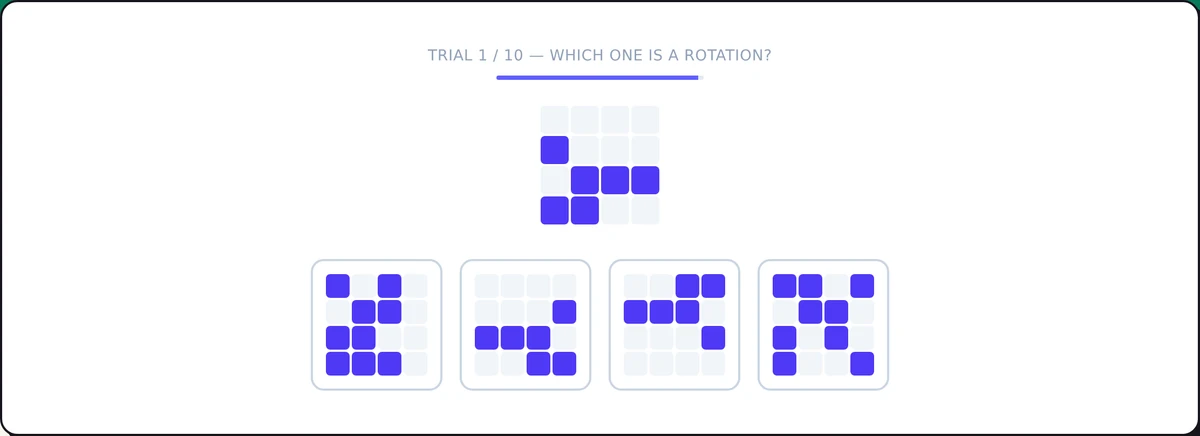
A spatial reasoning test measures how well you can picture shapes and manipulate them in your head: rotate a shape, tell a rotation from a mirror image, fold a flat net into a cube, fit pieces together or follow a route on a map. It turns up in engineering, technical and apprentice batteries and inside broader aptitude tests. Saville Assessment publishes a Spatial Reasoning practice test in its Technical range (Saville practice tests), and the Thomas GIA includes a Spatial Visualisation task in which you count rotated symbols that match, ignoring mirror images (Thomas GIA booklet, PDF). The good news is that spatial skill is one of the most trainable abilities tested: a meta-analysis of 217 studies found that training improved it, that the gains lasted, and that they carried over to untrained spatial tasks (Uttal et al., 2013). Start with our free mental rotation test, which drills the rotate-or-mirror decision at the heart of most spatial items.
Spatial reasoning at a glance
| Question type | What you do | Where you meet it | Free practice |
|---|---|---|---|
| Mental rotation | Decide whether a shape is the same as a target after turning it | Thomas GIA, HireVue Shapedance, many aptitude tests | Mental rotation test |
| Mirror images | Reject shapes that are reflections, however they are turned | Thomas GIA Spatial Visualisation, Shapedance | Mental rotation test |
| Cube nets and folding | Pick the cube a flat net folds into, or the net of a cube | Technical and engineering batteries | Paper practice (see below) |
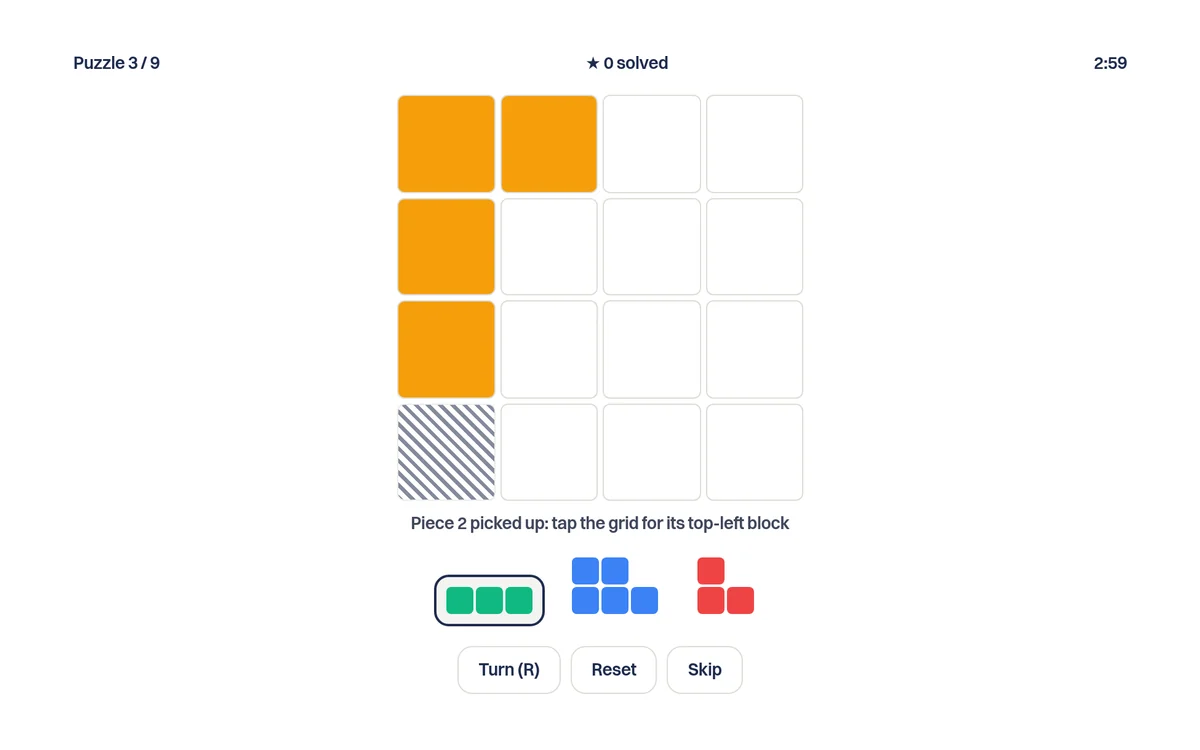
| Shape assembly | Choose the pieces that fit together into a target shape | Technical batteries, Criteria Cognify Grid Lock | Grid packing puzzle |
| Maps and routes | Follow directions, plan a path through obstacles | Pipe and route puzzles (Test Partnership's Pipe Puzzle, for example), directions tasks | Pathfinder puzzle |
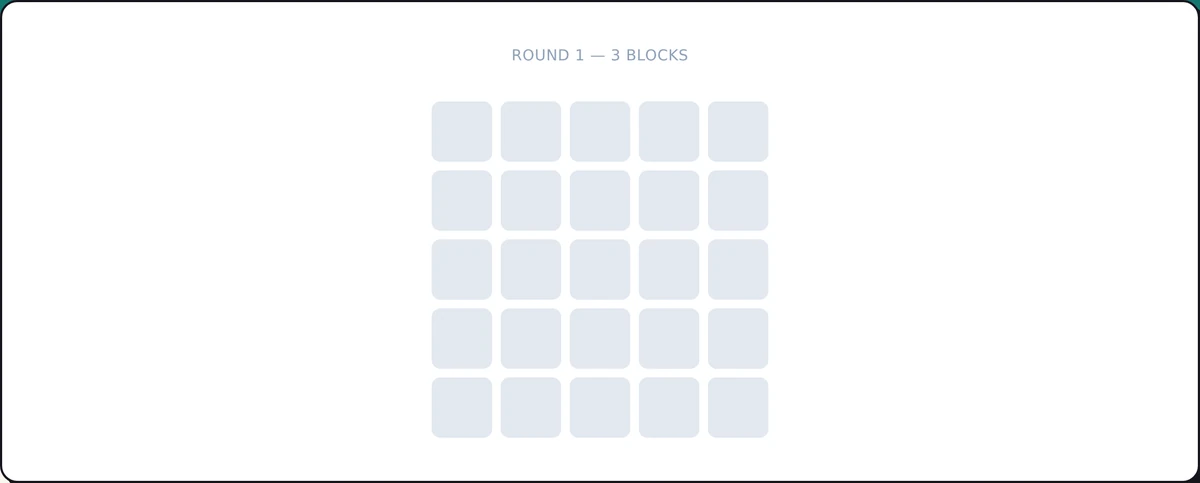
| Spatial memory | Remember positions and sequences on a grid | Game-based batteries | Corsi block test |
Who uses spatial reasoning tests?
- Engineering, technical and apprentice roles. Saville's Technical Aptitude range includes Spatial Reasoning alongside Mechanical and Diagrammatic Reasoning and a "Swift Apprentice Aptitude" test (Saville practice tests). Our Saville Assessment guide and degree apprenticeship online assessment guide cover where those appear.
- General ability tests. The Thomas GIA's fifth task is Spatial Visualisation; see the Thomas GIA guide. Criteria's CCAT mixes spatial items into its 50-question, 15-minute run; see the CCAT guide.
- Game-based assessments. HireVue's Shapedance is a mental rotation game, covered in the Shapedance guide; route-planning puzzles are covered in the pathfinder puzzle guide. Sova's optional logical reasoning test works with "shapes and sequences" too (Sova); see the Sova guide.
Employers in technical fields have a research reason to test it. A study following around 400,000 US high-school students found that spatial ability predicted who went on to degrees and careers in science, technology, engineering and maths, over and above verbal and maths ability (Wai, Lubinski and Benbow, 2009).
How each question type works, with shortcuts
Mental rotation and mirror images
The classic experiment behind this item type found that the time people take to judge whether two 3D shapes match grows with the angle between them, as if they were turning a mental picture at a steady speed (Shepard and Metzler, 1971). In a test, that means big angles are slow. The shortcut is to avoid rotating the whole shape:
- Find one asymmetric feature on the target, for example a short arm on the left of a long one.
- Find the same feature on the candidate and check which side it is on relative to the rest of the shape.
- Same side means rotation; opposite side means mirror. A mirror image can never be turned into the original, which is the rule the Thomas GIA's spatial task is built on.
Cube nets and folding
Typical item: a flat cross of six squares with symbols, and four cubes; which cube can this net make?
- Opposite faces never touch. In a straight run of three squares, the first and third end up opposite each other.
- Check adjacency, not position. Two faces that share an edge in the net share an edge on the cube. Rule out any cube that shows two opposite faces side by side.
- Track one corner. Pick a symbol, note which way it points, and see whether that direction is still possible on the cube.
Practise on paper: drawing and folding a few real nets is the fastest way to stop guessing.
Shape assembly
You are shown a target shape and several pieces. Count first: the areas or number of squares in the pieces must add up to the target. Then place the most awkward piece first, because the easy pieces fit anywhere. Our grid packing puzzle trains this "awkward piece first" habit.
Maps and routes
Directions tests ask you to follow turns ("left, then right, then left") from a starting heading. Keep the heading in words ("facing north") rather than imagining the map turning. Path puzzles reward planning the whole route before your first move; see the pathfinder puzzle guide.
Can you improve your spatial reasoning?
Yes, more than most abilities. The meta-analysis of 217 training studies found an average improvement of about half a standard deviation over control groups, and the gains held after a delay and transferred to spatial tasks that had not been trained (Uttal et al., 2013). What works in practice:
- Short, frequent sessions on the specific item type in your invitation, rather than one long cram.
- Learn a strategy per type (the feature check for rotation, adjacency rules for nets), then speed it up.
- Mix speeds. Untimed practice to get accurate, timed runs to get fast.
- Use physical objects for 3D items: a sugar-cube model or a folded net settles an argument with yourself in seconds.
Free spatial reasoning practice
- Mental rotation test (Shapedance-style): rotate or mirror, under time.
- Grid packing puzzle: fit pieces into a frame.
- Pathfinder puzzle: plan a route.
- Corsi block test: spatial memory.
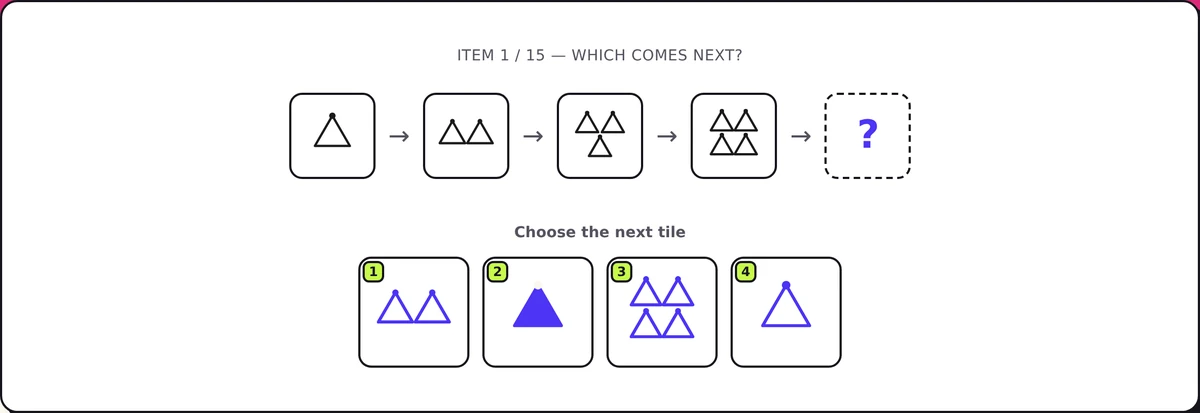
- Abstract reasoning test: shape sequences, often in the same battery.
- Mechanical aptitude test: the usual companion test in technical batteries.
For how spatial reasoning fits next to abstract, verbal and numerical tests, see reasoning tests explained.
FAQ
What is a spatial reasoning test? A test of how well you can visualise and manipulate shapes in your head: rotating shapes, recognising mirror images, folding nets into 3D objects, fitting pieces together or following routes.
What jobs use spatial reasoning tests? Mostly engineering, technical, design and apprentice roles, plus general ability tests that include a spatial section, such as the Thomas GIA and Criteria's CCAT. Game-based assessments such as HireVue's include a mental rotation game too.
How do you tell a rotation from a mirror image? Pick one asymmetric feature on the target, find it on the candidate shape and check which side it sits on relative to the rest. If it is on the same side, the shape is a rotation; if on the opposite side, it is a mirror image, which no rotation can produce.
Can you get better at spatial reasoning? Yes. A meta-analysis of 217 training studies found spatial skills improve with practice, the gains last, and they transfer to untrained spatial tasks.
Is the GamePrep mental rotation test the same as an employer's test? No. GamePrep is independent and not affiliated with Saville Assessment, Thomas International, Criteria, HireVue or any employer. Our games train the same skills with original tasks.
GamePrep is an independent practice site and is not affiliated with, endorsed by or connected to any test publisher or employer named on this page.