Does Practice Improve Game-Based Assessment Scores? What Our Data Shows
Yes, practice raises scores on most game-based assessment tasks, but not evenly. Our server-scored runs show the median player's third attempt beat their first on 17 of 19 games, and two barely moved.
Yes, you can practise for game-based assessments, and on most cognitive games it raises your score, but by very different amounts. Among players who came back for a third attempt on GamePrep (July to November 2026), the median third run beat the first run on 17 of the 19 games with enough data. The biggest movers were the Stroop test, inductive reasoning, n-back and the switching games. Numerosity and Pathfinder did not move at all. The research on retesting says the same thing in general terms: scores rise with repeated testing, mostly between the first and third attempt, and then level off. Practice helps most with format and strategy. It does much less for tasks that read stable traits, such as risk-taking in a balloon game.
What does our data show, game by game?
Every number below is a server-scored run on GamePrep between July and November 2026. "First-attempt median" is the middle raw score among all players' first runs. "Change" is the median of each returning player's third run minus their first. We only list games with at least 30 players and at least 10 players who reached a third run, and we leave out the reaction time test: its results before 4 November 2026 were inflated by a timing bug, so its practice figures are not usable.
| Game | Players | First-attempt median | Players with 3+ runs | Median change, run 1 to run 3 |
|---|---|---|---|---|
| Digit span | 422 | 6 digits | 92 | +1 digit |
| Stroop test | 383 | 60 (out of 100) | 69 | +12 |
| Flanker arrows | 359 | 74 (out of 100) | 49 | +6 |
| Mental math | 350 | 16 correct | 50 | +2 |
| Numerosity | 257 | 8 levels | 66 | 0 |
| Disco numbers | 244 | 74 (out of 100) | 26 | +2 |
| Inductive reasoning | 214 | 66.5 (out of 100) | 18 | +16 |
| N-back | 207 | 13 (out of 100) | 27 | +13 |
| Predict (day and night) | 163 | 56% better bets | 47 | +5 |
| Task switching | 162 | 61 (out of 100) | 26 | +9 |
| Pathfinder | 147 | 5 puzzles | 20 | 0 |
| Shapedance rotation | 140 | 6 rotations | 33 | +1 |
| Corsi blocks | 140 | 5 blocks | 43 | +1 |
| Odd one out | 118 | 77 (out of 100) | 16 | +8 |
| Balance | 78 | 9 level points | 33 | +4 |
| Lock | 71 | 118 ms timing error | 18 | 25.5 ms less error |
| Direction | 54 | 83 points | 14 | +6 |
| Ticket | 51 | 70 points | 20 | +13 |
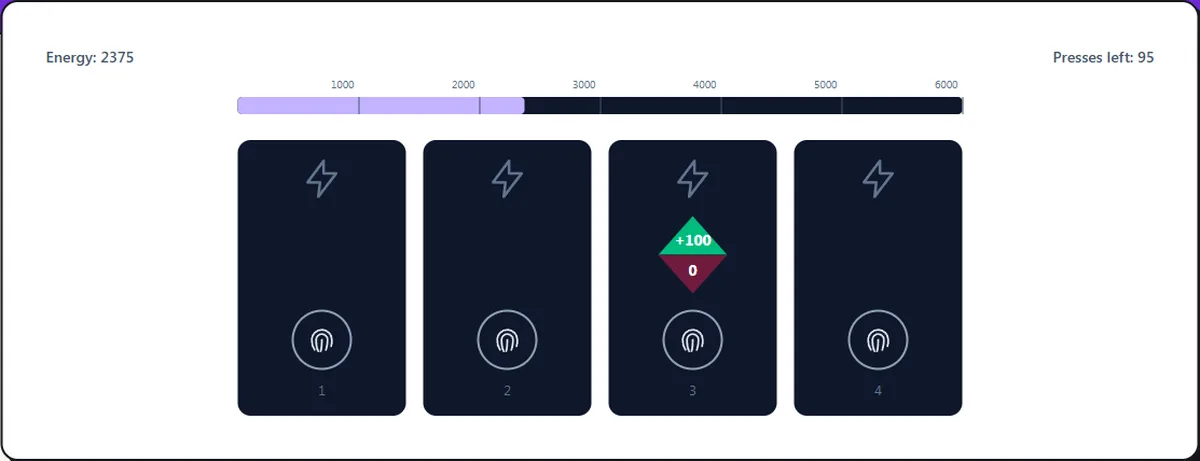
| Energy | 39 | 3,575 energy | 15 | +1,575 |
Games we left out because too few players have come back three times yet: backward digit span (207 players, 9 returners), numerical reasoning (116 players, 3), balloon (53 players, 5), order (48 players, 8) and ecosystem building (37 players, 2). The full spread of first attempts for every game is on score benchmarks, and the memory, attention and speed results are written up as a citable study in cognitive test statistics.
Why should you read these numbers with care?
Three things make a practice figure look better or worse than the real effect, and our data cannot separate them out.
- Only some players come back. Fewer than one in four players on most games reached a third run. People who return may be more motivated, more anxious about a real test, or unhappy with a bad first run. Their gains may not be typical of everyone.
- Regression to the mean. Anyone whose first run was unluckily low (a distraction, a misread instruction) will tend to score closer to their usual level next time, even with no learning at all. Some of every "improvement" is just that.
- Interface learning is not ability. A large part of an early gain is knowing which key does what, how fast the items come and what the screen is asking. That matters in a real assessment too, but it is a one-off gain, not a rising skill.
So the honest reading is: on these games, a typical returning player did better on the third try, and the size of the change tells you roughly how much of the task is format and strategy rather than raw capacity.
Which games barely move with practice?
Numerosity (0 change, 66 returners). The median player solved 8 levels on the first try and 8 on the third. The game rewards fast number recall, which builds over weeks of arithmetic, not over three sessions. The Numerosity guide has the scanning trick that helps more than repeats.
Pathfinder (0 change). This is a ceiling, not a failure of practice: most players already solve all 5 puzzles on their first attempt (the 25th to 90th percentile of first runs are all 5). There is no room left to show a gain.
Digit span, Corsi blocks and Shapedance (+1 each). These are span tasks with a small scale, where one extra item is a real step. A gain of one digit or one block is in line with what chunking gives, and it is hard to go further quickly.
Mental math and Disco numbers (+2 each). Arithmetic speed improves, but slowly.
Which games move the most, and why?
The big movers have something in common: a strategy or a rule you only discover by playing.
- Stroop (+12) and the switching games (task switching +9, Ticket +13). Once you have a habit for "name the ink, not the word" or "top box means the number", you stop paying the cost of each conflict.
- Inductive reasoning (+16). Pattern rules repeat. Once you have seen the common rule types, new items get easier. The sample here is small (18 returners).
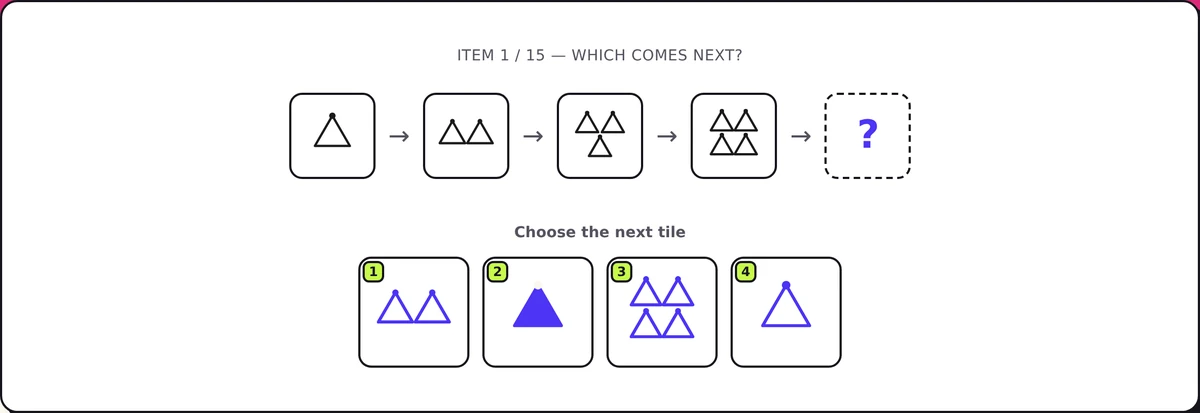
- N-back (+13). At least a quarter of first attempts score 0 out of 100, while the top tenth reach 88 or more. The rule ("was this letter shown two steps ago?") takes a run to sink in, and a clear method makes a large difference.
- Energy (+1,575 energy). The generators are shuffled every game, so this is not memorising the screen. Returning players learn the structure: the generator that pays most often also loses most.
What does the research say about practice effects?
Two meta-analyses cover retesting on cognitive ability tests:
- Hausknecht and colleagues (2007) combined 50 studies, 107 samples and 134,436 participants and found "an adjusted overall effect size of .26" for retesting, with larger effects "when practice was accompanied by test coaching and when identical forms were used" (Journal of Applied Psychology, abstract). An effect of .26 is about a quarter of a standard deviation.
- Scharfen, Peters and Holling (2018) analysed 122 studies with 153,185 people and found "significant retest effects and no further score gains after the third test administration". Their highlights add that "retesting multiple times can lead to score gains of half a standard deviation" (Intelligence).
That plateau after the third attempt is why we compare the first and third runs. It is also why practising one game twenty times is a poor use of an evening: spread the time across the games your invitation names.
Which skills are trainable and which are stable traits?
Trainable: format familiarity (instructions, keys, timing), strategy (chunking digits, planning a whole path before the first move, handling a rule switch), and the speed that comes from doing a task fluently. These are the gains in the table.
Stable, by design: behavioural tasks that read how you take risks, respond to setbacks or treat other people. Arctic Shores says its tasks read "natural, intuitive tendencies", the kinds of responses "that can be difficult to consciously shape in the moment", and that "candidates produce broadly consistent results over time" (Arctic Shores 2026 candidate guide). In those games, such as the balloon task, there is no higher score to practise towards.
What vendors say about preparing. They do not agree:
- Arctic Shores: "no practice is needed", although "if you'd like to just familiarise yourself with our assessment's format, that's totally fine", and it offers a practice task. It also warns that unofficial guides can lead to "poor or invalid measures" (Do I need to practice?).
- HireVue: "Beyond practicing like you would for any other type of interview, nope", because each assessment model "is developed for one type of job role" (HireVue candidate FAQ).
- McKinsey, for Solve: "There's no need to prepare—approach it with curiosity and creativity" (McKinsey).
- Clifford Chance, for the Watson Glaser critical thinking test it sets: "we strongly recommend that you practise as much as possible. Familiarity with the format and the style of questions will help you perform at your best" (Clifford Chance).
The pattern is consistent with the data: practice is pointless or even counterproductive for trait tasks you try to "game", and useful for ability tasks where knowing the format is half the battle.
How should you practise, then?
- Play each game in your invitation once, cold. That first run is your baseline and your format lesson.
- Learn the one strategy each game rewards. Our game guides name it: chunking for digit span, plan-first for Pathfinder, the switching habit for the Ticket game.
- Play two more times, on different days. The research and our data both point to most of the gain arriving by the third attempt.
- Play the trait tasks once, for format only. Then play them as yourself on the day.
- Stop before you are tired. A tired run is worse practice than none.
For the wider picture of what each vendor sends, see the complete game-based assessment guide.
FAQ
Can you practise for game-based assessments? Yes. On 17 of the 19 games with enough repeat players on GamePrep, the median third attempt beat the first. Gains are largest on games with a rule or strategy to learn (Stroop, inductive reasoning, n-back, switching games) and smallest on Numerosity and Pathfinder.
Does practice help on pymetrics, Arctic Shores or HireVue games? On the cognitive games, mostly yes: memory, attention and switching tasks improve with familiarity. On the behavioural games (balloon, money exchange, team tasks) there is no better score to reach, and Arctic Shores warns that trying to follow outside guides can produce invalid results.
How many practice attempts are worth it? About three per game. Research on retesting finds no further gains after the third administration, and our run 1 to run 3 comparison reflects that.
Is practising the same as cheating? No. Learning the format and a sensible strategy is normal preparation, and some employers recommend it. Using someone else's help, AI tools or answer sheets during the real assessment is cheating, and vendors such as McKinsey forbid it.
Are these numbers representative of all candidates? No. They come from people who chose to practise on GamePrep and, for the change column, only from those who returned at least three times. Treat them as a rough guide to how trainable each task is, not as a prediction for you.
GamePrep is an independent practice platform and is not affiliated with Arctic Shores, HireVue, Harver (pymetrics), McKinsey, Pearson TalentLens or any other assessment vendor. Our games are our own versions of publicly described task types. We provide practice only — no leaked questions or answers.