Error Checking Test
Formats, Train Driver Tests, Scoring and How to Practise
An error checking test asks you to compare an original with a copy and find the differences, fast. The formats publishers use, where train driver and admin applicants meet it, the five kinds of error to look for, and a free timed practice test.
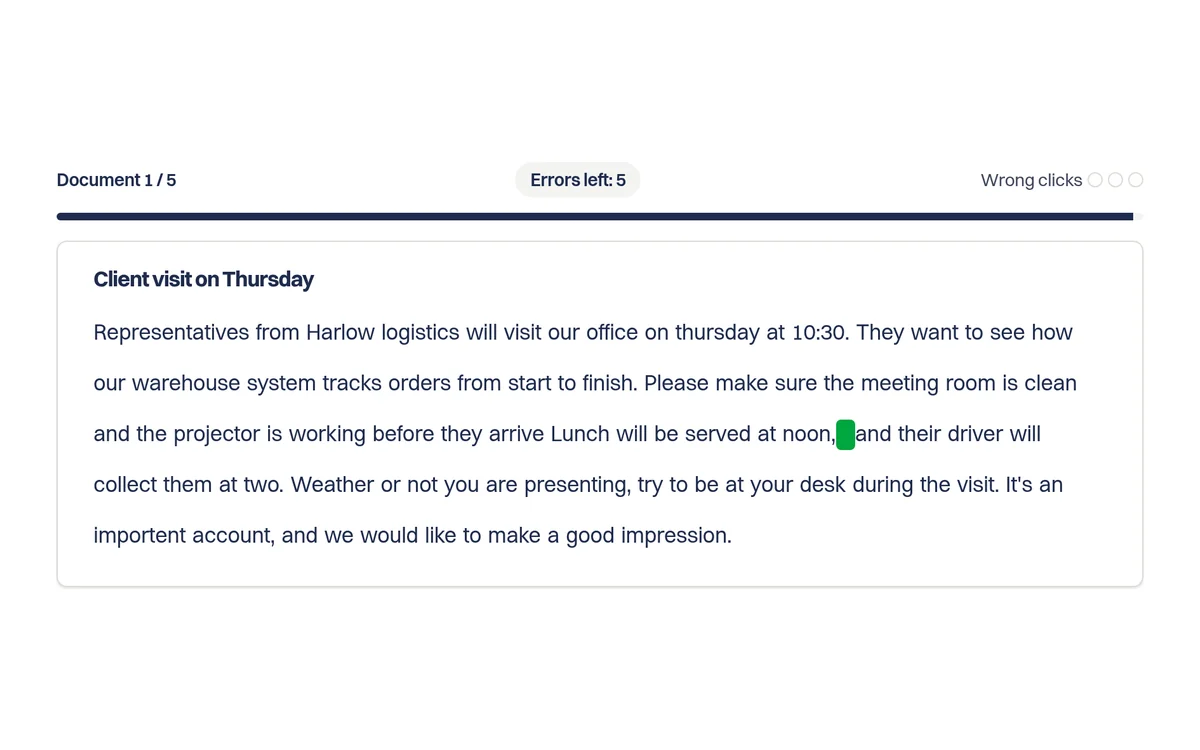
An error checking test gives you information twice, an original and a copy, and asks you to find where they differ before the time runs out. The differences are small on purpose: two digits swapped round, a zero where there should be a letter O, a doubled letter in a surname. One prep site sums it up as measuring "how quickly and accurately you spot differences between pieces of information", where "speed counts as much as accuracy" (Practice Aptitude Tests). You can try the format free in our error checking test.
What an error checking test looks like
There is no single format. Each publisher has its own, and the names vary too: checking test, data checking test, clerical checking, attention to detail test. The versions described publicly fall into four groups:
- Compare two lists and mark the mismatches. An original table and a copy, side by side; you mark every entry in the copy that differs. Assessment Day describes copies in which "some items have been transposed or swapped with other parts of the transcript" (Assessment Day). This is the format our practice test uses.
- Pick the exact match. A reference string and five options, of which one is identical. SHL's checking test is described this way: sequences of up to nine letters, digits or both, 25 questions, with the time per question falling from 8 seconds to 5 (JobTestPrep).
- Same or different. Pairs of strings, and for each you answer whether they match.
- Error codes against a reference chart. Used in train driver selection material: you compare references on a diagram with a chart and enter an error code only where they disagree, drawing a line through the box where there is no error (How2Become).
Timing is tight in every version. Practice Aptitude Tests gives 20 questions in 4 minutes, about 12 seconds each; Assessment Day says a typical real test gives about 14 minutes for 28 questions. Expect not to finish comfortably: the clock is part of what is measured.
Who has to take one
Employers use checking tests where small mistakes are expensive: administration, data entry, finance and banking operations, customer service and public-sector jobs (Practice Aptitude Tests). JobTestPrep names entry-level administrative support, sales and customer service roles for the SHL version.
Train drivers. In the UK, error checking is one of the tests trainee train driver applicants describe. On RailForums, an LNER apprentice train driver applicant lists "error checking" as the second of the psychometric stages, each passed before the next (RailForums, LNER thread), and in a general thread on train driver tests another applicant reports a 99th percentile on error checking (RailForums). Google suggests "error checking test train driver", "tfw" and "lner" as searches, so many applicants look for it. Train operators do not publish their test content, so treat the details as candidate reports, and check your invitation: it should name the tests and the provider.
The five kinds of error
Prep sites list the same handful of traps (Practice Aptitude Tests):
- Swapped characters. 4071 becomes 4701; Hughes becomes Hugehs. The commonest trap, because every character is still there.
- A wrong digit. One figure in a phone number, an amount or a staff number changed.
- Look-alike characters. O and 0, I and 1, S and 5, B and 8. They hide best in codes that mix letters and digits, such as postcodes and part numbers.
- Spelling. A doubled or dropped letter or a changed vowel in a name or place: Pritchard and Pritchrad, Llanelli and Llaneli.
- Punctuation. A dot for a comma in an amount, a slash for a hyphen in a reference, a full stop for the colon in a time, a misplaced dot in an email address.
How to check faster without missing more
- Compare in chunks. Three or four characters at a time, not the whole value at once. Reading a long code in one glance is how a swap slips through.
- Say codes in your head. "K-X-four-zero-seven-one" is harder to misread than a shape.
- Check the likely spots first: neighbouring characters, double letters, letters next to digits, punctuation.
- Keep moving. Do not reread a row you have finished. In a mark-the-mismatches test the last sheet is worth as much as the first, and sheets you never reach score nothing.
- Only mark what you can name. Many checking tests score correct marks minus wrong ones, and ours does. If you cannot say what differs, leave it.
Practise the format
Our error checking test gives you six sheets of eight records (a crew roster, invoices, a stock list, contacts, a service log and payee accounts). The original sits next to the copy, or above it on a phone, and you tap every copy cell that does not match. You get six minutes for 24 errors spread over the six sheets. Your score is errors marked minus wrong marks, with a percentile on our practice scale and every missed error shown afterwards. Each run builds new records from a seed, so you can retake it.
The same habits help in a data entry test, where you type records rather than check them, and in a proofreading test, where the errors are in sentences rather than codes.
FAQ
What is an error checking test? A timed test of attention to detail. You compare an original with a copy, such as lists of names, codes or numbers, and find the differences. Some versions ask you to pick the exact match from options, or to enter an error code for each mismatch.
Is there an error checking test for train drivers? Candidates for UK trainee train driver jobs report one among the online tests, and prep material describes a version based on error codes and a reference chart. Operators do not publish the content, so check what your invitation names.
How is an error checking test scored? It depends on the publisher. Match-the-option tests count correct answers. Mark-the-mismatches tests often subtract wrong marks, so guessing costs you. Our practice test scores errors marked minus wrong marks, out of 24.
How long is an error checking test? Usually a few minutes, with seconds per item. Published examples include 20 questions in 4 minutes (Practice Aptitude Tests) and about 28 questions in 14 minutes (Assessment Day).
How do I get better at error checking? Practise under time, compare three or four characters at a time, check the common traps first (swaps, look-alikes, double letters, punctuation) and keep an even pace.
GamePrep is an independent practice platform and is not affiliated with Transport for Wales, LNER, SHL or any other employer or test provider. Our test is an original practice version, and all records in it are invented. Formats change, so check your invitation. We provide practice only: no leaked questions or answers, and no guaranteed pass.