Watson Glaser Test
The Five Sections Explained, With Free Practice
The Watson Glaser test is Pearson TalentLens' critical thinking test: 40 items in five sections, timed at 30 to 40 minutes. What each section asks, how law firms use it, and free practice.
The Watson Glaser test (the Watson-Glaser Critical Thinking Appraisal) is a critical thinking test published by Pearson TalentLens: 40 items across five sections, timed at "30 to 40 mins", delivered online from an item bank (TalentLens). The five sections are drawing inferences, recognising assumptions, deducing, interpreting and evaluating arguments. Each has its own rule, and most lost marks come from applying the wrong rule rather than from hard reasoning. Law firms are the best-known users: Clifford Chance, for example, sets a 30-minute, 40-question Watson Glaser test after its online assessment. For Watson Glaser practice, our free critical thinking test has the same five sections in the same order, with an explanation for every answer.
What is the Watson Glaser test?
TalentLens says the test "assesses critical thinking... by measuring the ability to analyze arguments, evaluate information, and make objective decisions", and is meant to measure the ability to "analyse, reason, interpret and draw logical conclusions from written information" (TalentLens). It is marketed for graduates, managers, executives and professionals, and TalentLens adds that it is "also used by university selection teams".
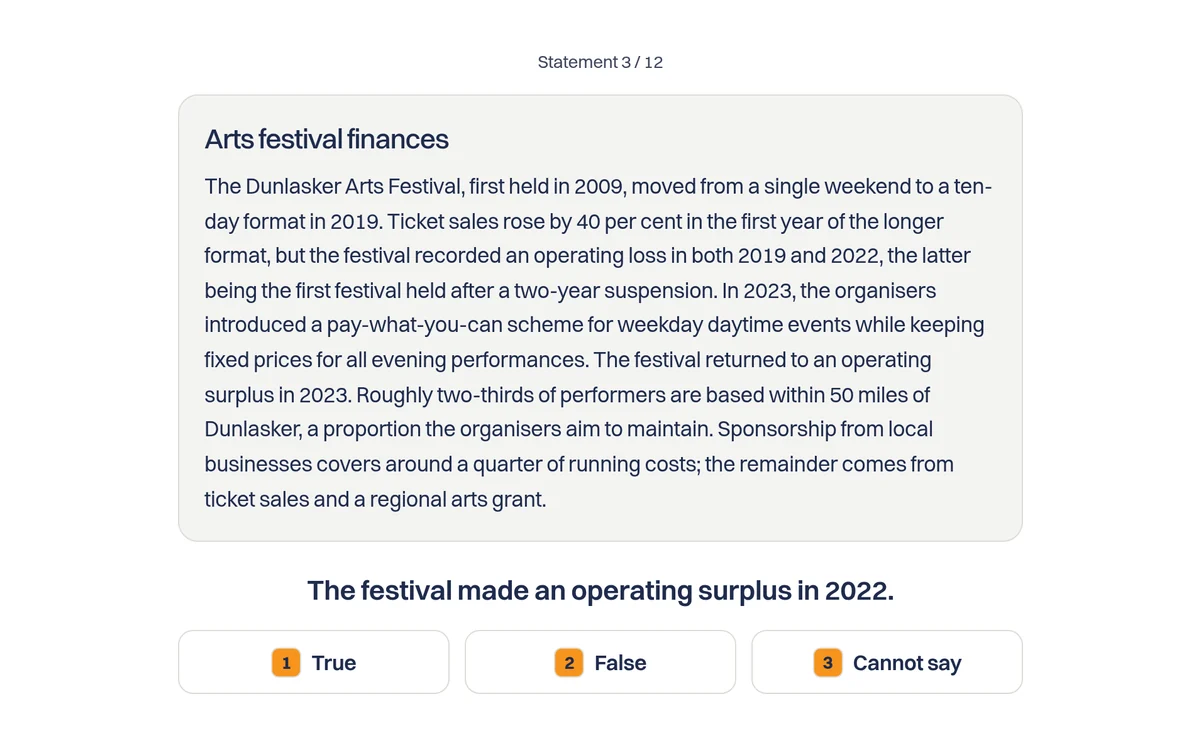
What you see: a short passage, statement or argument, then a series of proposed conclusions. You judge each one on its own, using the rule for that section. No legal or business knowledge is needed, and bringing in outside knowledge is a common way to lose marks.
What are the five sections?
TalentLens lists the five subtests like this (TalentLens):
| Section | TalentLens' description | What you decide |
|---|---|---|
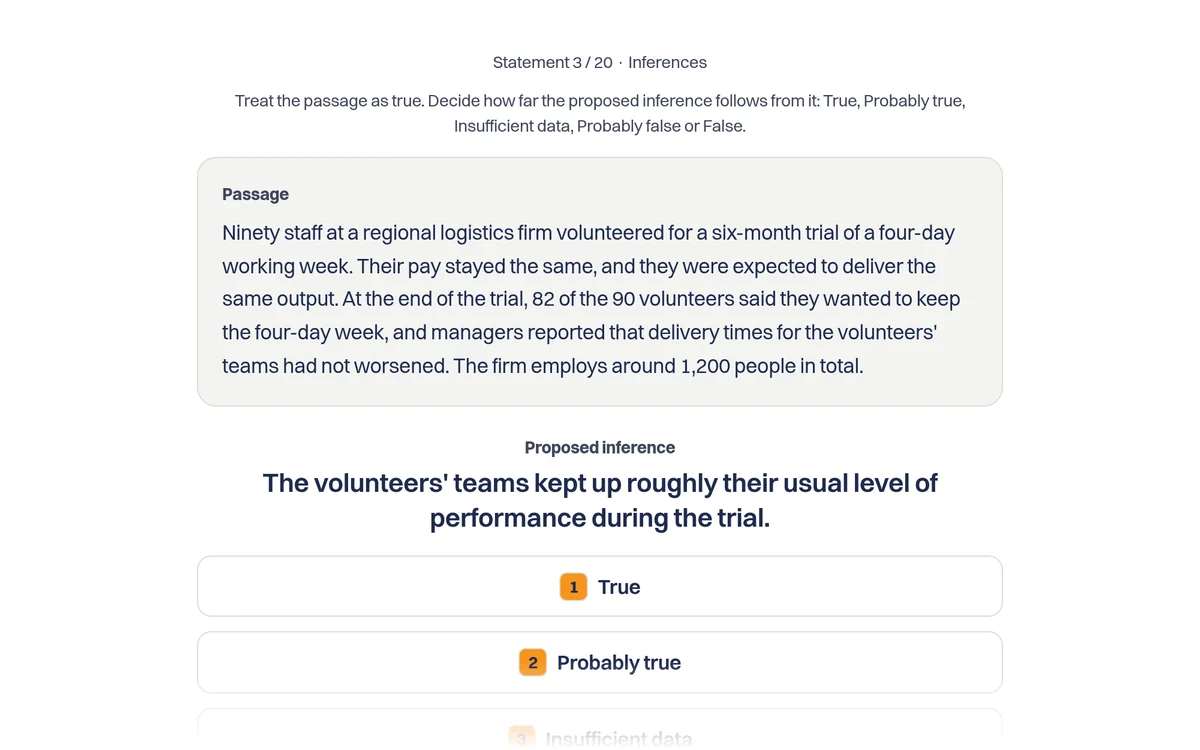
| Drawing inferences | "Rating the probability of the truth of inferences based on the information given" | How likely the inference is, from true to false, given only the passage |
| Recognising assumptions | "Identifying unstated assumptions or presuppositions underlying given statements" | Whether the statement takes the assumption for granted |
| Deducing | "Determining whether conclusions follow logically from given information/data" | Whether the conclusion must follow from the premises |
| Interpreting | "Weighing the evidence and deciding if generalizations or conclusions based on data are warranted" | Whether the conclusion follows beyond reasonable doubt |
| Evaluating arguments | "Evaluating the strength and relevance of arguments with respect to a particular question or issue" | Whether the argument is strong or weak |
Inferences
You rate an inference on a scale from true to false (practice materials use true, probably true, insufficient data, probably false, false). The trap is calling something "true" when the passage only makes it likely, or using common knowledge the passage does not give you. If the passage is silent, the answer is insufficient data.
Recognising assumptions
An assumption is something the speaker must take for granted for the statement to make sense. Test it by imagining the assumption is false: if the statement still works, it was not assumed. Strong words such as "only", "all" and "never" usually make an assumption too strong to be made.
Deductions
Accept the premises as true, however odd they sound, and ask whether the conclusion has to be true. "Some" means at least one, possibly all. If there is any way the premises hold and the conclusion fails, it does not follow. Our deductive reasoning test drills exactly this.
Interpretation
Here the bar is "beyond reasonable doubt", which is looser than strict deduction. Watch for an average read as a rule for everyone, a link read as a cause, and a change in how something was measured.
Evaluating arguments
An argument is strong if it is both important and directly related to the question. It is weak if it is trivial, off the point, or rests on tradition, popularity or someone's fame. Your own opinion on the question does not count.
How long is the Watson Glaser test and how is it scored?
TalentLens lists the test as 40 items, "30 to 40 mins timed", with "item-banked questions and instant results", and says it is suitable for unsupervised online screening (TalentLens). Because questions come from a bank, two candidates rarely see the same set.
Your raw score is compared with a norm group the employer chooses; TalentLens mentions "a wide variety of norm groups and the option for bespoke norms". TalentLens does not publish a pass mark, and employers do not either. Figures you see on prep sites, such as a required percentile for a particular firm, are candidate reports at best. Your invitation is the authority on the version and time limit you will sit.
Which law firms use the Watson Glaser test?
From the firms' own careers pages, checked on 7 November 2026:
- Clifford Chance (London). After the Clifford Chance Immersive Online Assessment, "you will be required to complete the Watson Glaser test", which "focuses on your ability to draw inferences, recognise assumptions, make deductions, interpret information, and evaluate arguments". "The test lasts 30 minutes and includes 40 questions", you have "four days (including weekends)" to complete it, and "the use of AI is not permitted". The firm adds: "we strongly recommend that you practise as much as possible" and offers its own Watson Glaser practice test (Clifford Chance).
- Osborne Clarke. Applicants first sit "an online verbal reasoning test and an online deductive reasoning test". The assessment centre day then includes "a group discussion, a partner interview, and a Watson Glaser test", and the firm "would strongly recommend that you practice the Watson Glaser test ahead of your assessment day" (Osborne Clarke).
Many other City firms are reported by candidates and prep sites to use it, but firms change tests between recruitment seasons, and some use critical reasoning tests from other publishers instead. A&O Shearman's London vacation scheme page, for example, describes situational judgement, verbal and numerical reasoning rather than a Watson Glaser test (A&O Shearman); see our situational judgement test guide. Check your own invitation.
How do you prepare for the Watson Glaser test?
- Learn the five rules before anything else. Most errors come from using deduction's strict rule in interpretation, or interpretation's looser one in deduction. Read the instructions at the start of each section every time.
- Take the official practice test. TalentLens offers a free one. It is "not a live test, but is intended for you to get a better understanding of how the Watson Glaser Critical Thinking test works", and it gives you a report with advice afterwards (TalentLens practice tests). If your firm offers its own, as Clifford Chance does, take that too.
- Practise with explanations, not just scores. The value is in understanding why "probably true" beats "true", or why an assumption is not made. Our critical thinking test shows the right answer and a short explanation for every statement.
- Pace yourself. Forty items in about 30 minutes is under a minute each, and passages are shared across several items. Read the passage once, carefully, then judge each statement quickly against it.
- Keep outside knowledge out. Judge only from what is on the screen, even when you know the real-world answer.
- Spread practice over a few days. Research on retesting finds most of the gain arrives by the third attempt; see does practice improve assessment scores.
How does our free critical thinking test work?
Our critical thinking test has 20 statements, four from each of the five sections, in the Watson Glaser order. Items were written for GamePrep from the public five-section format: the deductions are checked by a logic solver, and every other item was reviewed against a written rubric. Your answers are scored on the server, 75% accuracy and 25% speed. After each run you see the right answer and an explanation for every statement. These are not real Watson Glaser questions.
For the wider family of reasoning tests that often arrive alongside it, see reasoning tests explained and psychometric test practice. Verbal reasoning tests in the true / false / cannot say format are close cousins: practise them on our verbal reasoning test.
FAQ
What is the Watson Glaser test? The Watson-Glaser Critical Thinking Appraisal, a critical thinking test from Pearson TalentLens. It has five sections (drawing inferences, recognising assumptions, deducing, interpreting and evaluating arguments), and law firms and other graduate employers use it to screen applicants.
How many questions are in the Watson Glaser test? TalentLens lists 40 items, timed at 30 to 40 minutes. Clifford Chance's version is 40 questions in 30 minutes.
What is a good Watson Glaser score? Neither TalentLens nor employers publish a pass mark. Your score is compared with a norm group the employer chooses, so the bar differs between firms. Treat specific percentile "cut-offs" on prep sites as unverified.
Can you practise for the Watson Glaser test? Yes, and firms recommend it: Clifford Chance says to "practise as much as possible" and Osborne Clarke strongly recommends practising. TalentLens has a free official practice test, and our critical thinking test covers all five sections with explanations.
What is the difference between deduction and interpretation? In deduction, a conclusion follows only if it must be true given the premises. In interpretation, it follows if it is warranted beyond reasonable doubt by the evidence. The same conclusion can follow in one section and not the other.
Are there real Watson Glaser questions online? Not legitimately. Pearson's live items are item-banked and not public. GamePrep's questions are written for practice in the public format.
GamePrep is an independent practice platform and is not affiliated with, endorsed by or connected to Pearson or TalentLens. Watson-Glaser is a trademark of its owner. Law firm details are taken from the firms' own pages and change between seasons. We provide practice only — no leaked questions or answers.