Situational Judgement Test (SJT)
Formats, Scoring and Free Practice
A situational judgement test (SJT) shows you work scenarios and asks you to judge possible responses. The formats (most/least, ranking, rate each), how scoring keys work, who uses SJTs and free practice.
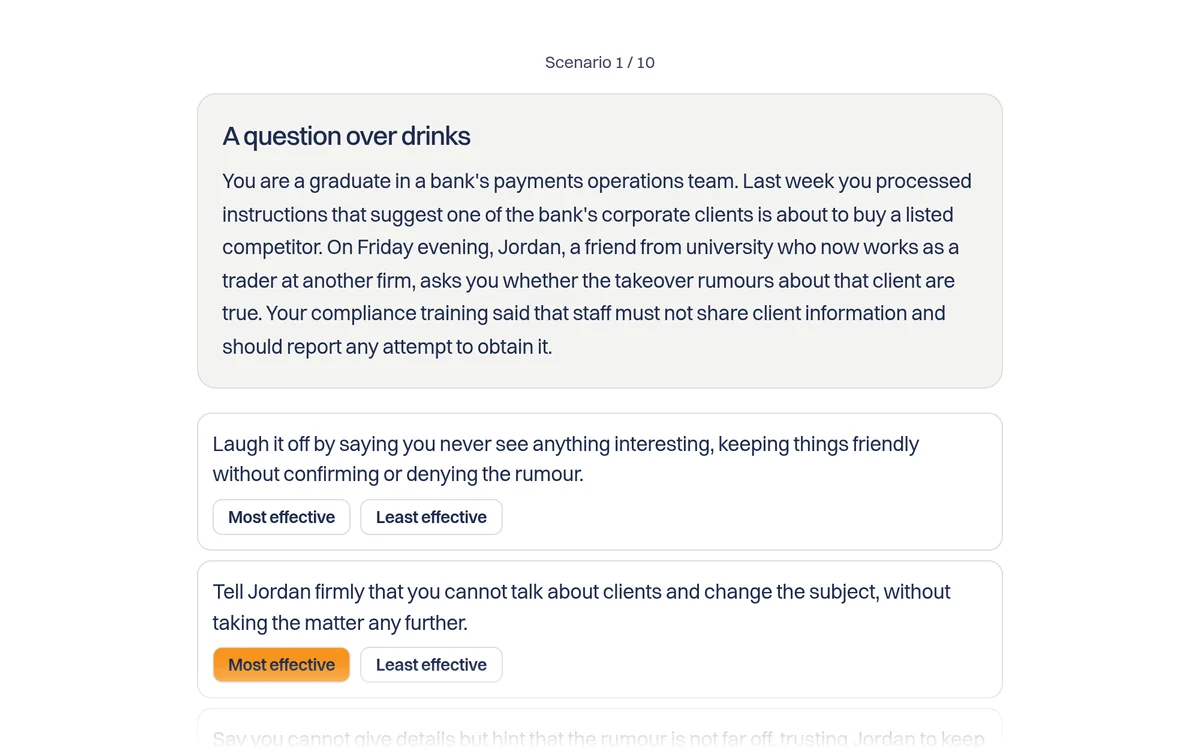
A situational judgement test (SJT) shows you realistic work scenarios and asks you to judge a set of possible responses: pick the most and least effective, rank them, or rate each one. Your answers are compared with a scoring key, usually built from the judgements of people who know the job, and close answers often earn partial credit. There is no knowledge to revise, but the format is very learnable: knowing what each response type asks, and what employers tend to reward, makes a real difference. Graduate employers such as Deloitte UK and A&O Shearman use SJTs, as does the UK Civil Service. You can try the most/least format on our free situational judgement test.
What is a situational judgement test?
The US Office of Personnel Management describes SJTs as tests that "present applicants with a description of a work problem or critical situation related to the job they are applying for and ask them to identify how they would handle it" (OPM). Because you are not actually doing the job, psychologists call them "low-fidelity simulations". OPM lists what they typically measure: "conflict management, interpersonal skills, problem solving, negotiation skills, facilitating teamwork, and cultural awareness".
A typical scenario: you notice a mistake in a report your manager has already sent to a client. Four responses follow, from fixing it quietly to telling your manager straight away. You judge them.
What are the SJT formats?
OPM lists five ways an SJT can ask for an answer: what you "would do", what you would be "most and least likely to do", the "best response among several options", the "best and second-best", or what "would most likely occur next" (OPM). In practice you will meet three main formats:
| Format | What you do | Where you meet it |
|---|---|---|
| Most / least | Pick the most effective and the least effective of four or five responses | Many graduate SJTs; our practice test |
| Rank order | Put all the responses in order, best to worst | Deloitte UK's Immersive Online Assessment ("ranking response options in order of preference") |
| Rate each | Rate every response on its own scale, independently of the others | UK Civil Service Judgement Test (four-point effectiveness scale) |
Some SJTs mix formats or wrap them in a chat or video. Aon's chatAssess is a "gamified situational judgment test" where you "reply to messages that are sent to you" over 20 minutes (Aon). Deloitte UK's assessment also includes "selecting the most appropriate response(s) from a given set", written answers and video responses (Deloitte UK).
Instructions matter. "What would you do?" and "what is the most effective response?" are different questions. The first asks about your behaviour; the second asks for your judgement about the situation. Read which one you are being asked every time.
How is an SJT scored?
There is no universal answer key. Each SJT has its own key, and three ideas cover most of them:
- An expert key. OPM: "Scores are based on subject matter experts' judgments of the best and worst alternatives", and the scenarios themselves "are typically based on critical incidents" from people who know the job.
- Partial credit for near misses. The UCAT, the admissions test for UK medical and dental schools, says that in its SJT "full marks are awarded for a question if your response matches the correct answer and partial marks awarded if your response is close to the correct answer". Its SJT has 69 questions in 26 minutes and is reported as one of four bands, band 1 being the highest (UCAT Consortium).
- A comparison group. The Civil Service Judgement Test turns your answers into a score "compared to a representative group of applicants" and shows it as a percentile (GOV.UK).
In a rate-each format, every response is judged on its own, so two responses can deserve the same rating. GOV.UK says so directly for the Civil Service test: "Do not assume that only one action is either effective or ineffective - you can rate more than one action the same."
Employers' keys reflect their own values. A response that is fine at one firm (escalate early) may be rated lower at another that prizes initiative. That is why reading the employer's values page before an SJT is genuinely useful.
Which employers and vendors use SJTs?
These come from each organisation's own pages, checked on 7 November 2026:
- UK Civil Service. The Civil Service Judgement Test "is an online situational judgement test" in two parts. The first is a self-assessment worth "15% of your overall CSJT score"; the second shows workplace scenarios where you rate four actions per scenario as unacceptable, poor, useful or good. There are "three scenarios for each behaviour", some as videos. It is untimed, but GOV.UK suggests allowing "at least an hour" (GOV.UK). The Fast Stream has its own separate tests; see our Civil Service Fast Stream guide.
- Deloitte UK. Its Immersive Online Assessment has a behavioural part with "realistic workplace scenarios" where you rank actions "based on how you would most and least likely approach each situation" (Deloitte UK). Deloitte's tip: "go with your gut instinct, don't try to second guess what it is we might be looking for." See our Deloitte guide.
- A&O Shearman (London vacation schemes). The online stage "includes situational judgement questions, verbal and numerical reasoning items and two short motivation questions to complete via video"; it is untimed and "should take around 45 minutes" (A&O Shearman).
- Aon. Sells chatAssess, its chat-style SJT, alongside its ability tests (Aon); see our Aon / cut-e guide.
- Cappfinity, SHL, Harver and others also build SJTs for employers, often branded with the employer's name. Our Cappfinity guide, SHL practice test guide and Harver guide cover their versions.
How do you do well on an SJT?
There is no trick, but there are patterns that most keys reward. These are the principles our own practice key is written from:
- Deal with the problem, early and directly. Responses that ignore an issue, hope it goes away or wait for someone else to notice are usually rated low.
- Own your mistakes. Telling the right person about an error you made beats hiding it or fixing it silently.
- Escalate at the right time. Not at the first sign of difficulty, and not after the deadline has passed. Try a sensible step yourself, then involve your manager if it is beyond your role.
- Put the client and the team before your comfort. Responses that protect your own workload at others' expense rarely score well.
- Never break confidentiality, safety or ethics rules. Any response that does is almost always the least effective.
- Judge each response in a rate-each test on its own. Do not force one "good" and one "bad" answer.
- Answer as the job, not as a saint. The best response is usually practical and proportionate, not the most dramatic.
Self-assessment sections (like part one of the Civil Service test, or work-style questions in Deloitte's) are different: answer honestly. GOV.UK warns that "you may be asked about them at interview". Our personality test guide explains why consistency matters more than a perfect profile.
How can you practise SJTs for free?
- Our situational judgement test: ten workplace scenarios from a first job, each with four responses. You pick the most and least effective. The right "most" earns 2 points and the second-best 1, and the same for "least" with the two worst responses. There is no speed component. After each run you see, scenario by scenario, how our key rates every response, which is the best way to learn the patterns above. The key was written for GamePrep; a real employer's key will differ, so treat it as format practice.
- The official practice tests. The Civil Service links an unscored practice test from its guidance page, and A&O Shearman points applicants to "a practice test" and SJT tips. Check your invitation for the employer's own. Take them: they show the exact interface.
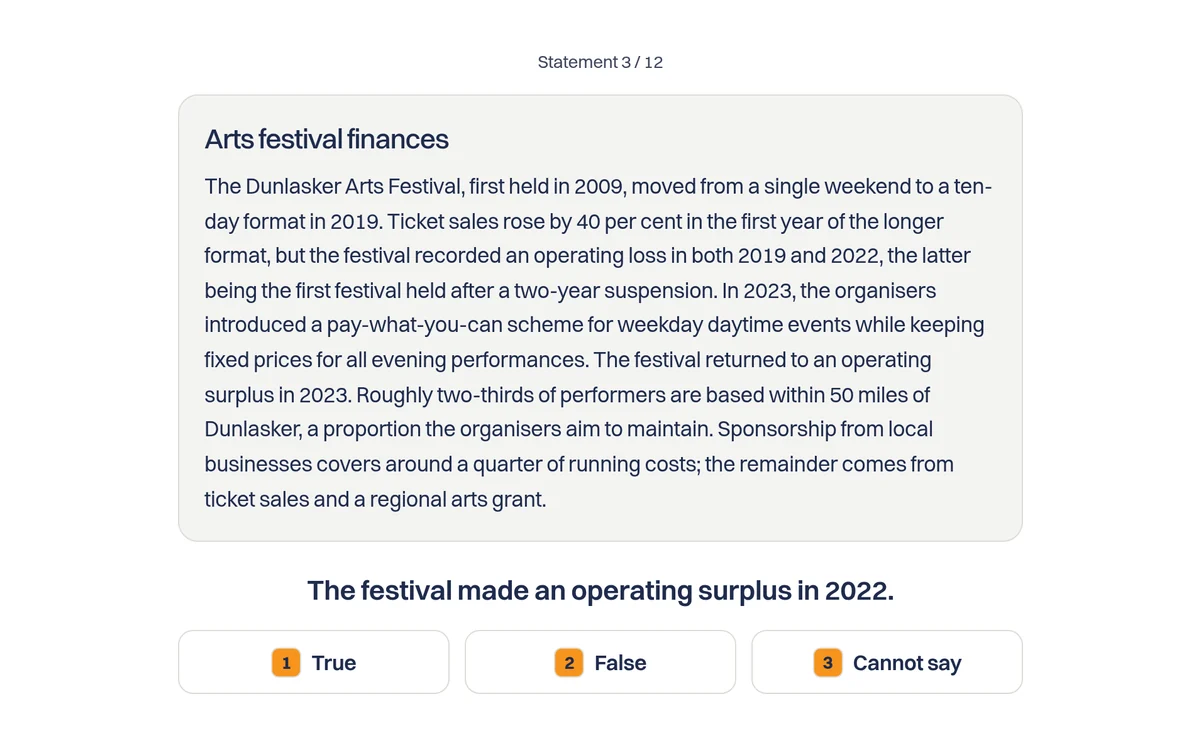
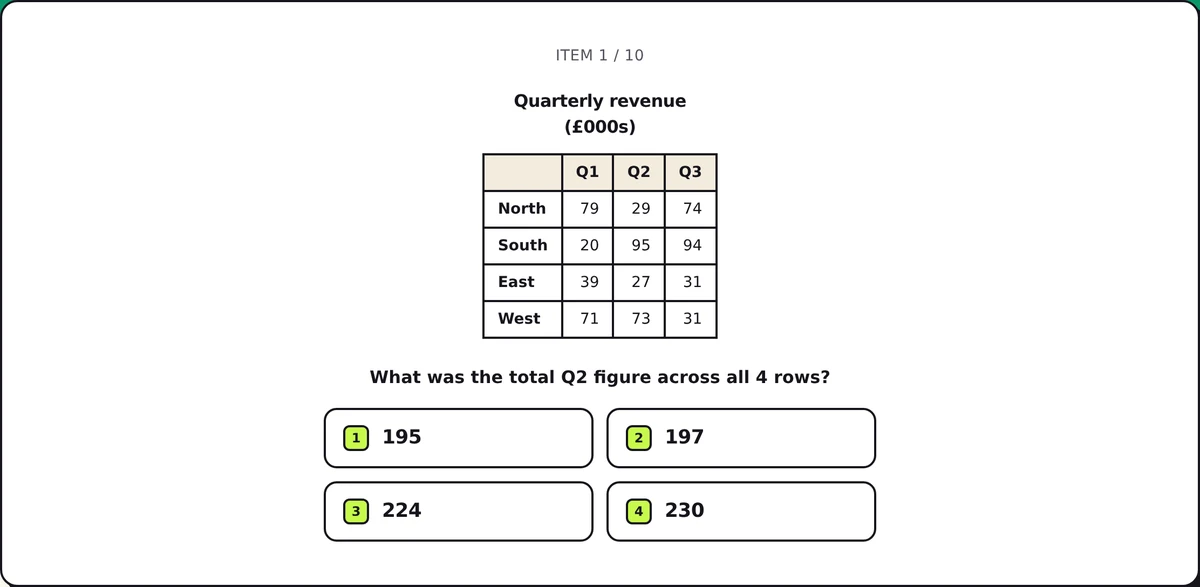
- Reasoning sections. SJTs often arrive with verbal and numerical reasoning tests in the same invitation. Those are scored on right answers and reward timed practice; our reasoning tests guide covers each type.
FAQ
What is a situational judgement test? A test that shows you realistic work scenarios and asks you to judge possible responses, by picking the most and least effective, ranking them or rating each one. Your answers are compared with a key built from experts' judgements about the job.
Can you fail an SJT? In effect, yes: employers set a minimum standard, and the Civil Service, for example, tells you whether you passed "at the minimum required standard for that job level". There is no published pass mark, and close answers often earn partial credit.
Is an SJT a personality test? No. A personality questionnaire asks how you usually behave. An SJT asks you to judge responses against a key, so some answers really are better than others. Some assessments include both, as the Civil Service Judgement Test does.
How long is a situational judgement test? It varies: the UCAT's SJT is 69 questions in 26 minutes, Aon's chatAssess about 20 minutes, and the Civil Service Judgement Test is untimed (GOV.UK suggests allowing an hour). Your invitation will say.
Should I answer what I would do or what is best? Whatever the instructions ask. "What would you do" is about you; "most effective" is about the situation. Where an employer says, as Deloitte does, to "go with your gut instinct", do that rather than guessing at a key.
Can I practise SJTs? Yes. You cannot learn an answer key, but you can learn the formats and the principles most keys reward. Our free SJT shows the reasoning for every response after each run.
GamePrep is an independent practice platform and is not affiliated with the UK Civil Service, UCAT Consortium, Deloitte, A&O Shearman, Aon, Cappfinity, SHL, Harver or any other employer or assessment vendor. Our scenarios and key were written for GamePrep. We provide practice only — no leaked questions or answers.