Reasoning Tests Explained
Abstract, Logical, Verbal and Numerical (Free Practice)
The four reasoning tests employers use, in plain terms. Abstract (inductive, diagrammatic, matrix), logical (deductive), verbal and numerical; what each item looks like, which vendors publish it, how it is timed, and free practice for each.
TL;DR: Employers' reasoning tests come in four main types.
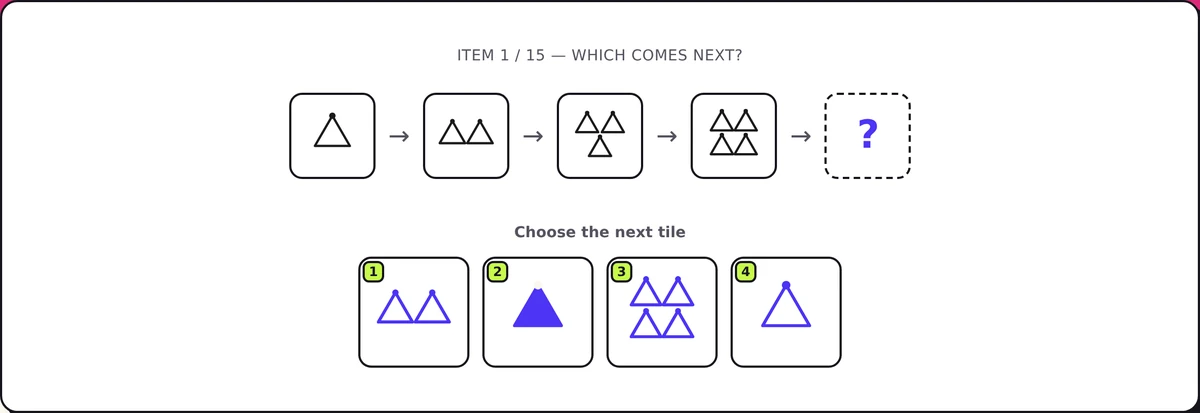
- Abstract reasoning (also called inductive, diagrammatic or matrix reasoning): find the hidden rule in a set of shapes and pick the shape that comes next or fills the gap.
- Logical reasoning in the deductive sense: read a few facts, then decide which conclusion must be true (or cannot be true).
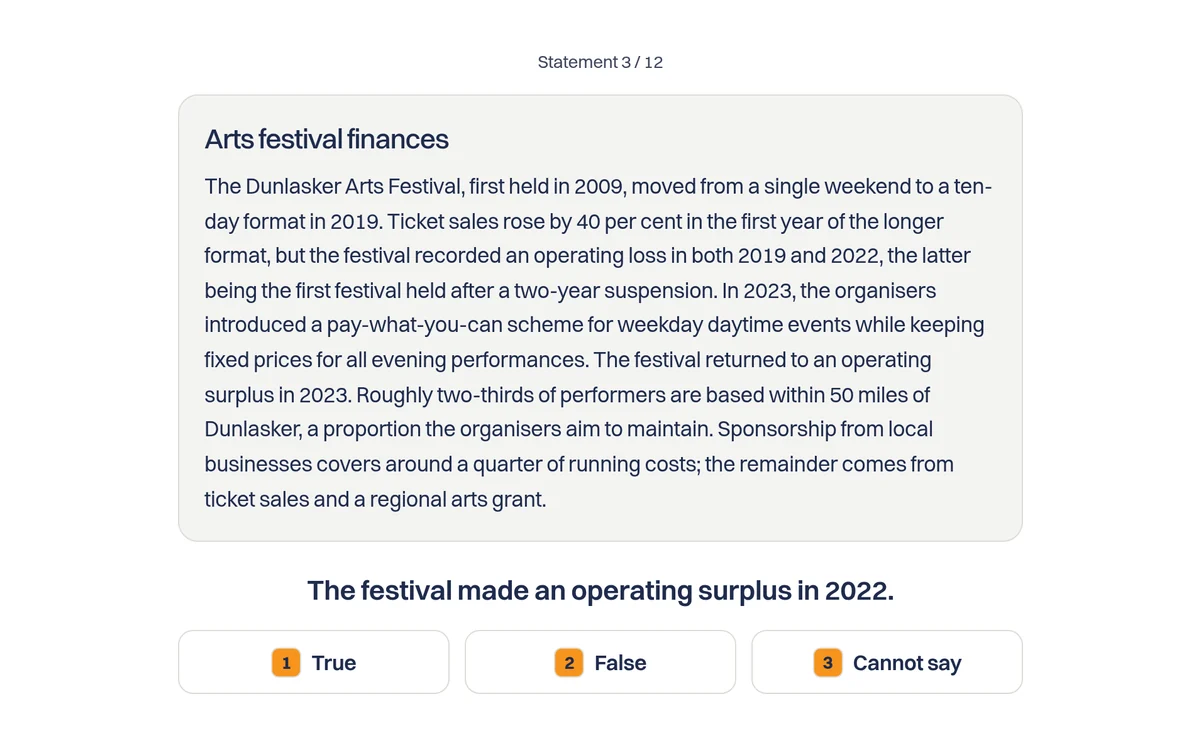
- Verbal reasoning: read a short passage and judge whether a statement follows from it, often as True, False or Cannot say.
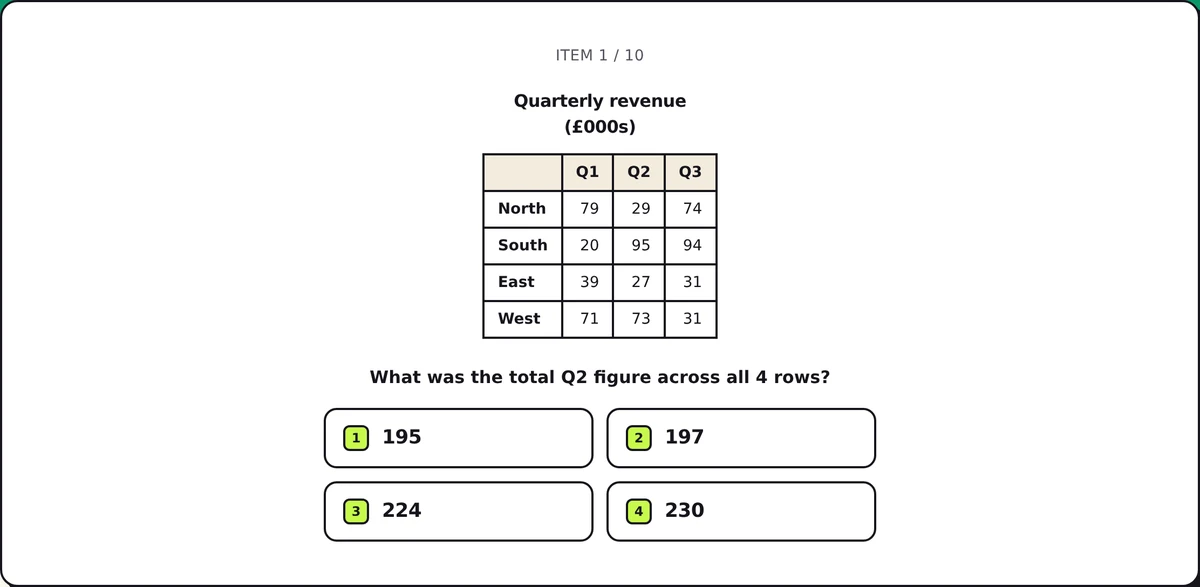
- Numerical reasoning: read a table or chart and answer a calculation question about it, against the clock.
They are ability tests, so you cannot memorise the answers, but the formats repeat and the method can be practised. Each type below links to a free practice test on GamePrep.
Abstract reasoning (inductive, diagrammatic, matrix)
What an item looks like. A row of shapes, or a grid of them with one cell empty. Something changes from one shape to the next: a shape gains a side, a dot moves one corner clockwise, an arrow rotates, shading flips between filled and empty. You pick the option that continues the rule or completes the grid. There are no words and no numbers.
What it measures. Spotting patterns in unfamiliar information and applying them. SHL says its inductive test assesses "your ability to identify underlying patterns in information and predict outcomes using that information" (SHL practice tests).
Who publishes this format.
- SHL Verify Interactive Inductive Reasoning: "working out the pattern in a set of images and identifying the correct next image" (SHL cognitive assessments).
- Aon (cut-e) scales clx, which Aon calls inductive logical reasoning: it "Measures your ability to look at a group of items, observe common patterns and interrelationships in order to draw logical conclusions", with 6 minutes to finish as many tasks as you can (Aon). Aon's switchChallenge is a related symbol task; see the switchChallenge guide.
- Korn Ferry (Talent Q): its logical reasoning test is designed "to test your ability to analyze abstract information and apply this in determining outcomes and patterns" (Korn Ferry candidate guide, PDF).
- Assessio Matrigma: a non-verbal matrix test of "only 12 minutes" where "The exercises include seeing relationships between different objects and filling in gaps where information is missing" (Assessio). This is a "matrix assessment"; our Matrigma guide covers it in detail.
- Saville Assessment lists separate practice tests for Diagrammatic Analysis, Abstract Reasoning and Diagrammatic Reasoning (Saville practice tests).
Timing. Aon's scales clx is 6 minutes in total. Matrigma is 12 minutes in total; in Adaptive Matrigma, which Assessio calls the most common version, each problem is shown separately so you do not have to plan your time across them (Assessio).
Technique.
- Check one rule at a time. Count first (sides, dots, lines), then position, then rotation, then colour or shading. Items often combine two rules, and if two options still look right you have missed the second one.
- On a grid, test rows and columns. A matrix rule can run across the rows, down the columns, or both. Confirm the rule on a complete row before you apply it to the row with the gap.
- Eliminate. Rule out options that break the one rule you are sure of, then compare what is left.
Free practice: Inductive Reasoning, timed and scored into a percentile.
Logical reasoning (deductive)
What an item looks like. A few facts or rules ("All the mentors are graduates. Some graduates are cyclists.", "The audit is the day after the fire drill"), then a set of statements. You choose the one that must be true, or the one that cannot be true. Some versions are puzzles: put meetings into a calendar, or rank people from clues.
What it measures. Drawing conclusions strictly from what you are given. SHL describes its deductive test as measuring "your ability to draw logical conclusions based on information provided, identify strengths and weaknesses of arguments, and complete scenarios using incomplete information" (SHL practice tests).
Who publishes this format. SHL Verify Deductive Reasoning: "reading statements, then determining which subsequent options cannot be true or must be true" (SHL cognitive assessments). It is also one of the three abilities in SHL's Verify Interactive G+, which allows 36 minutes for a maximum of 24 adaptive questions, about 90 seconds each (SHL fact sheet).
Watch the name. "Logical reasoning" means different things at different vendors. At Korn Ferry and in Aon's scales clx, the logical test is abstract pattern-finding (the section above). At SHL, the logical thinking is in the deductive test. Look at your invitation or the vendor's practice test: shapes mean abstract, statements mean deductive.
Technique.
- "Must be true" means true in every arrangement the facts allow. If you can picture one arrangement that fits every fact and makes the statement false, it is not the answer, however likely it sounds.
- "Could be true" is a different question. One arrangement is enough there. Read the question stem twice.
- Draw it. Overlapping circles for "all", "some" and "no"; a line of slots for orderings; a small grid for schedules. Shade only what a fact forces.
Free practice: Deductive Reasoning, with group, ordering and schedule items checked by a solver so exactly one answer is right.
Verbal reasoning
What an item looks like. A short business-style passage, then a statement about it. In the True / False / Cannot say format you decide whether the passage shows the statement is true, shows it is false, or does not give you enough to tell.
What it measures. Understanding written information and judging what it does and does not support. SHL: "your ability to understand written information and to evaluate arguments about this information" (SHL practice tests). Korn Ferry: "your ability to interpret verbal information and reach correct conclusions" (Korn Ferry candidate guide, PDF).
Who publishes this format.
- SHL publishes a free verbal reasoning practice test (SHL practice tests).
- Aon (cut-e) scales verbal: "49 tasks, finish as many as you can" in 12 minutes, where you "Determine the truth and accuracy of a statement based on the verbal information provided". Aon adds that "incorrect answers generally have a negative effect on the final results" (Aon). That is about 15 seconds a task.
- Korn Ferry (Talent Q) verbal reasoning: Korn Ferry says all its cognitive ability tests are adaptive, starting at average difficulty and getting harder or easier with your answers, with a time limit for each question (Korn Ferry candidate guide, PDF).
- Saville Assessment lists Verbal Analysis and Verbal Comprehension practice tests (Saville practice tests).
- Cappfinity assessments are usually branded by the employer and include verbal and numerical sections; see the Cappfinity guide. Employer-branded tests can be timed differently: Deloitte UK's Immersive Online Assessment has a cognitive section that "includes numerical and verbal reasoning questions", no overall time limit, and some timed questions where "the speed of your response will contribute to your score" (Deloitte).
Technique.
- False is not the same as Cannot say. False means the passage says something that contradicts the statement. Cannot say means the passage does not settle it either way. The usual slip is answering False when the passage simply does not say.
- Use only the passage. What you know about the world does not count. If the passage does not say it, the answer is Cannot say, even when the statement is obviously true in real life.
- Watch the qualifiers. "Some", "most", "all", "only", "usually" and "never" change what a statement claims. A passage about "most" customers does not support a statement about "all" of them.
Free practice: Verbal Reasoning, True / False / Cannot say against the clock.
Critical thinking (Watson Glaser style)
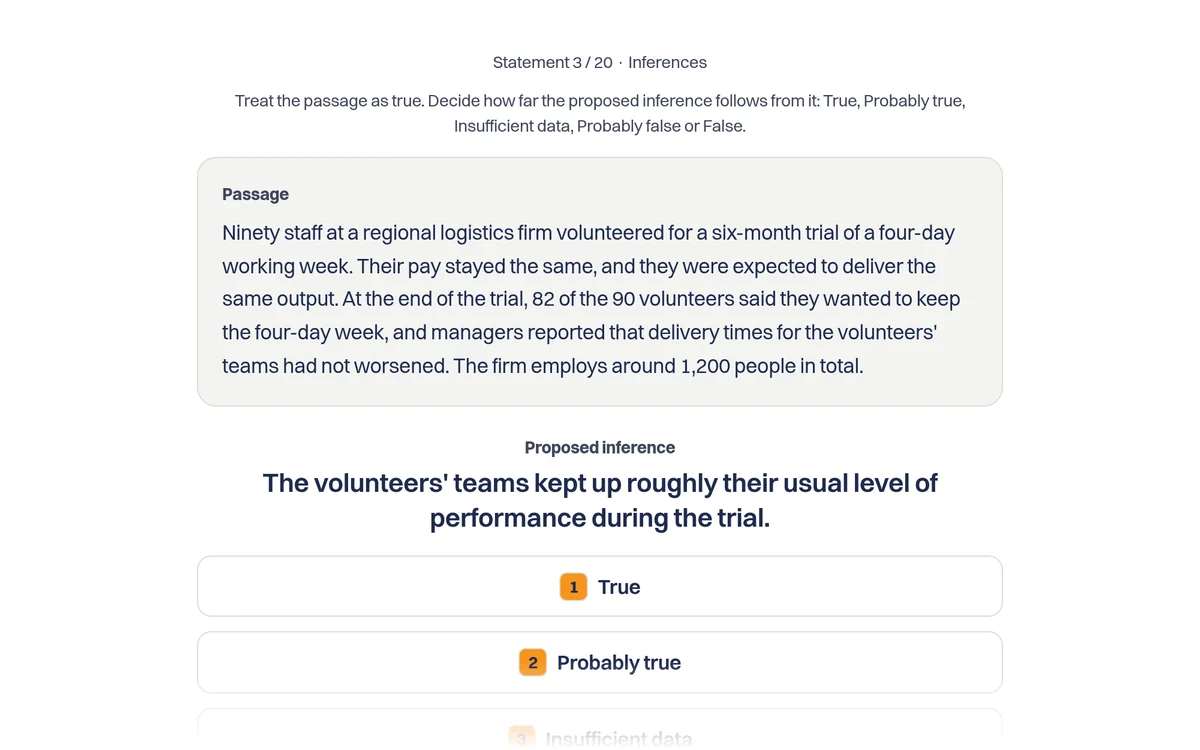
What an item looks like. A short passage, statement or question, then a proposed statement you judge on its own: an inference (True, Probably true, Insufficient data, Probably false, False), an assumption (made or not made), a deduction or interpretation (follows or does not follow) or an argument (strong or weak).
Who publishes this format. The Watson-Glaser Critical Thinking Appraisal from Pearson TalentLens. TalentLens lists five subtests (drawing inferences, recognising assumptions, deducing, interpreting and evaluating arguments), 40 items, "30 to 40 mins timed", and item-banked questions, and offers a free practice test (TalentLens). Law firms name it on their careers pages, for example Clifford Chance in London ("30 minutes", "40 questions", Clifford Chance) and Osborne Clarke at its assessment centre (Osborne Clarke). Test Partnership's Signals series also has a critical thinking test built for legal recruitment (see the Test Partnership guide). Each of the five Watson Glaser sections, with its own rule and the law firms that set it, is explained in our Watson Glaser test guide.
Technique.
- Each section has its own rule. Read the instructions before every section; "follows" means something stricter in deductions than in interpretation.
- Probably true is not True. True needs the passage to settle it; a likely cause the passage does not prove is Probably true at most.
- An assumption is what the speaker relies on, not what is plausible. Words like "only", "all" and "never" usually make a proposed assumption too strong.
- A strong argument is important and directly related to the question. Tradition, popularity and someone's fame make an argument weak, whatever you think of the question.
Free practice: Critical Thinking, all five sections with an explanation for every answer.
Numerical reasoning
What an item looks like. A table or chart of business data (sales by region, costs by year), then a question that needs one or two steps: a percentage change, a ratio, a difference, a total. You pick from options, or on some interactive versions you drag an answer into place.
What it measures. SHL: "your understanding of tables of statistical and numerical data, as well as your ability to make logical deductions" (SHL practice tests). Its Verify Interactive Numerical Reasoning includes "solving word problems, performing numerical calculations, and interpreting charts and graphs" (SHL cognitive assessments).
Who publishes this format.
- SHL Verify Interactive Numerical Reasoning, also part of G+ (above).
- Aon (cut-e) scales numerical: 37 tasks in 12 minutes, finish as many as you can, deciding "the truth and accuracy of a statement based on the numercial data provided" (Aon's spelling) (Aon). That is about 19 seconds a task.
- Korn Ferry (Talent Q) numerical reasoning: "your ability to analyze and draw inferences from numerical information and data", adaptive, with a time limit per question (Korn Ferry candidate guide, PDF).
- Saville Assessment lists Numerical Analysis and Numerical Comprehension practice tests (Saville practice tests).
- Cappfinity includes numerical sections in its employer-branded assessments (see the Cappfinity guide).
Technique.
- Read the question before the table. Know which figure you need, then find it. Many errors are reading errors: wrong row, wrong year, thousands read as units.
- Percentage change divides by the old figure.
(new − old) ÷ old, every time. - Estimate first. A rough answer in your head catches a mistyped calculation before you commit.
Free practice: Numerical Reasoning for the table questions and Mental Math for calculation speed. The numerical reasoning practice guide covers calculators and shortcuts.
Analogy questions
An analogy item gives you a pair and asks for the word that completes a second pair in the same way: "hand is to glove as foot is to ?". Some abstract tests use the same idea with shapes: A changes into B, so what does C change into? Verbal analogies test vocabulary and the relationships between words. Criteria's CCAT, for example, has verbal questions on "how words relate to one another" alongside maths, logic and spatial reasoning, with 50 questions in 15 minutes (Criteria); see our CCAT guide.
Technique. Say the first relationship as a full sentence ("a glove covers a hand"), then test each option in the same sentence ("a sock covers a foot"). If more than one fits, make the sentence more precise. The common relationships are part and whole, opposite, function, type of, and degree (warm, hot). For figural analogies, list what changed from A to B (rotation, count, shading) and apply exactly those changes to C.
We do not have a dedicated analogy drill. For figural analogies, Inductive Reasoning trains the same rule-finding.
Situational judgement (often in the same battery)
A situational judgement test (SJT) is not a reasoning test, but it often arrives in the same invitation. SHL: "Situational Judgment Tests present candidates with workplace situations and ask them to evaluate several different courses of action that a person could take in that situation" (SHL practice tests). Korn Ferry's is "designed to measure a variety of factors required to be successful in a particular role" (Korn Ferry candidate guide, PDF). Deloitte UK's Immersive Online Assessment asks you to rank actions by how you would "most and least likely approach each situation" (Deloitte). The formats (most/least, rank order, rate each) and how SJT keys are scored are covered in our situational judgement test guide.
There is no rule to find, but there is a method. Prefer responses that deal with the problem directly and early, involve the right person, and keep within your role. Avoid the options that ignore the problem or hand it to someone else without acting.
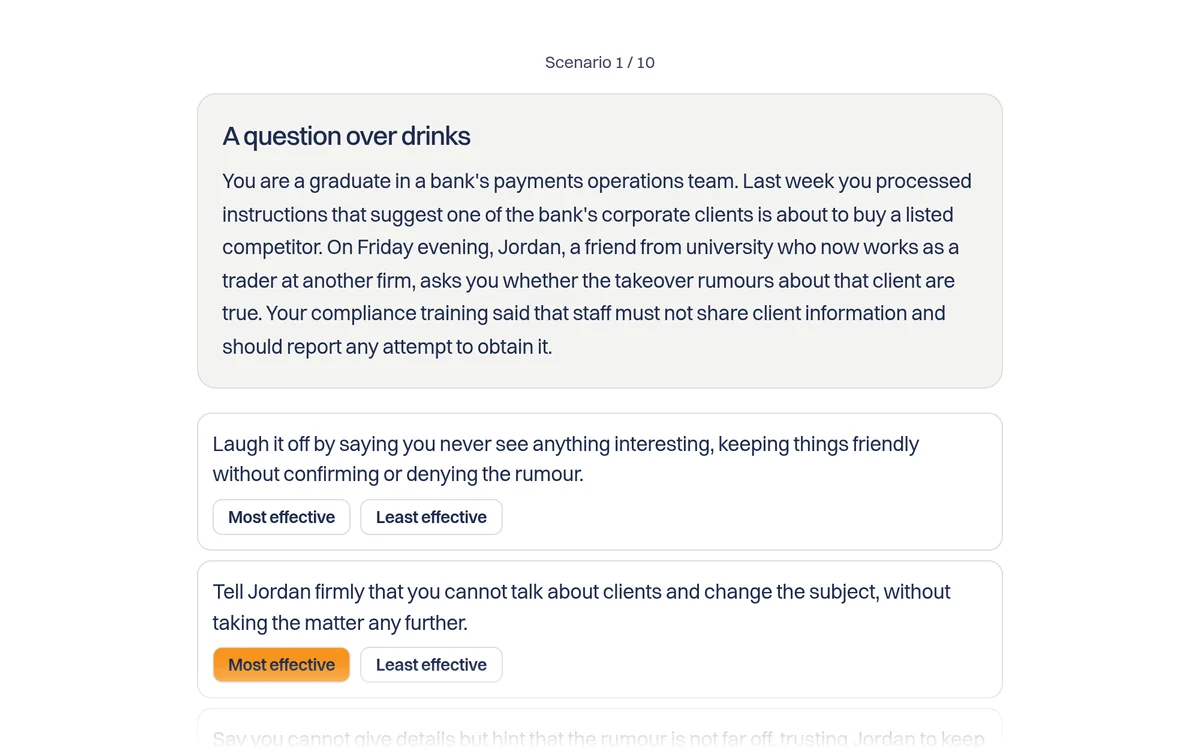
Free practice: Situational Judgement, picking the most and least effective response.
Comparison table
| Type | What it looks like | Vendors that publish it | Free practice |
|---|---|---|---|
| Abstract (inductive, diagrammatic, matrix) | Shapes that change by a hidden rule; pick the next one or fill the gap | SHL, Aon (scales clx), Korn Ferry / Talent Q (logical), Assessio Matrigma, Saville | Inductive Reasoning |
| Logical (deductive) | Facts, then which conclusion must or cannot be true | SHL (Verify Deductive, G+) | Deductive Reasoning |
| Verbal | Passage, then True / False / Cannot say | SHL, Aon (scales verbal), Korn Ferry / Talent Q, Saville, Cappfinity | Verbal Reasoning |
| Critical thinking | Passage or statement, then judge an inference, assumption, conclusion or argument | Pearson TalentLens (Watson-Glaser), Test Partnership (Signals) | Critical Thinking |
| Numerical | Table or chart, then a calculation question | SHL, Aon (scales numerical), Korn Ferry / Talent Q, Saville, Cappfinity | Numerical Reasoning, Mental Math |
| Analogy | "A is to B as C is to ?" with words or shapes | Criteria (CCAT verbal questions) | Inductive Reasoning for figural analogies |
| Situational judgement (not reasoning) | Workplace scenario, rate or rank the responses | SHL, Korn Ferry, Cappfinity | Situational Judgement |
For the full batteries, see the SHL guide, the cut-e / Aon guide, the Cappfinity guide and the Matrigma guide.
FAQ
What is an abstract reasoning test? A timed test of shapes that follow a hidden rule. You pick the shape that comes next in a row, or the one that completes a grid. There are no words or numbers, only pattern-finding. Vendors also call it inductive, diagrammatic or matrix reasoning: SHL calls its version inductive reasoning, Aon calls scales clx inductive logical reasoning, and Assessio's Matrigma is a 12-minute matrix test. You can practise the format free on the Inductive Reasoning test.
What is the difference between inductive and deductive reasoning tests? An inductive test gives you examples and asks you to work out the rule, usually from shapes. A deductive test gives you the rules as written facts and asks what must follow from them. Inductive means finding the pattern; deductive means applying the facts strictly. SHL publishes both as separate tests.
How do I practise logical reasoning tests for free? First check which kind your test is. If it shows shapes (Korn Ferry's logical test, Aon scales clx), practise on Inductive Reasoning. If it shows statements and conclusions (SHL Deductive), practise on Deductive Reasoning. SHL also publishes free practice tests on its candidate site, which show the real interface.
Are reasoning tests timed? Almost always, but in different ways. Aon gives a fixed total (12 minutes for 49 verbal tasks or 37 numerical tasks, 6 minutes for scales clx) and you finish as many as you can. Korn Ferry sets a time limit for each question. SHL's Verify Interactive G+ allows 36 minutes for up to 24 questions. Some employer-branded assessments, such as Deloitte UK's, have no overall time limit but time some questions and count your speed.
What is a matrix assessment? A form of abstract reasoning test where the shapes sit in a grid with one cell missing, and you choose the option that completes it. The rule can run across rows, down columns or both. Assessio's Matrigma is one example; see our Matrigma guide.
Do wrong answers cost marks? On some tests, yes. Aon says incorrect answers generally have a negative effect on the final result, so a burst of guesses near the end can lower your score. On adaptive tests like Korn Ferry's, a wrong answer leads to an easier next question. Read your test's instructions before you start.
GamePrep is an independent practice platform, not affiliated with SHL, Aon, cut-e, Korn Ferry, Talent Q, Assessio, Saville Assessment, Cappfinity, Criteria, Deloitte or any other assessment vendor or employer. We provide practice only: no leaked questions or answers.