Abstract Reasoning Test
Question Types, the Rules Behind Them and Free Practice
An abstract reasoning test shows shapes that change by a hidden rule. The five question formats (series, matrix, odd one out, sets, diagrammatic), the rules that come up again and again, worked examples, vendor timings and free practice.
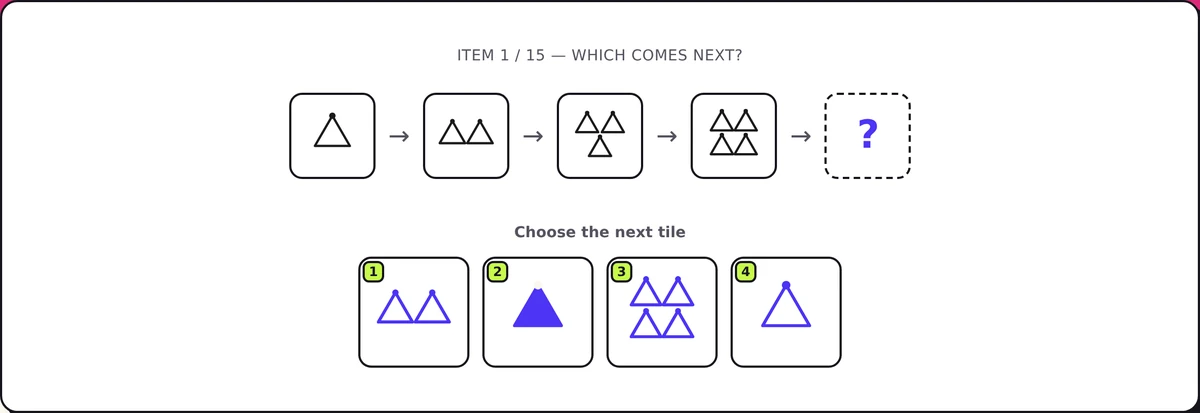
An abstract reasoning test shows you shapes that change by a hidden rule and asks you to find the rule: pick what comes next in a series, fill the gap in a grid, spot the odd one out, or sort new figures into groups. There are no words and no numbers, so it measures how quickly you can find patterns in unfamiliar information. The format goes back to Raven's Progressive Matrices, first published in 1938 (Wikipedia), and today SHL, Aon (cut-e), Korn Ferry, Saville, Assessio and Arctic Shores all sell versions of it. You cannot memorise the answers, but the rules repeat, so a short list of them and a fixed checking order are worth more than any number of random puzzles. Our free Inductive Reasoning test practises the series format, timed and scored.
This page goes deep on the shape puzzles. If you are not sure whether your test is abstract or verbal logic, start with the logical reasoning test guide, which sorts out the names; for all four reasoning tests side by side, see reasoning tests explained.
Abstract, inductive, diagrammatic: are they the same test?
Mostly, yes. Vendors use different names for tests that all show abstract figures governed by a rule you have to infer:
- SHL calls its version inductive reasoning: "working out the pattern in a set of images and identifying the correct next image" (SHL).
- Aon (cut-e) has several: scales clx, "Inductive Logical Reasoning", 6 minutes; scales ix, where you "select the item in a series of 9 that does not fit the common pattern", 20 tasks in 5 minutes; and scales cls, where you "assign new images to the relevant patterns", 12 tasks in 12 minutes (Aon).
- Korn Ferry (Talent Q) calls its version logical reasoning, designed "to test your ability to analyze abstract information and apply this in determining outcomes and patterns" (Korn Ferry candidate guide, PDF).
- Saville Assessment publishes separate practice tests for Abstract Reasoning, Diagrammatic Analysis and Diagrammatic Reasoning (Saville practice tests).
- Assessio Matrigma is a matrix test; see our Matrigma guide.
The one real split is diagrammatic tests built around operators (below), which test following a process rather than spotting a pattern in a sequence.
The five question formats
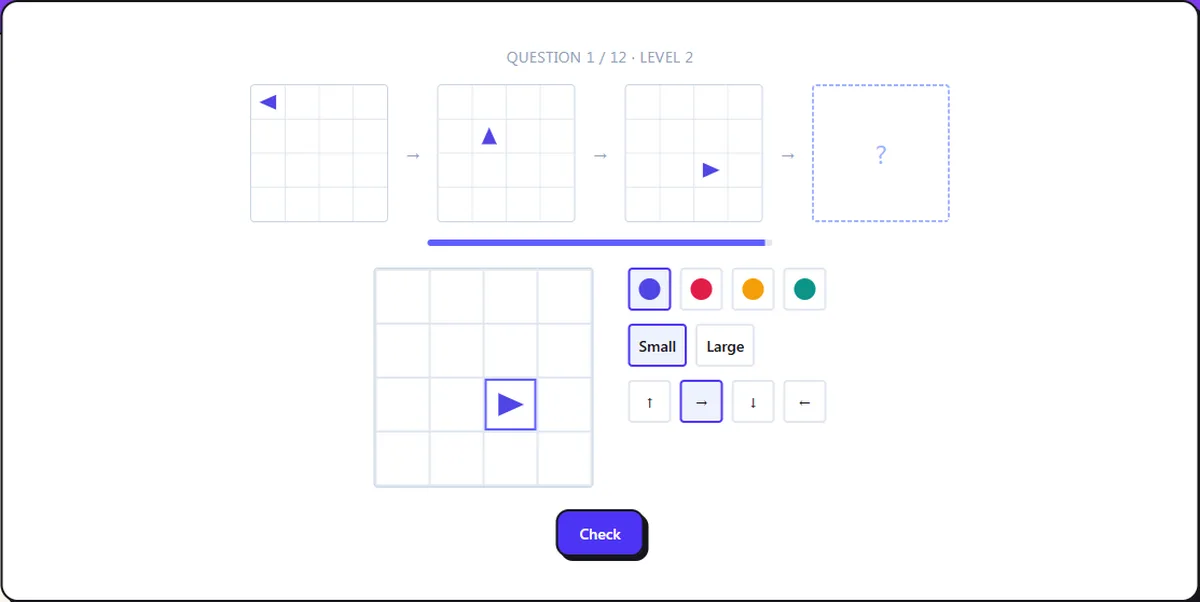
1. Series (what comes next). A row of four or five frames, then options for the next one. This is the most common format and the one our Inductive Reasoning test uses. Arctic Shores' Patterns task is a series with three squares and five options; our Patterns game copies it, and the Arctic Shores Patterns guide explains it. Its Order task makes you build the next frame yourself rather than pick it (Order game).
2. Matrix (fill the gap). A grid, usually three by three, with one cell empty. The rule can run along the rows, down the columns or both. Raven's matrices use grids from two by two up to six by six with six to eight answer options (Wikipedia).
3. Odd one out. Several figures, all but one obeying the same rule. Aon's scales ix is this format with nine figures (Aon). It is a different skill from the fast visual search in HireVue's odd-one-out game, where one shape is simply rotated or flipped; that one is practised on our odd one out game.
4. Sets (which group does it belong to). Two groups of figures, Set A and Set B, each defined by its own rule, then new figures to place in A, B or neither. Aon's scales cls ("assign new images to the relevant patterns") works this way. The trap: a figure can share a surface feature with Set A and still break Set A's rule.
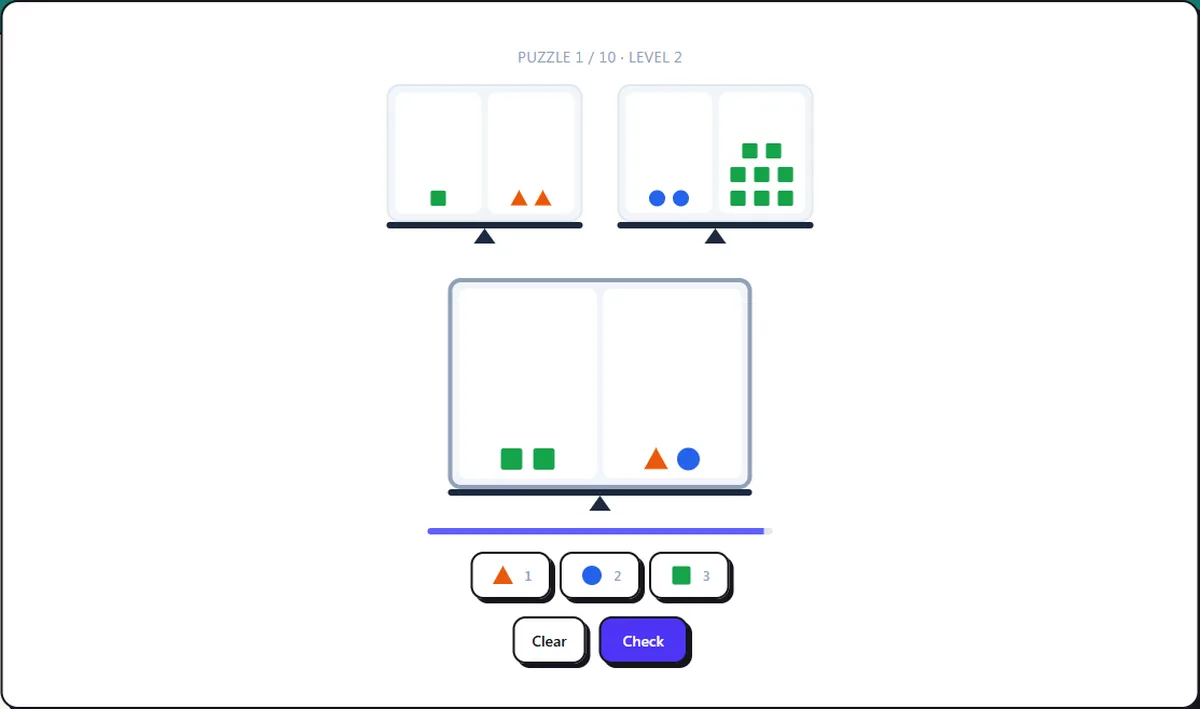
5. Diagrammatic (operators). Figures pass through boxes, and each box does something: rotate, change colour, remove an element, swap positions. You work out what each box does from examples, then predict the output of a new chain. Saville's Diagrammatic Analysis cannot be taken on a phone, according to its practice page (Saville), a hint that these items are visually dense.
The rules that come up again and again
Almost every item is built from a handful of changes. Check them in the same order every time:
- Count. Number of shapes, sides, dots, lines or intersections goes up or down by a fixed step (3, 4, 5…) or alternates.
- Position. A dot or shape moves round the frame by a fixed number of places, clockwise or anticlockwise, or bounces between two positions.
- Rotation and reflection. An arrow or shape turns by 45° or 90° each step, or flips left to right.
- Shading and colour. Filled and empty alternate, colours cycle in a fixed order, or shading moves from one element to the next.
- Size. A shape grows or shrinks one step at a time.
- Combination. In matrix items, the third cell in a row can be the first two overlaid, with shared lines kept or removed.
Hard items layer two or three of these at once, often on different elements of the frame. The useful habit: if two options still look right, you have missed a rule. Go back and check the next item on the list.
Two worked examples
Series. Frame 1: a square with one dot in the top-left corner, white. Frame 2: a pentagon, dot in the top-right corner, black. Frame 3: a hexagon, dot bottom-right, white. What comes next?
- Count: sides go 4, 5, 6, so the next shape has 7 sides.
- Position: the dot moves one corner clockwise each step, so next it sits bottom-left.
- Shading: white, black, white, so next is black.
The answer is a black heptagon with a dot in the bottom-left. A typical wrong option gets two of the three right, such as a black heptagon with the dot top-left, which is why checking every rule against every option beats picking the one that "looks right".
Matrix. Row 1: one circle, two circles, three circles. Row 2: one triangle, two triangles, three triangles. Row 3: one star, two stars, empty cell. The row rule is count plus one, the column rule is shape. The missing cell holds three stars. Real items hide the same logic under more detail, but the method is identical: confirm the rule on a complete row, then on a complete column, then apply both to the gap.
Timing and scoring
Abstract tests are short and fast. Aon's scales clx and scales ix take 6 and 5 minutes; scales cls gives you about a minute a task (Aon). Aon also says that on its tests "incorrect answers generally have a negative effect on the final results", so guessing blindly at the end can cost you. Adaptive tests such as Korn Ferry's adjust difficulty to your answers, so a run of hard items usually means you are doing well.
How to get better at abstract reasoning
- Learn the rule list above until you check it without thinking. Most lost marks come from stopping after the first rule you find.
- Eliminate rather than search. Rule out every option that breaks the rule you are sure of, then compare what remains on the next rule.
- Practise against a clock. Untimed, most people get most items. The test is whether you can do it in under a minute. Our Inductive Reasoning test takes about three minutes and scores accuracy and speed into a percentile; play it once cold, then a few times over several days.
- Practise more than one format. Add the Patterns game for longer, multi-rule series with feedback that spells out the rules you missed.
- Review your misses. Note which rule type you missed (rotation is the usual culprit) and look for it first next time.
For employer batteries that include an abstract section, see the SHL guide and the cut-e / Aon guide.
FAQ
What is an abstract reasoning test? A timed test of shapes that change by a hidden rule. You pick the next shape in a series, fill the gap in a grid, find the odd one out or sort figures into groups. It uses no words or numbers and measures how quickly you spot patterns in new information.
Is abstract reasoning the same as inductive reasoning? In employer tests, effectively yes. SHL calls its shape test inductive reasoning, Aon calls one version inductive logical reasoning, and Korn Ferry calls its version logical reasoning. All of them show abstract figures and ask you to infer the rule.
What is the difference between abstract and diagrammatic reasoning? Abstract (inductive) items ask what comes next in a pattern. Diagrammatic items show figures passing through operators, such as boxes that rotate or recolour them, and ask you to work out what each operator does and predict an output. Saville publishes both as separate tests.
How can I practise abstract reasoning tests for free? Use our Inductive Reasoning test for timed series items and the Patterns game for multi-rule series with feedback. Vendors such as SHL and Saville also publish free practice tests on their candidate sites.
Can you improve your abstract reasoning score? Your underlying ability changes slowly, but your score on a given test can improve with familiarity: knowing the common rules, checking them in a fixed order and being used to the time limit. Most early mistakes come from stopping at the first rule you notice.
How long is an abstract reasoning test? Usually short. Aon's versions take 5 to 12 minutes. Other vendors vary, and adaptive tests end after a set number of items. Your invitation gives the exact time.
GamePrep is an independent practice platform, not affiliated with SHL, Aon, cut-e, Korn Ferry, Talent Q, Saville Assessment, Assessio, Arctic Shores, Pearson or any employer. Our tests are practice items written for GamePrep, not real test questions, and we provide no leaked questions or answers.