Arctic Shores Tiles (Sequence) Game
How the Memory Task Works, Decoys, Tips & Free Practice
The Arctic Shores Tiles game (also called Sequence or Tile Sequence) lights up icon tiles in an order you repeat; the sequence grows after each success, a distracting icon appears that you must ignore, and two errors in a row end it. What prep sites report, what it measures, tips and a free practice version.
The Arctic Shores Tiles game, also called Sequence or the Tile Sequence game, lights up tiles on a board one after another and asks you to tap them back in the same order. The sequence gets longer each time you succeed, a distracting icon appears at some point that you must ignore, and the game ends after two errors in a row (JobTestPrep). It is a visual memory task with an attention twist. Play the free tiles game. Every Arctic Shores-style task we have is in one place: the free Arctic Shores practice test.
How the Arctic Shores Tiles game works
What prep sites describe (checked 25 November 2026; we found no candidate account, so treat the details as reported, not confirmed):
- A board of icon tiles that light up in order. JobTestPrep: "a board of tiles; the icons on the tiles will light up in a sequence. Your job is to memorize the sequence and click on the tiles in the same order. The game will end after two errors in a row."
- It gets longer. "With every round you succeed, the sequence gets longer" (JobTestPrep).
- A decoy to ignore. "At some point, a new type of icon is added to the game as a distraction, and you must ignore it" (JobTestPrep). Graduates First words it as "a distracting icon appears that you have to skip" (Graduates First), and GameAssessmentPrep says "Distractor icons appear during playback to disrupt encoding" (GameAssessmentPrep).
- Older descriptions mention "tiles or stamps" lighting up (Graduates First).
- Length: "Adaptive — a few minutes" (GameAssessmentPrep), which says its own grid size and pacing are reconstructions.
Arctic Shores doesn't publish the board, the pacing or the scoring. Your invitation and the task's own tutorial are the source of truth.
What does it measure?
JobTestPrep lists "Memory", "Balancing automatic and controlled behavior" and "Responses' speed and efficiency to incoming information". In psychology terms, it is a Corsi-style span task: how long a sequence of locations you can hold in visuospatial working memory, plus the control to not tap something that grabbed your attention. The natural score is the longest sequence you reproduce.
On classic Corsi block tests, most adults reproduce five or six blocks. Decoys make it a little harder.
What helps
- Use two codes, not one. Trace the path as a shape ("down, across, up") and say the icons under your breath ("moon, key, fish"). Two memory codes survive a distraction better than one.
- Keep your eyes on the last real tile when a decoy flashes. Looking at it is what costs you the sequence.
- Chunk long sequences into groups of three or four.
- Don't rush the first tap. Replay the sequence in your head once, then tap at an even pace.
- After a miss, reset. You get one more try at the same length: a fresh start, not a reason to panic.
How to practise for the Tiles game
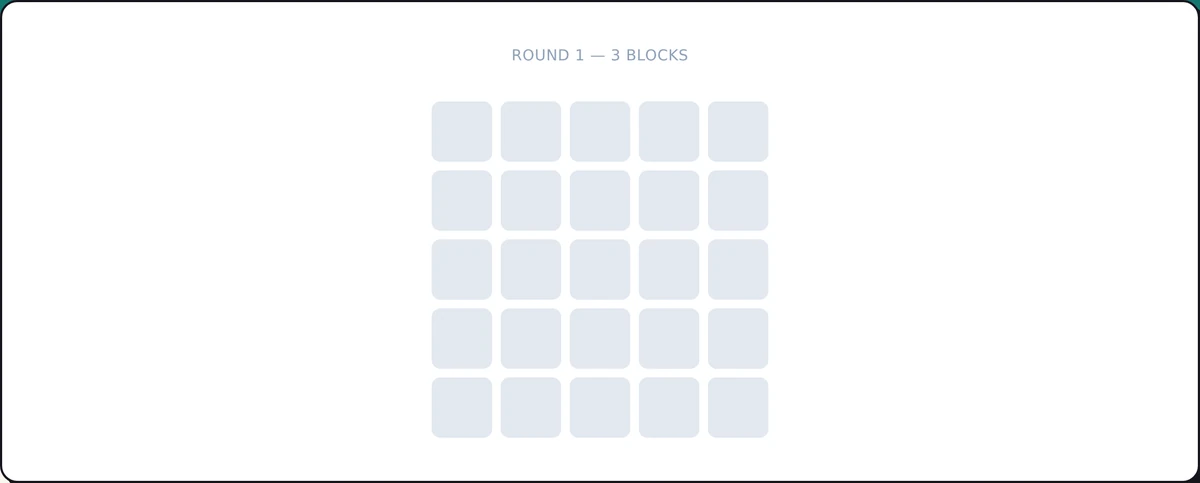
- Play the tiles game. A 4 x 4 board of sixteen icons. It starts at three tiles and adds one per success, up to ten; a miss gives one more try at the same length, and two misses in a row end the run. From five tiles, orange sparks flash on other tiles during playback: decoys that are never part of the answer. The result shows your longest sequence, how many decoys you tapped and your pace between taps. Our own icons and board, built from the descriptions above.
- Train the plain span with the Corsi block test, the classic version without decoys.
- Train verbal memory too with the digit span test: naming the icons leans on it.
Who uses the Tiles game?
GameAssessmentPrep lists Airbus; treat that as unconfirmed. Any employer using Arctic Shores can include it. See our Airbus guide and the full task list in our Arctic Shores assessment guide, with guides to the Expressions game, the Patterns game and the Order game.
FAQ
What is the Arctic Shores Tiles game? A visual memory task: tiles on a board light up in a sequence and you tap them back in the same order. Prep sites also call it the Sequence or Tile Sequence game.
How does the Tiles game end? After two errors in a row, according to JobTestPrep. The sequence grows by one tile after each success.
What is the distracting icon? At some point a different kind of icon starts appearing during the sequence. It is not part of the answer; ignore it and don't tap it.
What is a good score on a tiles or Corsi memory task? Most adults reproduce five or six tiles on a classic Corsi test; seven or more is strong.
Can you improve at the Tiles game? Yes, mostly through strategy: naming the icons as well as tracing the path, chunking, and keeping your eyes off the decoys. A few practice runs also remove the surprise of the decoy.
Is the free practice game the real task? No. It is an independent practice version with our own board, icons and decoys.
GamePrep is an independent practice platform and is not affiliated with Arctic Shores. Arctic Shores does not publish its task rules; the details above come from prep providers, and assessments change, so verify everything against your invitation. We provide practice only: no leaked questions or answers.