Pymetrics Money Exchange Games 1 and 2
How They Work and What They Measure
Pymetrics Money Exchange 1 is a trust game (send money, it is tripled, your partner returns some) and Money Exchange 2 is a dictator game (split an extra $5). There are no right answers. How both work, what they read, and free practice.
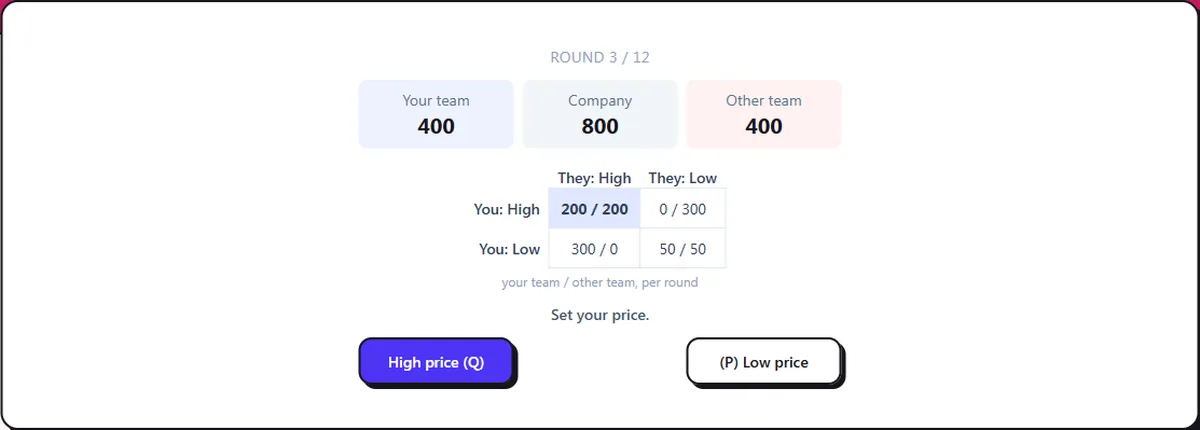
The pymetrics Money Exchange games are two short economics games about trust and fairness: in Money Exchange 1 you send a partner part of $10, the amount is tripled, and the partner decides how much to send back; in Money Exchange 2 an extra $5 is split, first by your partner and then by you. After each exchange you rate how fair it was. They come from the classic trust game and dictator game in behavioural economics, and the pymetrics patent names both (pymetrics patent WO2015200880A1). pymetrics says its games have "no right or wrong answers" (pymetrics Support Center), so there are no "answers" to learn. You can see the format free on our Money Exchange practice.
How the pymetrics Money Exchange games work
pymetrics (now part of Harver) publishes no step-by-step description of these games. The rules below come from its patent and from prep sites that have rebuilt the games, and the sources disagree on some details, which we note.
Money Exchange 1: the trust game
- The setup. "You are given $10", and your partner starts with nothing (JobTestPrep, GameTestPrep).
- You send. You choose how much to send, from $0 to $10 in $1 steps (GameTestPrep).
- It is multiplied. Prep sites say the amount is tripled. The patent's worked example also says the money "would triple by the time the money reached the other person", although its general text mentions doubling.
- Your partner returns some. The partner may send back nothing, some or all of what it received.
- You rate it. You then "rate on a scale of 1 to 10 how fair your partner was" (JobTestPrep); GameTestPrep describes the scale as 0 to 10.
- Once. "The game has one round of play" (JobTestPrep).
Money Exchange 2: the dictator game
- The setup. You and your partner each start with $5 (GameTestPrep, GameAssessmentPrep).
- Round 1: you watch. Your partner gets an extra $5 and splits it however it likes. You rate how fair the split was.
- Round 2: you split. You get the extra $5 and can give some of it away, keep it, or even take up to $5 from your partner, in 50-cent steps. Your partner cannot refuse. You then rate your own split (GameTestPrep).
- JobTestPrep sums it up: "both you and your partner are given money, but only one of you receives an extra amount". The patent calls it a "Dictator Task" used to measure altruism. One prep site calls the game an ultimatum game, where offers can be rejected, but we found no other source that describes rejecting.
Real money, real partner?
The patent describes "fictional earnings", and prep sites say the money is not real. Who the partner is varies by source: the patent and JobTestPrep describe another participant, while other prep sites describe "programmed assessment software" (Soreno). Either way, nothing you do changes anyone's actual bank balance.
What the Money Exchange games measure
The patent says the trust task studies "trust and reciprocity" and the dictator task measures altruism. JobTestPrep says game 1 assesses "trust and risk-taking" and game 2 "altruism". Harver lists fairness and generosity among the traits its games read (Harver). The fairness ratings add a second signal: how you judge an exchange, including your own.
How it is scored. There is no target amount. The pymetrics approach builds a model from people already doing the role: the patent says the system "identified the traits of successful employees in a position at the company", and candidates' results "can be compared to those of current employees". So the same choice can fit one role's profile and not another's. Sending everything is not "good" and sending nothing is not "bad".
What people typically do in these games
These are among the most studied games in economics, so there is good data on ordinary behaviour, outside any hiring context:
- Trust game. Across 162 replications, senders send about half of their money on average, and receivers return a bit over a third of what they get (Johnson and Mislin, 2011, Journal of Economic Psychology).
- Dictator game. Across 616 treatments, dictators give about 28% of the money on average, and a sizeable minority give nothing (Engel, 2011, Experimental Economics). When taking from the other player is allowed, as in Money Exchange 2, many people who would otherwise give a little take instead (List, 2007, Journal of Political Economy).
These averages are a reference, not a target. Our practice result sets your choices next to them so you can see your own pattern.
How to approach the Money Exchange games
- Decide as you really would. pymetrics compares a profile, and an act tends to come out inconsistent across the battery: very generous here and very risk-averse in the balloon game, for example.
- Make the ratings mean something. Rate the partner's return and your own split by the same standard. Rating your own lopsided split as perfectly fair, or a generous partner as unfair, is the kind of inconsistency worth avoiding.
- Do not overthink the arithmetic. The sums are trivial: what you keep, what is tripled, what comes back.
- Know the format before the day. The point of practice here is only that the rules are not new when you meet them.
How our practice version works
Our Money Exchange practice runs both games as the sources describe them: $10 and a tripling in Exchange 1, then $5 each and an extra $5 split twice in Exchange 2, with 0 to 10 fairness ratings after each. The partner is a computer with rules shown before you start: in Exchange 1 it returns a whole number of dollars from nothing up to half of what it received, and in Exchange 2 it gives you from nothing up to half of its extra $5. The result shows what you did, a plain label for each game (for example "Trusting" or "Split it evenly"), and how your choices compare with the research averages above. It shows no percentile and no "good score", because there is none to show without the role profile pymetrics uses.
Where Money Exchange sits in the pymetrics battery
The pymetrics battery is about a dozen short games. A few measure capacity and reward practice, such as Digits, Arrows and, to a degree, Stop and Tower. Money Exchange belongs with the trait games, like Balloon, where the only goal is an honest run. Our complete pymetrics games guide covers them all, and the pymetrics practice hub lists every practice game we have.
FAQ
How much should I send in Money Exchange 1? There is no correct amount. pymetrics compares your choices with the profile of people already in the role. Send what you would actually send.
Is there an answer key for the pymetrics Money Exchange games? No. pymetrics says the games have no right or wrong answers. Pages that sell "answers" are selling a guess at what an employer wants, which differs from role to role.
What is the difference between Money Exchange 1 and 2? Game 1 is a trust game: what you send is tripled and your partner decides what to return. Game 2 is a dictator game: an extra $5 is split by one player and the other cannot refuse; you watch your partner split, then you split.
Is the money real? No. The patent describes fictional earnings and prep sites say the money is not real.
Is my partner a real person? Sources differ: the patent describes another participant, several prep sites describe the software. It does not change how you should play.
Can I fail the Money Exchange games? Not on their own. Your choices feed a profile that is compared with the role's, alongside every other game in the battery.
How long do they take? A couple of minutes each. Harver says the whole battery takes about 25 minutes on average (Harver).
GamePrep is an independent practice platform and is not affiliated with pymetrics or Harver. Money Exchange is pymetrics' name; our practice version, partner rules and result text are our own, built from the public sources cited above. Game sets vary by employer and change between cycles; treat your invitation as the source of truth. We provide practice only, never leaked questions or answers.