Thomas GIA Test
The Five General Intelligence Assessment Tasks Explained
The Thomas International General Intelligence Assessment (GIA) is five very short, fast tests (reasoning, perceptual speed, number speed and accuracy, word meaning and spatial visualisation), each lasting 2 to 5 minutes, answered with the mouse. What each task looks like, how to work through it quickly and free practice for each.
The Thomas GIA (General Intelligence Assessment) is five short, fast online tests from Thomas International: Reasoning, Perceptual Speed, Number Speed and Accuracy, Word Meaning and Spatial Visualisation. Thomas's candidate booklet says "each test lasts between 2 and 5 minutes", each starts with 8 practice examples, the whole assessment including instructions takes 30 to 45 minutes, you answer with the mouse alone, and "both speed and accuracy are equally important" (Thomas GIA example booklet, PDF). Thomas markets the GIA as a measure of fluid intelligence, "the part of your IQ that defines learning agility" (Thomas, GIA). The tasks are simple; the difficulty is doing dozens of them at speed without slips, which makes the GIA unusually responsive to a little practice. The spatial task in particular is a rotation-versus-mirror judgement, exactly what our free mental rotation test trains.
Thomas GIA at a glance
| What Thomas says | |
|---|---|
| Tests | Reasoning, Perceptual Speed, Number Speed and Accuracy, Word Meaning, Spatial Visualisation |
| Length | Each test 2 to 5 minutes; 30 to 45 minutes in all with instructions (booklet); "just 45 minutes" (product page) |
| Practice | 8 practice examples before each test; a free example booklet for candidates |
| Answering | Mouse only, no keyboard; Thomas suggests plugging a mouse into a laptop |
| Scoring priority | "Both speed and accuracy are equally important" |
| What it is for | Fluid intelligence and learning agility, used in hiring for sales, tech, operations and leadership roles |
Sources: the GIA example booklet and the GIA product page, checked 26 November 2026.
The five GIA tests, one by one
All five descriptions below follow Thomas's booklet. The examples are our own.
1. Reasoning
Each item is a statement comparing two people, for example "Tom is heavier than Fred". You read it for as long as you like, click, and the statement disappears; then a question appears, such as "Who is lighter?", with the two names to choose from. Harder items use negatives and opposites: "Wendy is not as strong as Rachel. Who is weaker?" (Wendy).
How to get faster: turn every statement into one fixed picture before you click, such as "Tom on top", and answer the question from that picture. The traps are negatives ("not as") and opposite words ("duller" after "brighter"). Our deductive reasoning test trains careful reading of logical statements, though it is slower and longer.
2. Perceptual Speed
You see four pairs of letters, one pair per box, and count how many pairs are the same letter, ignoring case: E/e matches, Q/y does not. Answers run from 0 to 4.
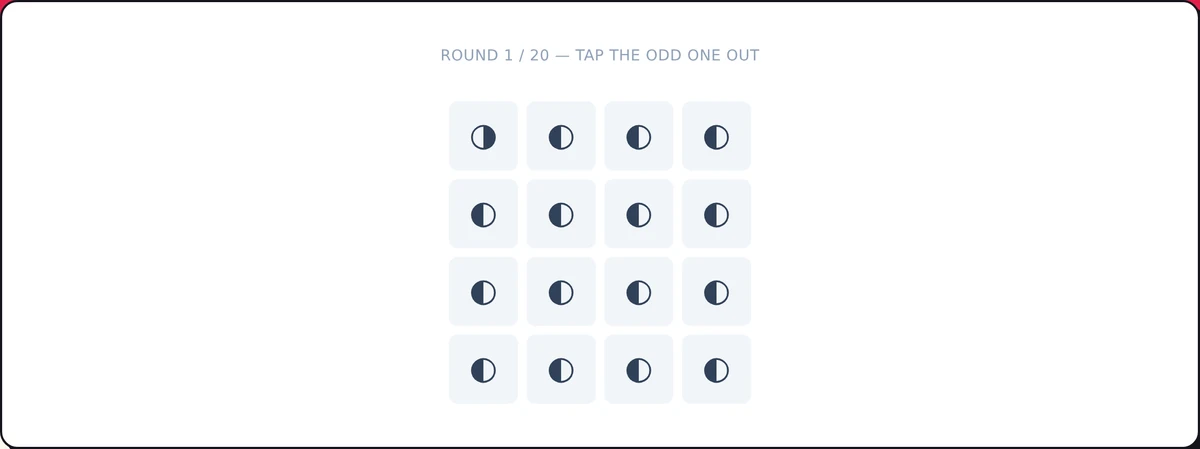
How to get faster: scan left to right once, count on the fly, and do not re-check a pair you have already judged. Upper and lower case of the same letter always count as the same, which is the most common slip. Our odd-one-out visual search trains the same quick visual comparison.
3. Number Speed and Accuracy
Three numbers appear, say 4, 2, 8. Find the highest (8) and the lowest (2); then decide which of them is further from the remaining number (4). Here 8 is four away and 2 is two away, so the answer is 8.
How to get faster: always do the three steps in the same order: highest and lowest, the middle number, the two distances. Mental subtraction speed is the bottleneck, and our mental math drill builds it directly.
4. Word Meaning
Three words; two are related (same meaning or opposite meaning) and one is the odd one out. Halt, Cold, Stop: the odd one is Cold. Up, Down, Street: Up and Down are opposites, so Street is the odd one.
How to get faster: look for the pair first, not the odd word. Remember that opposites count as related. Vocabulary helps; our CCAT-style test has synonym, antonym and analogy items under a tight clock.
5. Spatial Visualisation
Each box holds two symbols, one above the other. The bottom one is either the same symbol rotated or a mirror image, rotated. You count how many boxes hold a matching pair (0, 1 or 2). Thomas's point is that a mirror image "can never match" no matter how it is turned.
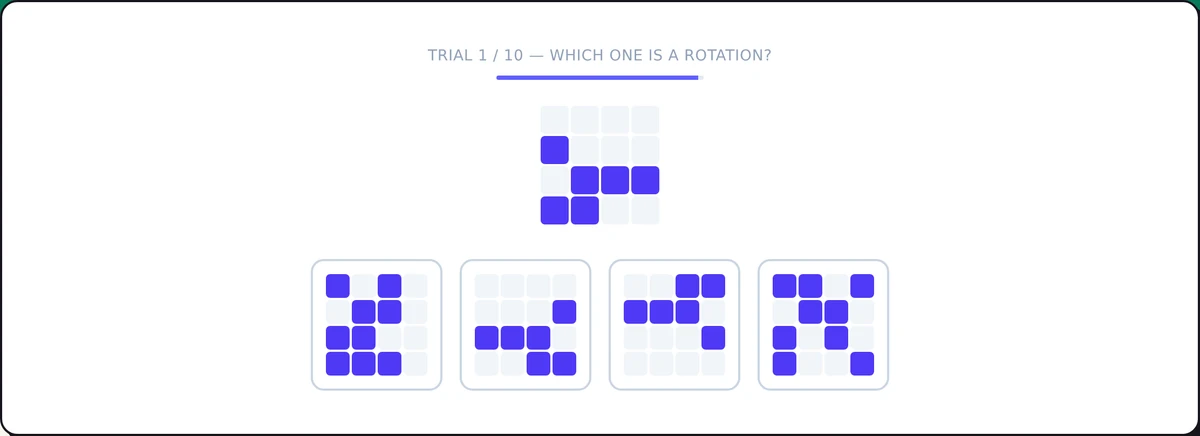
How to get faster: pick one feature that gives the handedness away (which side a tail or stroke sits on) and check only that, rather than rotating the whole shape in your head. Our mental rotation test is built on exactly this rotate-or-mirror decision, and the Shapedance guide explains the shortcut. For the wider family, see the spatial reasoning test guide.
How the GIA is scored
Thomas says results are "instant, visual results that managers can easily interpret" (Thomas, GIA), and that the platform is designed for hiring managers to use without training. Thomas does not publish a pass mark. Because each test is a fixed short window, your score on each task is driven by how many items you get right in the time; the booklet's instruction to treat speed and accuracy as "equally important" means a fast run full of errors is not a good run.
Who uses the Thomas GIA?
Thomas says the GIA is "used by 11,000+ businesses globally" and names sectors such as SaaS, financial services and professional services, with roles in senior leadership, sales, tech, customer success and operations (Thomas, GIA). Logos shown on that page include McDonald's, BP, Siemens and Red Bull Racing; a logo on a vendor's page shows the company is a Thomas client, not that every role there uses the GIA. Recruitment agencies also send the GIA on behalf of smaller employers, so the invitation may come from an agency rather than the employer.
How to prepare for the Thomas GIA
- Read Thomas's example booklet (PDF) so none of the five rules is new on the day.
- Use all 8 practice examples before each test. They are free calibration.
- Drill the two speed bottlenecks: mental subtraction for Number Speed (mental math) and rotate-or-mirror for Spatial Visualisation (mental rotation).
- Use a mouse, not a trackpad, as Thomas suggests. Every answer is a click, so pointer speed adds up over hundreds of items.
- Keep a steady rhythm. Each test is only a few minutes long; a long pause on one item costs several easy ones.
- Sit it somewhere quiet, "completely free from interruptions", as the booklet asks.
Other vendors' short-format ability tests: Korn Ferry / Talent Q, Saville Assessment, Criteria CCAT and the Matrigma test. The perceptual speed task is a cousin of the checking tests in our e-tray and error-checking guide.
FAQ
What is the Thomas GIA test? The General Intelligence Assessment from Thomas International: five short online tests of reasoning, perceptual speed, number speed and accuracy, word meaning and spatial visualisation, used by employers to estimate fluid intelligence and learning agility.
How long is the Thomas GIA? Each of the five tests lasts 2 to 5 minutes. With instructions and practice examples the whole assessment takes 30 to 45 minutes, according to Thomas's candidate booklet.
Is the GIA timed? Yes, each test runs for a few minutes and you work through as many items as you can. Thomas says speed and accuracy are equally important.
Can you practise for the Thomas GIA? Yes. Thomas gives candidates a free example booklet and 8 practice examples before each test. Because the tasks are simple and speed-driven, getting used to the rules and the pace makes a real difference.
Do I need a keyboard or calculator? No. Every answer is given by clicking with the mouse, and the number task is done in your head.
Is GamePrep affiliated with Thomas International? No. GamePrep is independent and not affiliated with Thomas International. Our games train similar skills with original tasks; they are not the GIA.
GamePrep is an independent practice site and is not affiliated with, endorsed by or connected to Thomas International. Thomas and GIA are names of Thomas International's products, used here only to describe them.