Verbal Reasoning Test
Formats, Examples and How to Pass (True, False, Cannot Say)
A verbal reasoning test gives you a short passage and asks whether statements about it are true, false or cannot be told from the text. The formats publishers use (SHL, Korn Ferry/Talent Q, Saville, Cappfinity, the UK Civil Service), a worked example, the mistakes that cost marks and free practice.
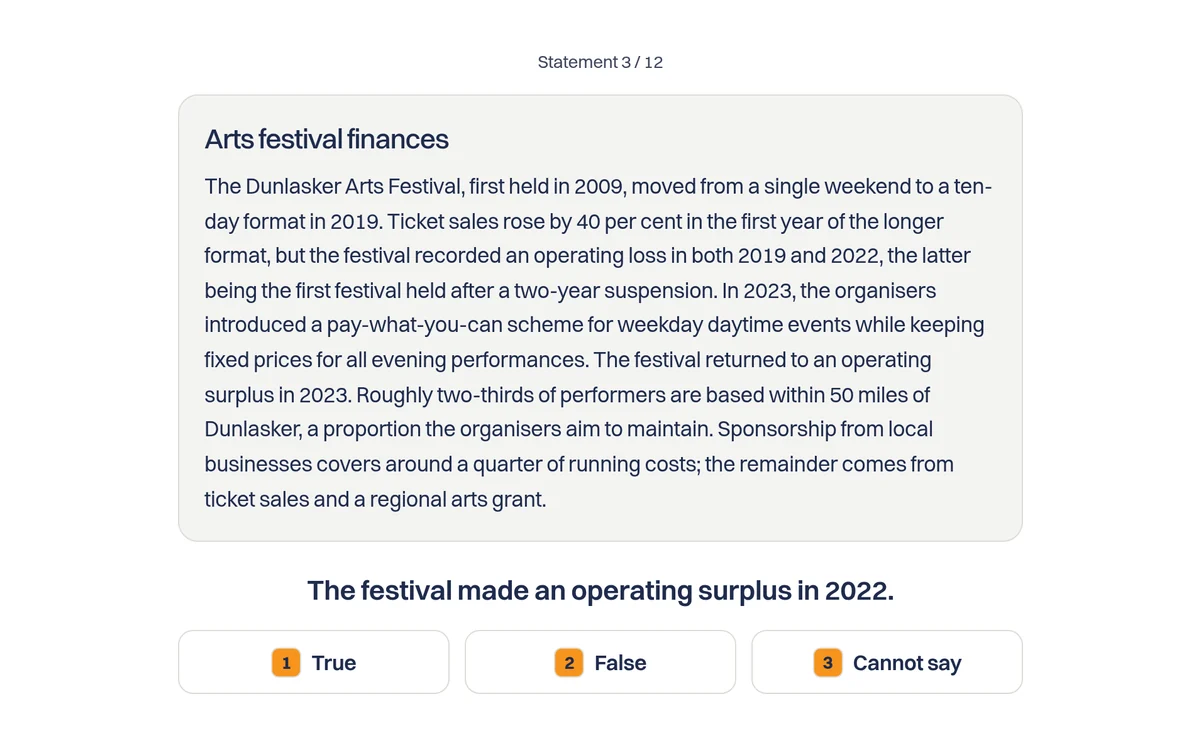
A verbal reasoning test gives you a short passage of business-style text and asks you to judge statements about it, most often as True, False or Cannot Say, using only what the passage says. It is one of the most common online tests in graduate, apprentice and professional hiring. The UK Civil Service describes its own version exactly that way: you read a passage, then decide whether a statement is "true", "false" or you "cannot say" (GOV.UK). Korn Ferry says its verbal tests "measure your ability to interpret verbal information and reach correct conclusions" (Korn Ferry candidate guide). No outside knowledge is needed, and bringing it in is the classic way to lose marks. You can try the True / False / Cannot Say format now on our free verbal reasoning test: twelve statements across four original passages, scored as a percentile.
Verbal reasoning test at a glance
| What to expect | |
|---|---|
| Task | Read a passage (often 100 to 250 words), judge statements about it |
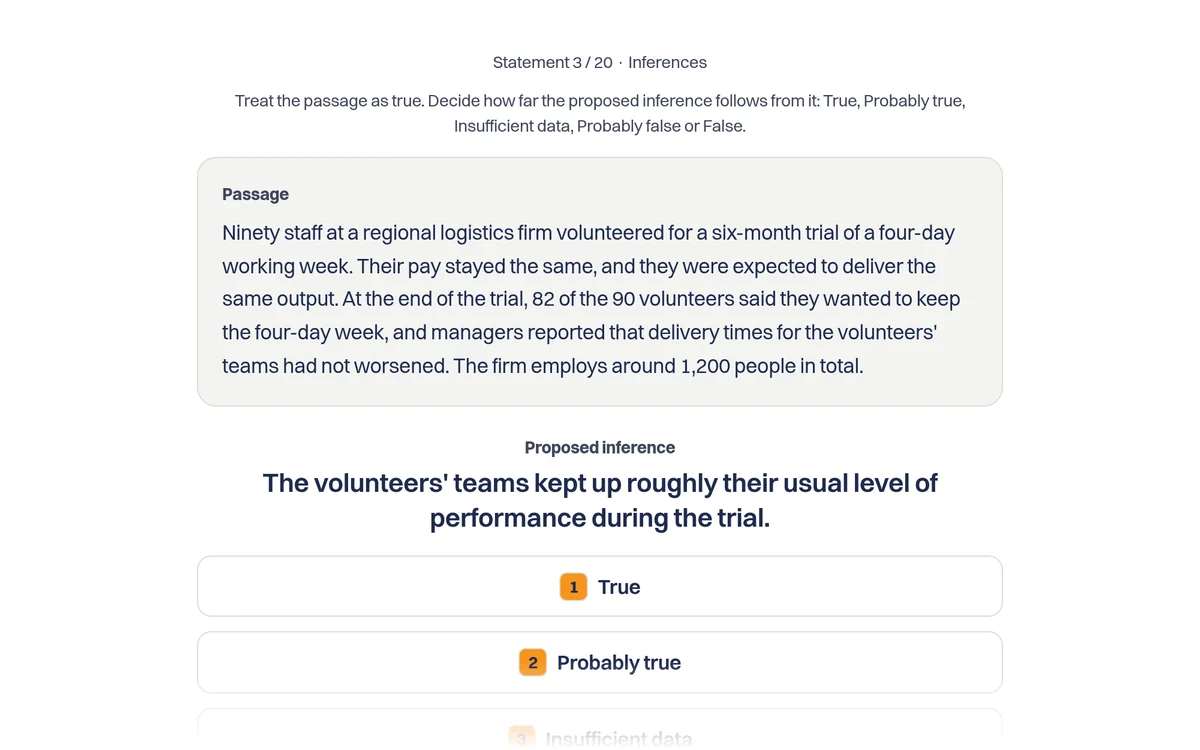
| Main answer format | True / False / Cannot Say; some publishers use multiple choice or "which conclusion follows" |
| Timing | Fixed overall clock (SHL-style), a clock per question (Korn Ferry, adaptive), or untimed (UK Civil Service) |
| Scoring | A percentile against a comparison group of other applicants |
| Who sets it | Graduate schemes, apprenticeships, banks, consultancies, the Civil Service, law firms (usually as critical thinking) |
| Free practice | Our verbal reasoning test; official demos from the publisher named in your invitation |
The True / False / Cannot Say rules
Almost every lost mark comes from blurring these three definitions:
- True: the statement follows from the passage. It is stated, or it must be so given what is stated.
- False: the passage says the opposite, or something that rules the statement out.
- Cannot Say: the passage neither confirms nor contradicts it. This holds even when the statement is obviously true in real life.
The hard pairing is False versus Cannot Say. A useful test: can you point to a sentence that makes the statement impossible? If yes, False. If you can only say "the passage doesn't mention that", it is Cannot Say.
A worked example
"Since the firm moved its customer support team to a four-day week in 2024, average response times have improved by 12%. Most of the improvement came from email queries; phone waiting times are broadly unchanged. The board will review the policy next spring."
- "Email response times have improved since 2024." True. Most of the 12% improvement came from email.
- "Phone waiting times have got worse." False. The passage says they are broadly unchanged, which contradicts "worse".
- "The four-day week will be scrapped next spring." Cannot Say. A review is planned; its outcome is not given.
- "Staff are happier on a four-day week." Cannot Say. Plausible, but the passage only talks about response times.
Our verbal reasoning practice is built on the same rules, and every statement there is written for GamePrep rather than copied from a real test.
Verbal reasoning formats by publisher
Each publisher has its own house style. The table sticks to what the publisher or a public employer says, and flags what only prep sites report.
| Publisher | Format | What is official |
|---|---|---|
| UK Civil Service (Civil Service Verbal Test) | True / False / Cannot Say, adaptive, not timed (most people take 15 to 45 minutes) | All of it, per GOV.UK. See our Civil Service tests guide |
| Korn Ferry / Talent Q (Elements, Aspects) | Business-related passages, adaptive, a time limit per question | Korn Ferry says all its cognitive tests are adaptive with per-question limits; its entry-level Aspects Verbal test has 12 questions, up to 13 minutes, about 8 minutes on average (Korn Ferry technical review). See our Korn Ferry / Talent Q guide |
| SHL (Verify and newer interactive tests) | Passage plus True / False / Cannot Say statements | SHL says its verbal tests "measure your ability to understand written information" and offers a free practice test (SHL practice tests). Question counts and timings are reported by prep sites, not published by SHL |
| Saville Assessment | Verbal Analysis (graduate/professional) and Verbal Comprehension (entry level), timed | Saville lists both as free timed practice tests (Saville practice tests). See our Saville guide |
| Cappfinity | Passage-based statements, often inside an employer-branded assessment, sometimes untimed with speed counted | See our Cappfinity guide |
| Sova | Verbal reasoning is one of the ability tests an employer can switch on | Sova lists verbal reasoning among its ability tests (Sova candidate hub). See our Sova guide |
| Pearson TalentLens (Watson Glaser) | Critical thinking: inferences, assumptions, deductions, interpretation, arguments | A different test with five rule sets. See our Watson Glaser guide |
Kenexa (IBM) and other publishers also sell verbal reasoning tests, but we found no current public candidate page with their format, so check the practice link in your invitation.
Adaptive versus fixed-length tests
Two designs change how you should pace yourself:
- Fixed length, one overall clock (the classic SHL style): everyone gets the same number of statements. Do not stall on one; a guess costs you less than five unanswered questions at the end.
- Adaptive (Korn Ferry, the Civil Service): you start on a question of average difficulty, a right answer leads to a harder one and a wrong answer to an easier one (Korn Ferry candidate guide). Korn Ferry warns that "you will feel continuously challenged and stretched", which is the design, not a sign you are failing. With a clock per question, Korn Ferry's advice is to "use the full time given and not to rush into an unconsidered answer".
The Civil Service test is adaptive and untimed: "your score is not affected by how long you take" (GOV.UK). There you can read every passage twice.
How verbal reasoning is scored
Your raw result is compared with a comparison group and reported as a percentile. The Civil Service gives the example that "a percentile of 44 means you scored better than 44% of the group" (GOV.UK), and Korn Ferry reports its ability tests the same way. Employers rarely publish cut-offs. Passing a minimum is not always enough either: the Civil Service says a recruiter may raise the pass mark after the deadline, and meeting the minimum "does not guarantee" an invitation to the next stage.
Tips that actually move the score
- Read the statement first, then the passage. You are hunting for the one sentence the statement depends on.
- Underline the qualifiers in your head: all, most, some, only, always, since, until, may. Most traps sit in one word.
- Watch tense and time. A figure for 2024 says nothing about 2025.
- Cause is not correlation. "Sales rose after the campaign" does not say the campaign caused it.
- Leave your knowledge at the door. If the passage says the capital of Australia is Sydney, then for this question it is.
- Know your test's clock. Untimed and adaptive (Civil Service), per-question (Korn Ferry) and overall (SHL-style) each need a different pace.
- Practise the format, then the speed. Accuracy first; speed comes from recognising the patterns.
Free verbal reasoning practice
- True / False / Cannot Say: our verbal reasoning test (about 8 minutes, scored on accuracy and speed).
- Critical thinking (Watson Glaser style): our critical thinking test, five sections with explanations.
- Logic from premises: our deductive reasoning test.
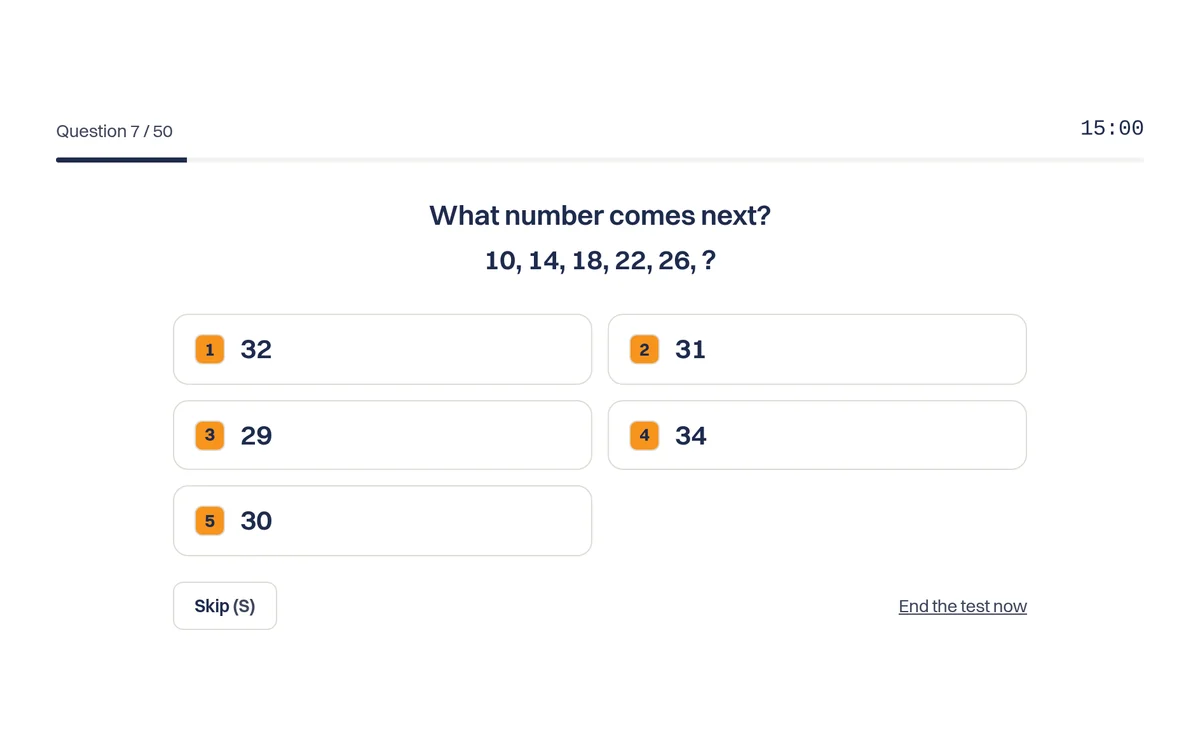
- Word meaning and analogies under a tight clock: the CCAT-style test.
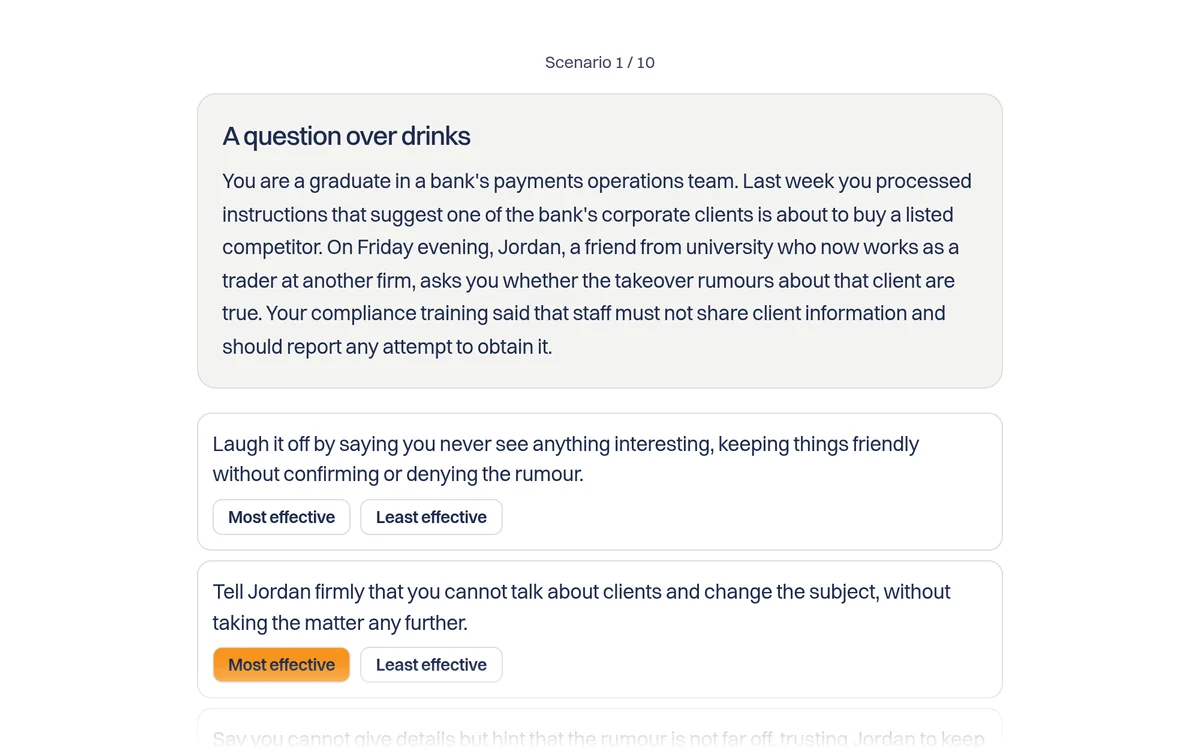
- The judgement test that usually sits beside it: our situational judgement test.
- Official demos: the publisher named in your invitation almost always has one. Do it once: it is the only practice that matches the real interface.
For how verbal reasoning fits with numerical, abstract and logical tests, see reasoning tests explained. If your invitation is for an apprenticeship, the degree apprenticeship online assessment guide lists what each employer sends.
FAQ
What is a verbal reasoning test? An aptitude test where you read short passages and judge statements about them, usually as True, False or Cannot Say, using only the information given. Employers use it to measure how well you understand and draw conclusions from written information.
What is the difference between False and Cannot Say? False means the passage contradicts the statement. Cannot Say means the passage neither confirms nor contradicts it, even if the statement is true in real life. If you cannot point to a sentence that rules the statement out, the answer is Cannot Say.
How long is a verbal reasoning test? It depends on the publisher. The UK Civil Service Verbal Test is untimed and most people take 15 to 45 minutes. Korn Ferry's entry-level Aspects Verbal test has 12 questions with a per-question clock, about 8 minutes on average. SHL-style tests use one overall time limit given in your invitation.
Can you get better at verbal reasoning tests? Yes, mostly by learning the answer rules and the common traps (qualifiers, time frames, cause and effect) and by practising under the same kind of clock. Reading quickly is helpful, but applying the rules consistently matters more.
Is a calculator or dictionary allowed? No dictionary is needed and none is offered; the passages are written to be understood without specialist vocabulary. Calculators are only relevant to numerical tests.
Is the GamePrep verbal reasoning test the real SHL or Civil Service test? No. GamePrep is independent and not affiliated with SHL, Korn Ferry, Saville Assessment, Cappfinity, Sova, Pearson TalentLens or the UK Civil Service. Our passages and statements are original and follow the same True / False / Cannot Say rules.
GamePrep is an independent practice site and is not affiliated with, endorsed by or connected to any test publisher or employer named on this page. Test names belong to their owners and are used only to describe the tests.